
Pulse / Stay informed
News
Scientific and technical advances, in context.
In focus

1866: Mendel made inheritance countable
Gregor Mendel's pea experiments showed how a hereditary difference could disappear in a hybrid and return in its descendants in predictable proportions. Published in 1866, the work became a foundation of genetics. Its strength was a testable explanation built from generations of counted offspring; its limits matter too, because not every trait follows a simple dominant–recessive pattern.
Read the articleLatest articles

1965: the FFT made Fourier analysis practical at scale
Published in April 1965, James Cooley and John Tukey's five-page paper helped make a demanding calculation routine: finding the frequency components of a sequence. Its fast Fourier transform reorganized the work into smaller, reusable calculations. For a power-of-two length, the arithmetic grows roughly as the number of points multiplied by its logarithm, rather than its square. Earlier mathematicians had discovered related methods. The lasting change was their effective implementation and diffusion in electronic computing. Speed makes larger calculations affordable; it does not improve the underlying measurements or remove numerical and sampling limits.

Sound waves test critical topological edge states
An acoustic experiment published on 7 October 2026 tests a counterintuitive prediction: some waves can remain concentrated at the edge of a lattice even when a gap closes in the spectrum of the model’s periodic evolution. The researchers reconstructed that evolution from pressure measurements and used interference to distinguish two types of edge mode. This is an experimental realization of earlier theoretical work in a classical sound-wave analogue, with finite samples, losses and limited robustness tests; it does not demonstrate quantum entanglement or a quantum computer.
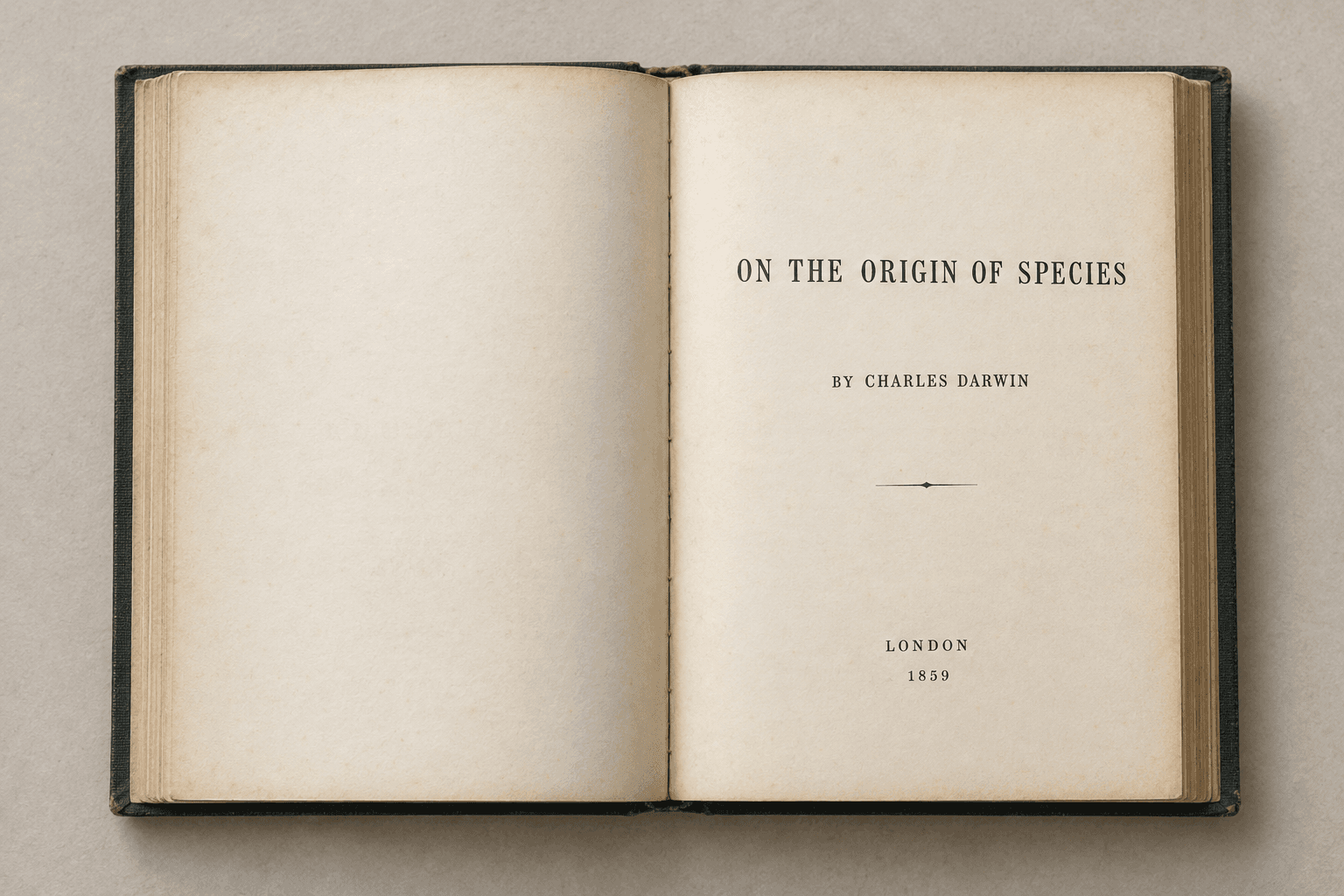
1859: Darwin connected life’s diversity to descent and natural selection
Published on 24 November 1859, On the Origin of Species connected the diversity of living things to branching descent and natural selection: inherited differences can influence how many descendants organisms leave. Darwin assembled a historical argument from several kinds of evidence, while acknowledging serious difficulties and an unknown mechanism of heredity. This was a lasting change in biology, not a complete account of evolution in its modern form.