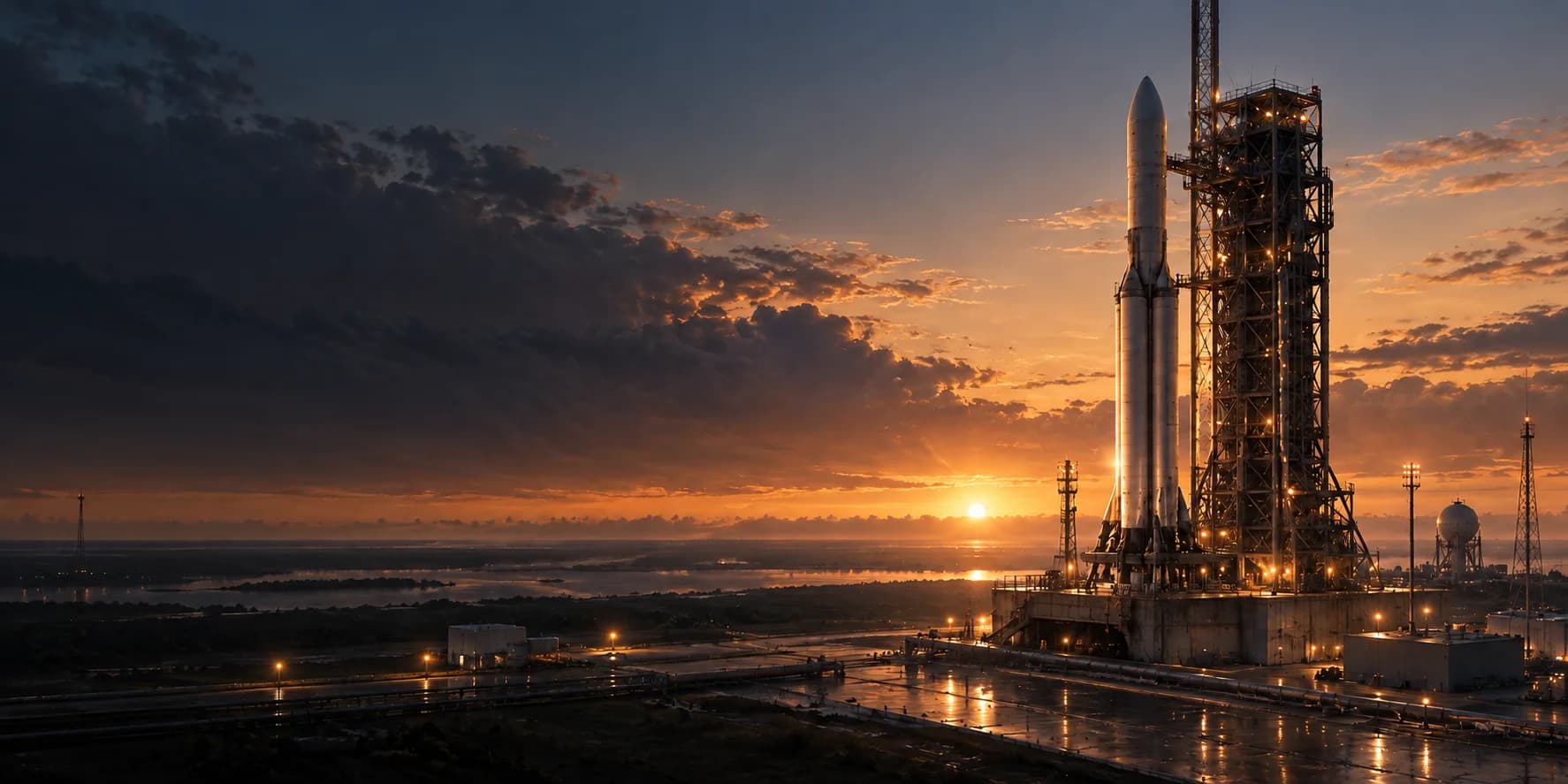
Lunar Colonization
Artemis II: first crewed lunar flyby in over 50 years
Four astronauts, April 1-10, 2026: first crewed flight of the Orion capsule
Tracking critical ecosystems shaping humanity's future.
This inherited map is a starting point. Its data and categories are neither exhaustive nor validated by the routine.
Lunar Colonization
Four astronauts, April 1-10, 2026: first crewed flight of the Orion capsule
Orbital Space Industry
Announced on February 23, 2026, completion of the commercial critical design review moves the program from design to manufacturing. It is the twenty-eighth milestone of its Space Act agreement.

A permanent return to the Moon: crewed base, resource extraction, space hub
Scientific and logistical infrastructure for sustained lunar exploration

An autonomous human presence on Mars: colonies, ISRU, self-sustaining life
Human multiplanetarity, spacefaring civilization, unlimited Martian resources

LEO/GEO commerce: stations, manufacturing, tourism, energy, communications
Microgravity research, commercial stations and orbital services

Healthy life: aging biology, cell therapies and regeneration
Prevention of age-related disease and extension of healthy life

Generative models: reasoning, multimodality, alignment and transformation
Acceleration of selected cognitive tasks, with alignment and governance challenges

Decarbonizing energy: solar/wind at scale, battery revolution, fusion cold & hot
Growing low-carbon electricity, with grid, storage and flexibility needs

Programming life: CRISPR, protein design, biofoundries, biomaterials
Cures for genetic diseases, exajoule-scale bioproduction, new materials, zero-waste manufacturing

Beyond classical silicon: qubits, quantum supremacy and applications
Potential new tools for simulation, optimization and cryptography

From Level 4 to Level 5: human driving becomes optional
Automated mobility and logistics, constrained by safety and regulation

The abyss: Earth's final frontier, less explored than Mars
Discovery of new species, critical mineral resources, understanding of the climate

The energy of the stars on Earth: the holy grail of the energy transition
Potential low-carbon energy source, still dependent on scientific and industrial breakthroughs

Defending the digital world: zero-trust, post-quantum, defensive AI
Protection of critical infrastructure and stronger digital trust
Understand objectives, methods, results and limitations.
Completed projectCompleted in 2003, the Human Genome Project made a shared DNA reference available for studying human biology. It did not read every region or capture every person's genetic variation. Later T2T and pangenome projects addressed different parts of those limitations; their results are not achievements of the completed programme.
Orbital campaign activeTracking the Starship program: Starbase infrastructure, flight cadence, rocket variants and Raptor industrialization.
Legacy reference: the routine has not yet audited its sources and dates.
Early clinical trialsConcrete tracking of the transhumanism axis: implants, robotic surgery, clinical protocols and long-term safety.
Legacy reference: the routine has not yet audited its sources and dates.
Multi-source transition underwayStructured tracking of the major energy systems: energy types, capture methods, storage and scale-up.
Legacy reference: the routine has not yet audited its sources and dates.