A difference can disappear without being lost
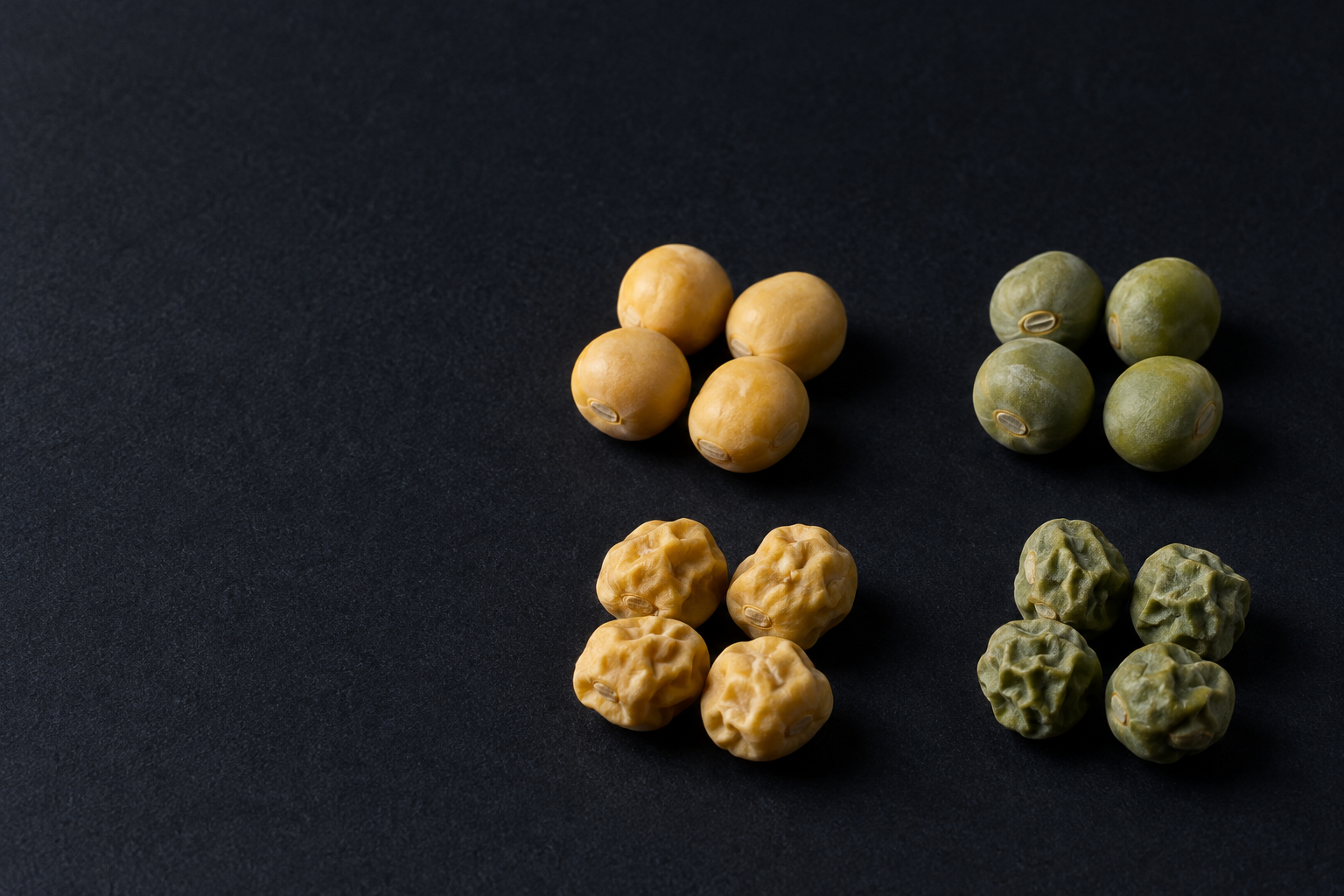
Cross a pea plant that breeds consistently for round seeds with one that breeds consistently for wrinkled seeds. In the first hybrid generation, the seeds can all look round. Has the wrinkled character vanished? Mendel followed the descendants and found that it reappeared.
The crucial distinction is between what an organism looks like and what it can transmit. A round-seeded hybrid and a round-seeded plant that breeds true may look alike, yet produce different offspring. Appearance alone cannot distinguish them. Following another generation can.
This was an advance in how to investigate inheritance. Rather than describing the overall resemblance of a hybrid to its parents, Mendel separated recognizable differences, counted their descendants and compared generations. His own introduction acknowledged earlier hybridization researchers; he did not invent plant crossing. Mendel, original paper.
Mendel presented his research at meetings in Brünn, now Brno, on 8 February and 8 March 1865. The society's volume was designated for 1865, but the paper was printed in 1866, on pages 3–47. Presentation and publication are different dates. Publication information in the German reprint.
Why peas made the question tractable
Mendel needed fertile plants with differences that could be classified consistently and with pollination that could be controlled. Peas were useful because their flowers normally protect the reproductive organs and readily self-fertilize. Deliberate crossing let him connect known parents with subsequent generations.
He reported testing 34 varieties over two years and selecting 22 for crossing. For the main experiments, he chose seven sharply distinguishable characters. Differences that could only be described as “more” or “less” were unsuitable for those separate counting experiments. That selection made the analysis clearer while limiting the kinds of variation it directly tested.
The following counts are Mendel's published observations from the descendants of hybrids—the generation commonly called F2 today. Seeds were the counted objects for the first two rows; plants were the counted objects for the others. They must not be combined into a single number of independently tested plants.
| Character | Dominant appearance: reported count | Recessive appearance: reported count | Counted objects |
|---|---|---|---|
| Ripe seed shape | Round or roundish: 5,474 | Angular and wrinkled: 1,850 | 7,324 seeds from 253 hybrids |
| Seed interior colour | Yellow: 6,022 | Green: 2,001 | 8,023 seeds from 258 plants |
| Seed coat and associated flower colour | Coloured coat and violet-red flowers: 705 | White coat and white flowers: 224 | 929 plants |
| Ripe pod shape | Inflated: 882 | Constricted: 299 | 1,181 plants |
| Unripe pod colour | Green: 428 | Yellow: 152 | 580 plants |
| Flower position | Along the stem: 651 | At the top: 207 | 858 plants |
| Stem length | Long: 787 | Short: 277 | 1,064 plants |
Source: the original paper's seven one-character experiments. The older text uses “albumen” for the seed interior; the English version identifies the pea cotyledons, the seed leaves. The flower-colour observation was associated with the seed-coat character, not an additional eighth experiment. German text, English translation.
The counts approach three dominant appearances for each recessive appearance; they are not exactly three to one. In the seed-shape experiment, 1,850 out of 7,324 seeds were wrinkled: about 25.26%. A three-to-one model would give 1,831 wrinkled seeds at that total, a difference of 19. This is an arithmetic comparison with the published summary, not a new experimental result or a statistical authentication of the historical data.
From appearance to a mechanism
In modern explanatory notation, let A and a be two versions, or alleles, of one gene. AA and aa describe plants with two matching versions; Aa describes a plant with different versions. For this example, assume that A gives the round appearance in both AA and Aa. A dominant allele is therefore one whose relevant appearance is expressed in this pairing. “Dominant” does not mean more frequent or more valuable.
Suppose an Aa hybrid contributes A or a to a reproductive cell with equal probability. If the egg and pollen contributions combine at random, four equally likely pairings give:
P(AA)=41,P(Aa)=21,P(aa)=41.
The underlying combinations have a 1:2:1 ratio. When AA and Aa share the same appearance, the visible classes collapse to 3:1. Among round offspring, the model consequently predicts one-third AA and two-thirds Aa. Those are different predictions that can be examined by growing their offspring.
Mendel performed that follow-up. Of 565 plants grown from round seeds, he reported 193 that produced only round seeds and 372 that produced both round and wrinkled seeds. This was evidence beyond a single visible ratio. The modern AA/Aa/aa notation explains the logic; Mendel's own formula used A and a for constant forms and Aa for the hybrid, so the notation should not be mistaken for his discovery of DNA or a molecular description of a gene. Original experiments and reasoning.
Two characters—and the condition behind multiplication
What happens when seed shape and seed interior colour are followed together? Mendel reported 556 seeds from 15 hybrid plants: 315 round-yellow, 101 wrinkled-yellow, 108 round-green and 32 wrinkled-green.
If each character has a 3:1 visible ratio and the two are inherited independently, multiplying the probabilities predicts the following, where R denotes round shape and Y yellow cotyledons:
P(R,Y)=43×43=169.
The four appearance classes then have expected proportions 9:3:3:1. For 556 seeds, that means expected counts of 312.75, 104.25, 104.25 and 34.75 in the same order as the reported observations. Fractional expectations describe an average over repetitions, not fractional seeds in a real harvest.
Independence is a condition, not something multiplication proves. In modern genetics, nearby genes on the same chromosome can be inherited together because recombination does not always separate them. This linkage can alter the two-character proportions even when a single gene still segregates. The 1866 pea experiments therefore do not justify claiming that every pair of hereditary differences is independent. Mendel's two-character experiment, NHGRI explanation of linkage.
Mendel also tested his explanation with crosses between hybrids and the parental forms. The crosses with the doubly recessive parent predicted four visible classes in approximately equal numbers. He reported 31, 26, 27 and 26 seeds when the hybrid supplied the egg cells, and 24, 25, 22 and 27 when it supplied the pollen. Changing the cross tested a consequence of the explanation rather than simply recounting the original experiment. Reproductive-cell experiments.
Why the work became a historical turning point
Mendel provided a framework in which an inherited difference could remain present without being visible, separate when reproductive cells formed and recombine in offspring. That made inheritance susceptible to numerical predictions and discriminating crosses.
Its broader place in science developed later. Renewed attention around 1900 expanded the influence of the work; the familiar “rediscovery” label should not imply that Mendel's paper was never distributed or that the subsequent history was a single event. The National Human Genome Research Institute identifies his experiments as a foundation of modern genetics and records the renewed attention to them in 1900. NHGRI on Mendel, NHGRI historical timeline.
Subsequent discoveries supplied physical and human contexts. Sutton connected chromosome behaviour during meiosis—the cell division that produces reproductive cells—with patterns of segregation; the institute's timeline dates his observations to 1902 and his stronger chromosome argument to 1903. In 1902, Garrod interpreted the familial occurrence of alkaptonuria using Mendelian inheritance. These were later developments, not experiments conducted in Mendel's paper. Chromosome theory, Historical application to alkaptonuria.
The lasting change was a way to connect an unseen hereditary composition to observations through testable predictions. It became part of genetics, not a complete explanation of all biological differences. The NHGRI explicitly cautions that the inheritance of many traits is more complicated than single-gene dominant–recessive patterns.
Method and verification
Question and comparison. Mendel asked how distinguishable parental characters reappeared through generations of hybrids. The comparisons included self-fertilized hybrids, subsequent offspring and reciprocal crosses in which each parental form could supply either pollen or egg cells. The following details are reported in the 1866 paper and were checked in accessible editions; the experiments were not repeated for this article.
Materials and controls. The paper describes garden beds and some pots, plant supports, forceps for preparing flowers, controlled transfer of pollen and greenhouse plants used to check possible insect interference. Vigorous plants were selected intentionally. For the stem-length experiment, short plants were moved to another bed to prevent taller plants from suppressing them. These are relevant controls and selection decisions, not a report of modern randomization or blinding.
Observation and losses. Classification was made on mature, dried seeds where appropriate. Mendel noted weakly expressed green colour, damaged seeds, occasional unintended pollination and failures to germinate or reproduce. For example, the two-character follow-up did not retain every one of the 556 seeds as a fruiting plant. Missing observations must remain visible rather than be silently replaced by an ideal ratio.
Data and scope. The consulted paper contains aggregated counts and some plant-level examples, not a complete modern dataset of every plant, environment and scoring decision. Exact original stock identifiers sufficient to obtain the same material today, comprehensive environmental measurements, a randomization schedule, blinded scoring records and raw notebooks were not established from these sources. Their absence from this dossier limits a literal reconstruction; it does not erase the reported observations.
What was checked here. The displayed totals, fractions, expected counts and modern four-pairing explanation were recalculated with a short, original Python script using only its standard library. This checks the arithmetic of published summaries and an explanatory model. No third-party research code was executed. No plant experiment, molecular assay or independent biological replication was performed.
How to examine the explanation. Start with the counts and their units, then state the assumptions: equal transmission of the two alleles, random combination, complete dominance for the scored appearance, and comparable survival and detection of the classes. For two characters, add independence. Compare observed classes with the predictions, retain failures and ambiguous scores, and examine another cross or generation. Agreement with one ratio alone does not identify every underlying mechanism. New physical experiments require their own material, protocol and controls.
Duration, cost and limitations. Mendel described an eight-year investigation and a two-year initial variety trial; this article does not add those durations as separate successive periods. No reliable monetary cost was established. Statistical uncertainty, clustering of seeds within plants and classification decisions prevent treating 7,324 seeds as 7,324 independently randomized plants. No invented confidence interval or acceptance threshold is applied.
Mendel himself ended by asking for important experiments to be repeated and for other plant groups to be tested. His experiments with other plants included limited fertility and ambiguous colour results, which he distinguished from the clearer pea results. The boundary between observation, explanation and hypothesis belongs to the historical contribution as much as the familiar ratios do.
Sources and editorial note
The scientific reference is Gregor Mendel, Versuche über Pflanzen-Hybriden, Verhandlungen des naturforschenden Vereines in Brünn, volume IV for 1865, published 1866, pages 3–47. The accessible German text consulted is reproduced in Erich von Tschermak's second edition, Leipzig, 1911; it is a later edition of the original paper. The MendelWeb English version derives from William Bateson's 1901 translation with editorial corrections. These are versions of the same primary source, not independent experimental confirmations.
Institutional pages cited above provide later historical context and current explanations. The original Sutton and Garrod papers were not read for this article; their contribution is described as reported by the institute's timeline. A 1911 Morgan linkage-paper record was identified, but its full text could not be read through the available web reader, so no result from that inaccessible paper is attributed here.
AI assisted the source comparison, writing and arithmetic checks. This article is a historical explanation with explicit source and reproduction limits; it has not received an independent human scientific review.
Cover: AI-generated conceptual illustration of dry pea seeds. Its groups are examples of seed form and colour, not experimental counts or historical specimens.