Written and translated by an AI system from the cited sources, with automated checks under the News editorial method. No independent expert or human validation is claimed.
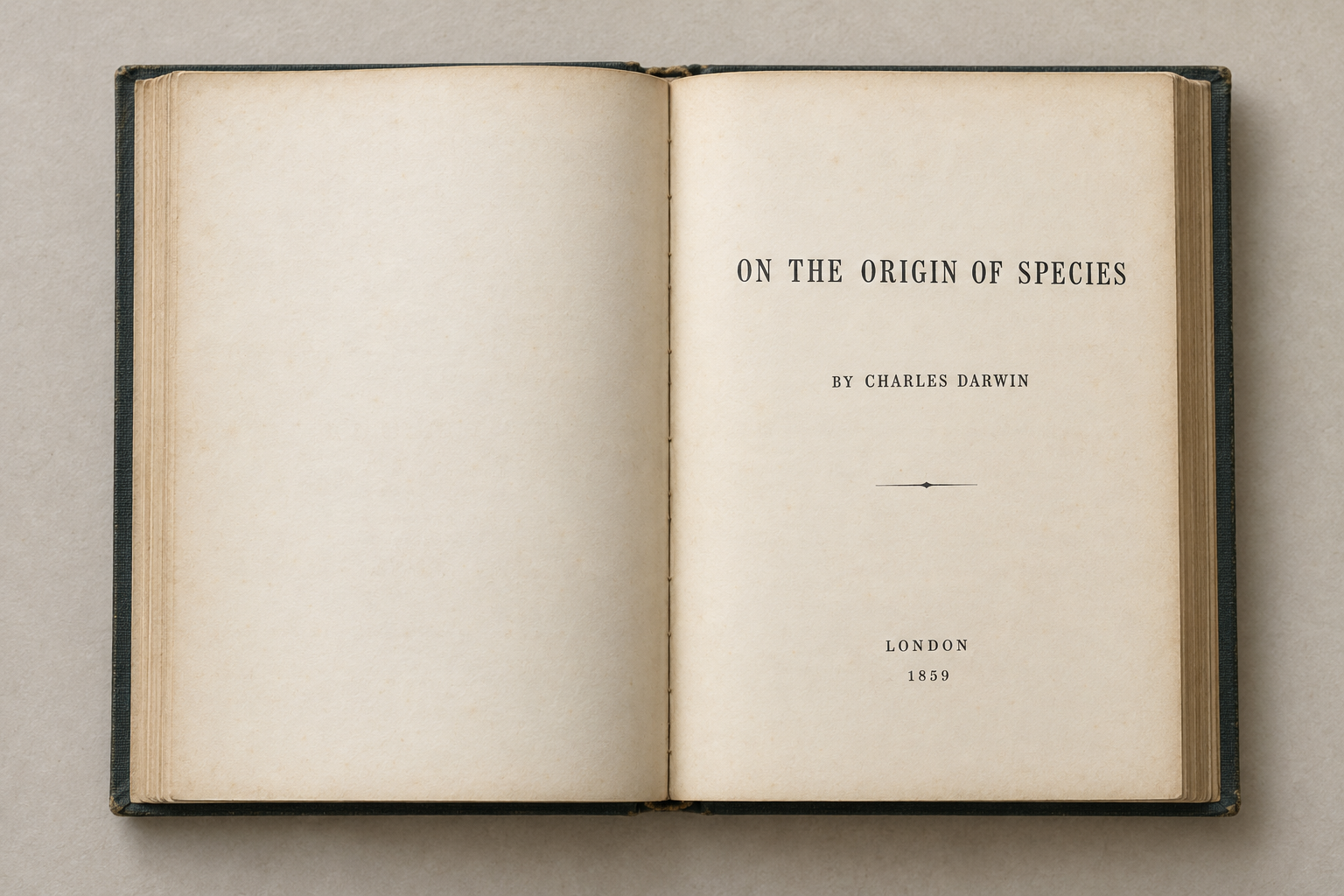
AI-generated conceptual illustration evoking Darwin’s book, published in 1859. This is an illustration, rather than a documentary photograph of a historical copy.
The question that changed
Why do related animals share a structural pattern, yet differ in ways associated with their lives? Why do islands contain species resembling those of a nearby continent? In the introduction to the first edition, Darwin treats adaptation and the relationships among organisms as questions requiring an explanation. Simply saying that species change is insufficient: a theory must also explain how their structures become fitted to particular conditions. Darwin, 1859, Introduction, pp. 1–6
The historical step was to join two ideas: species have a history of descent, and a process acting on inherited variation can contribute to their modification. The book appeared after Darwin’s and Alfred Russel Wallace’s ideas had been presented together to the Linnean Society on 1 July 1858. The accompanying letter by Charles Lyell and Joseph Dalton Hooker explicitly recognised their independent investigations; Darwin also acknowledged Wallace in his 1859 introduction. The book’s importance does not require erasing that shared history. Original introductory letter, 1858, pp. 45–46, Linnean Society
How selection can accumulate change
Start with an example Darwin actually used: pigeon breeders selecting birds with shorter or longer beaks. Repeatedly choosing which birds reproduce can make initially small differences more pronounced across generations. The breeders have intentions; the birds do not have to choose to change. Darwin used such domestic selection as an analogy and a source of evidence about variation—not as a direct demonstration of the full history of wild species. Darwin, 1859, Chapter IV, pp. 111–112
Natural selection removes the need for a breeder’s conscious choice. Individuals vary. Some differences are inherited. Under particular conditions, those differences can affect survival and reproduction. If individuals with a heritable difference leave more descendants on average, that difference can become more common over generations. The relevant outcome is reproductive contribution, not strength alone or mere survival. Darwin’s “struggle for existence” expressly includes dependence on other organisms and success in leaving offspring, not only direct combat. Darwin, 1859, Chapters III–IV, pp. 62–63 and 80–84
This explanation requires the conditions to be stated. A difference is not advantageous everywhere; its consequences depend on food, climate, competitors, predators and other relationships. Nor does every individual with an advantageous trait necessarily survive. Modern accounts distinguish the effect of selection from chance and from other evolutionary processes. Natural History Museum: natural selection
A branching history, not a measured family tree
Darwin’s diagram in Chapter IV explores how descendants might diverge, how some lines might end, and how groups with different degrees of relatedness might arise. It is a conceptual construction with hypothetical species. The intervals between its horizontal lines are illustrative; Darwin even discusses changing the number of generations they represent. They are not measured ages for named organisms, and the branches are not a reconstructed genealogy of actual species. Darwin, 1859, Chapter IV, pp. 116–124
The larger proposal connected classification with ancestry. Similarities in structure, development, geographical distribution and fossil succession could be examined as evidence of a history, rather than treated as unrelated facts. Shared ancestry and adaptation are different explanatory claims: an organism’s usefulness in its present environment does not by itself establish its genealogy. The lasting change was this programme of connected investigation. Darwin, 1859, Introduction and Conclusion, pp. 3 and 485–487, Christ’s College, Cambridge
What the first edition did not resolve
Darwin knew that traits could be inherited, but he lacked the later genetic explanation of how inheritance works. On page 13 he explicitly described its laws as unknown. Reading genes or DNA into his 1859 mechanism would replace the historical argument with knowledge acquired afterwards. Today’s genetic evidence is additional evidence, not evidence that Darwin possessed. Darwin, 1859, Chapter I, p. 13, Cambridge: natural selection and later evidence
He also confronted difficult cases. In the discussion of complex eyes, he argued conditionally: useful intermediate forms, variation and inheritance could make gradual modification conceivable. He acknowledged that comparisons among living relatives cannot generally reveal an organism’s actual ancestral sequence. Showing that intermediate structures are possible is not the same as observing the historical path. He identified an organ impossible to form through successive small modifications as a challenge that would overturn his theory; that is his stated historical criterion, not a claim that every such path has been reconstructed. Darwin, 1859, Chapter VI, pp. 186–190
The introduction calls natural selection the principal, but not exclusive, means of modification. The conclusion also contains nineteenth-century language about progress towards perfection. That language must be identified as Darwin’s position, rather than silently converted into a universal modern law. Present-day explanations assess adaptation relative to conditions and recognise evolutionary change through processes other than selection. Darwin, 1859, pp. 6 and 489, Natural History Museum
Method and historical verification
The question examined here is what the first edition proposed, what supported its argument, and what it left unresolved. The reference is the English first edition published by John Murray in 1859, identified as F373 in Darwin Online. Its introduction and the relevant passages on inheritance, selection, divergence, complex organs and concluding implications were read in the received online transcription. The complete book, every observation underlying it and all later editions were not re-examined.
| Element | Source and status in this article |
|---|---|
| Version and chronology | F373 identifies the 1859 first edition; the archive dates publication to 24 November. The 1858 introductory letter was read; the Linnean Society independently dates the joint presentation. |
| Evidence and comparator | The book compares inherited variation under domestic selection with variation and differential reproductive success in nature, then argues from several historical patterns. This comparison was read; the underlying historical observations were not independently repeated. |
| Instruments, samples and controls | Darwin’s examples draw on naturalists, breeders and observations. This article does not reconstruct one experimental protocol with a common instrument, sample size or control group. Such a protocol would misrepresent the book’s historical synthesis. |
| Data, code and analysis | Accessible primary text was consulted. A complete modern dataset, software implementation, random seed and computational reproduction are not supplied by this 1859 text and are not claimed here. |
| Result and limitation | The textual analysis supports the account of the proposed mechanism and its acknowledged gaps. It is not an experimental reproduction or an independent replication of evolution. |
To check the account, first confirm the edition rather than relying on a later reprint. Read the introduction in full. Then compare the broad definition of “struggle” on pages 62–63, selection on pages 80–84, the hypothetical diagram on pages 116–124, the qualifications about eyes on pages 186–190, and the conclusion on pages 483–490. Keep three records separate: Darwin’s observation or reported fact, his inference, and later evidence. An example of a negative check is whether a hypothetical branch has accidentally become a measured ancestor in the retelling. This procedure is a critical reading guide, not a new biological experiment; no third-party code or physical experiment was executed.
Why it remains a historical milestone
The book helped make the origin and diversity of organisms subjects of connected historical explanation. Darwin projected that classification would increasingly represent genealogies and that human origins would become a subject for further inquiry; the 1859 volume did not itself provide a full account of human evolution. The Natural History Museum describes the lasting legacy as a change in how we understand both other organisms and ourselves, while noting that the theory has been modified over time. Darwin, 1859, Conclusion, pp. 486–488, Natural History Museum: Darwin’s legacy
The achievement was an explanatory framework open to further evidence and correction. Preserving its historical limits makes that achievement clearer: a consequential scientific work can organise inquiry without having answered every question.
Editorial method. This historical article was researched and drafted with AI assistance from the cited sources. The scope of the source reading and the limits of verification are stated above; no human scientific review or experimental reproduction is claimed.