
Pulse / Stay informed
News
Scientific and technical advances, in context.
In focus

X(2370): BESIII constrains a decay forbidden for a flavour singlet
In a sample of (10,087 ± 44) million J/ψ, BESIII sees no evidence for the X(2370)→K*(892)⁰K̄⁰ submode: its significance is 0.1 σ and the product branching fraction is limited to 2.7 × 10⁻⁶ at 90% confidence. The suppression supports the ‘flavour singlet’ interpretation; identifying it as a glueball remains a model-based conclusion, not a direct detection of bound gluons.
Read the articleLatest articles

Double Chooz publishes the first quantitative measurement of residual antineutrino flux
Over 17.2 live days with both Chooz reactors shut down, Double Chooz measures 106 ± 18 residual candidates after background subtraction: the background-only hypothesis is rejected at 5.9 σ. The result is compatible with the 88 ± 7 predicted events; without experimentally separating the sources, the model attributes 44% of them to the spent-fuel pools.

The proton's baryon number may not be carried by its quarks — the gluon-junction hypothesis regains ground
Since the 1970s, a marginal hypothesis has held that what makes a proton a proton is not lodged in its three quarks, but in a Y-shaped junction made of gluons. The STAR collaboration has weighed the two scenarios on four billion collisions of isobaric nuclei — two billion per species — and on photon-gold collisions: baryon number reaches the centre of the collision nearly twice as efficiently as the naive expectation of the quark picture. The authors conclude that this picture is disfavored, without announcing any statistical significance or claiming to have detected the junction.
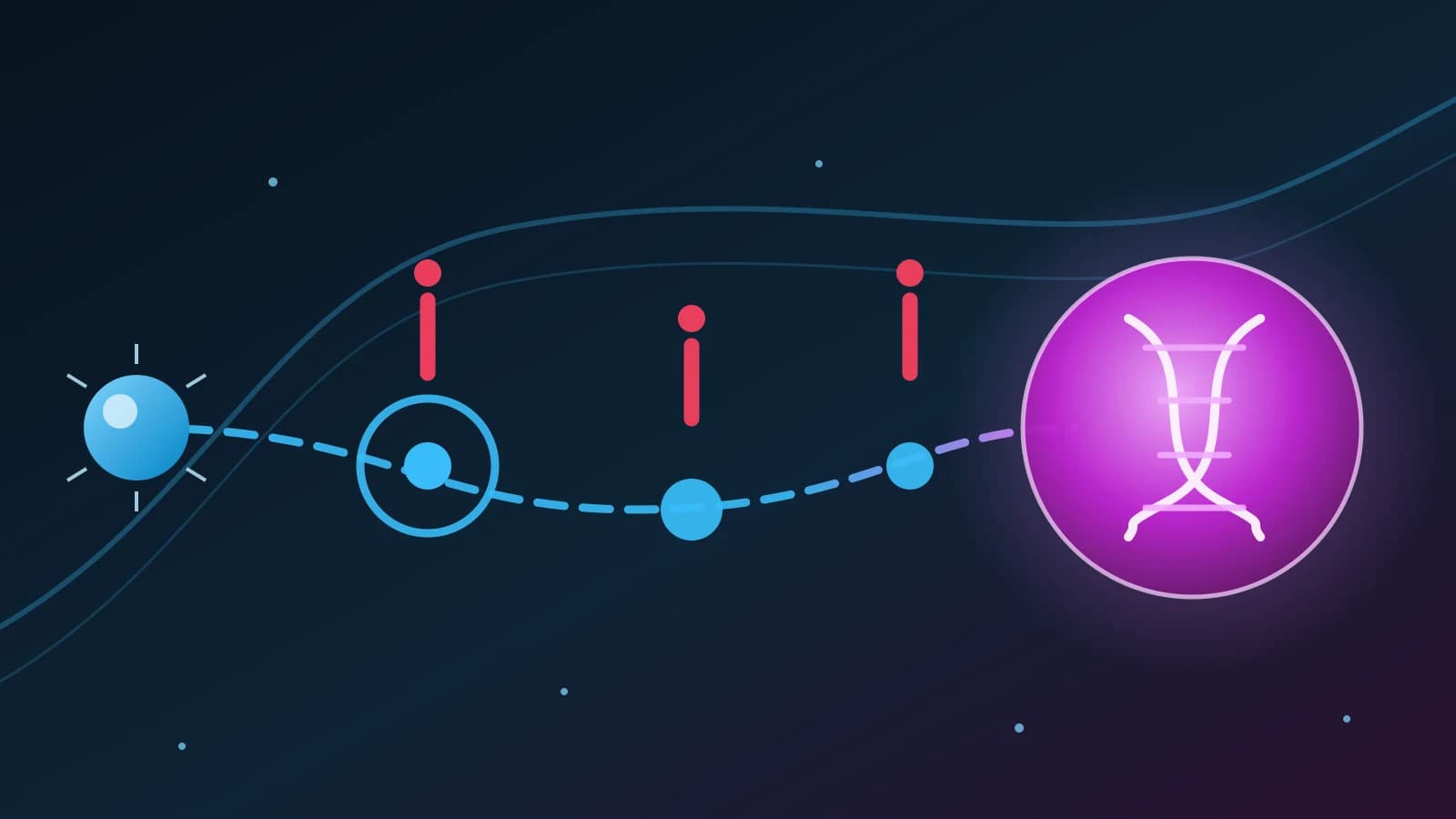
To edit a genome better, first switch off the genes that slow delivery down
Rather than refining the editing tool yet again, a Wisconsin team turned the question around: which human genes prevent the tool from reaching its destination? A screen across 19,114 genes points to six. Switching off just one of them, GJB2, raises correction of a blinding mutation from 5.8% to 46.6% in patient-derived retinal cells, and restores measurable electrical activity to the faulty ion channel in a fraction of the edited cells. Cell-culture work: nothing has yet been tested in an organism.