
Spaceflight · systems engineering
Starbase · Starship
Understand the system, distinguish the demonstrated milestones
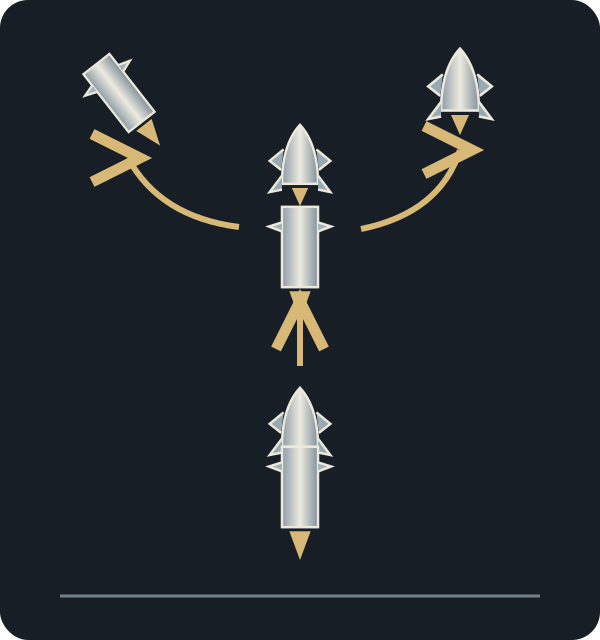
AI-generated conceptual illustration — not a photograph, flight observation or scale drawing.
How it worked
Ascent and separation
The booster supplies initial thrust, then the upper stage continues. The two stages and the ground system have separate roles.
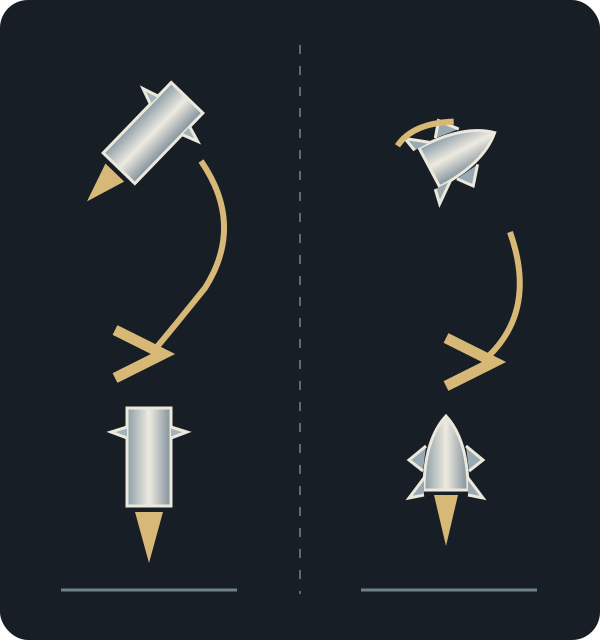
Separate return requirements
The booster uses braking and landing burns. The upper stage manages orbital manoeuvres and atmospheric entry; splashdown, recovery and reuse are different outcomes.
Purpose
Starbase is SpaceX’s development and launch site in Texas; Starship is its two-stage launch system. SpaceX reports orbital insertion and 26 satellite deployments on Flight 14. Those results are distinct from recovering and reusing both stages, routine orbital propellant transfer or a demonstrated lunar landing.
124 m Current total design height; dated SpaceX description[S1]
9 m Current design diameter[S1]
33 + 6 Booster and upper-stage engines in the current design[S1]
26 Flight 14 satellite deployments reported by SpaceX[S6]
English original and translations drafted and reviewed with AI assistance. Source reports remain attributed; no independent human engineering validation is claimed. Generated illustrations and editorial diagrams are identified in their captions. Editorial method
Status, results & limitations
An orbital result reported; full reuse remains a separate objective
Flight 14 adds orbital insertion and 26 satellite deployments to SpaceX’s reported record. Engine anomalies and the precautionary early return remain part of that result. It does not establish routine refuelling or recovery and reuse of both stages.
Read the evidence and caveatsPeople & organisations
Roadmap & legacy
Milestones are ordered; spacing is not a time scale.
Programme
2026
- 2026May: Flight 12, V3 and Pad 2 suborbital test2026 — May: Flight 12, V3 and Pad 2 suborbital test[S4]
- 2026July: Flight 13 suborbital deployments2026 — July: Flight 13 suborbital deployments[S5]
- 2026September: Flight 14 orbital insertion reported2026 — September: Flight 14 orbital insertion reported[S6]
Technical publications
Technical follow-up
- 2026February: additional Boca Chica trajectories assessed2026 — February: additional Boca Chica trajectories assessed[S8]
Independent extensions
Separate research programmes
Resources & evidence
Purpose and scope
The engineering objective is to transport payloads with a system designed for reuse of both stages. Starbase at Boca Chica, Texas combines development, manufacturing and launch operations. Starship names the upper stage and, in common usage, the complete system with the Super Heavy booster. These are related objects, not interchangeable organisations. NASA’s Human Landing System (HLS) is a lunar application with its own requirements. Florida launch-site projects are separate infrastructure extensions. Neither an orbital flight nor an environmental decision alone establishes the readiness of those applications.
[S1][S2][S3][S7][S9]Starbase and infrastructure
The site connects vehicle assembly and testing with a launch pad, tower and ground propellant systems. Pad 2 and the V3/Raptor 3 configuration first flew together on Flight 12, according to SpaceX. Ground readiness, launch, controlled return, recovery and reuse must each be assessed separately. Boca Chica is distinct from Kennedy Space Center’s Launch Complex 39A. Their environmental reviews concern different sites and proposed operations; a reviewed annual launch scenario is not a measured launch cadence.
[S1][S4][S7][S9]How the two-stage system works
Super Heavy supplies the initial ascent thrust; the upper stage continues after separation. Raptor engines use methane and oxygen. The current SpaceX presentation gives 124 m total height and 9 m diameter, with 33 booster engines and six upper-stage engines, including three vacuum engines. These are dated design descriptors, not measurements of every flight article. The stages follow different return paths. Booster braking and landing burns are distinct from upper-stage orbital insertion, deorbit and atmospheric entry. Hot staging, engine relight, thermal protection, control and propellant management couple the success of the flight phases. The diagrams below show relationships without physical scale or a claimed flight trajectory.
[S1][S4][S6][S10]Flight evidence: suborbital tests and orbital insertion

SpaceX describes Flight 12 on 22 May 2026 and Flight 13 on 24 July 2026 as suborbital tests; releasing satellite hardware on those trajectories was not an orbital service demonstration. Both booster accounts include hard splashdowns. For Flight 14 on 28 September 2026, SpaceX reports its first orbital insertion, deployment of 26 Starlink V3 satellites, deorbit and targeted splashdown. It also reports an early booster-engine shutdown and an early vacuum-engine shutdown on the upper stage, compensated by other engines. The return was brought forward as a precaution. The preflight timeline still displayed on the mission page is not used as a measured flight duration. This flight account does not demonstrate catching or reusing both stages. Satellite contact and deployment are also distinct from completing on-orbit checks and entering customer service.
[S4][S5][S6]Lunar application and propellant transfer
NASA’s HLS application requires development work beyond launching a payload to Earth orbit. Cryogenic propellant transfer between vehicles, storage, mission integration and lunar landing are separate demonstrations. The March 2026 NASA Inspector General report treated a vehicle-to-vehicle transfer demonstration as planned for 2026; that historical plan does not prove that it has since occurred. The inspected sources do not establish routine orbital refuelling, a verified lunar landing, a repeatable fast turnaround or an actual cost per flight. Those remain specific evidence questions rather than a percentage of overall completion.
[S2][S3]Environmental review and operating permission
The FAA’s Boca Chica page, updated on 2 September 2026, lists final environmental documents for additional trajectories and Pacific contingency reentries. The separate February assessment addresses additional launch trajectories and return-to-launch-site profiles. Completion of environmental review does not guarantee a licence modification. These documentary milestones do not establish an individual flight licence, a flight outcome, a successful return or an operational refuelling capability. The reviewed launch scenarios at Boca Chica and LC-39A must not be presented as achieved annual cadence. The exact current licence conditions have not been audited for this dossier.
[S7][S8][S9]What the evidence establishes and what remains open
The reference combines current developer flight accounts, official technical descriptions and agency documents. Several sources from one organisation are not independent corroboration. No raw orbital telemetry, fleet-wide reliability statistics, exhaustive environmental-condition audit or independent performance replication was analysed. The next useful evidence would concern repeatable recovery and reuse of both stages, quantified propulsion and thermal margins, vehicle-to-vehicle propellant transfer and the HLS mission chain. No future operational date is assigned. Public source links and exact revision history support later corrections; absence of a new announcement is not evidence of suspension or abandonment.
[S1][S2][S3][S6][S7]Sources
- [S1] Starship — current system description (consulted 12 October 2026)
- [S2] Human Landing Systems — NASA
- [S3] NASA’s Management of the Human Landing System Contracts — IG-26-004 (March 2026)
- [S4] Starship Flight 12 — 22 May 2026, SpaceX postflight account
- [S5] Starship Flight 13 — 24 July 2026, SpaceX postflight account
- [S6] Starship Flight 14 — 28 September 2026, SpaceX postflight account
- [S7] SpaceX Starship Super Heavy at Boca Chica — FAA page updated 2 September 2026
- [S8] Final Tiered Environmental Assessment — Additional Launch Trajectories and Starship Boca Chica Landings (February 2026)
- [S9] SpaceX Starship-Super Heavy at Kennedy Space Center LC-39A — FAA
- [S10] Starship/Super Heavy — FAA project description, updated 24 July 2025
Editorial method
This reference distinguishes the launch site, the vehicle programme, environmental decisions and the lunar variant. Current public primary sources were consulted on 12 October 2026; the reviewed February environmental-assessment module retains its consultation date of 21 September 2026. SpaceX flight accounts are developer reports, not independent measurements. Page dates, flight dates and intended timelines are distinguished. Layout and software checks do not validate physical performance.
English original and translations drafted and reviewed with AI assistance. Source reports remain attributed; no independent human engineering validation is claimed. Generated illustrations and editorial diagrams are identified in their captions.
Revision 1 ·
12 October 2026 — Replaces the inherited generic roadmap with dated source-based milestones. Adds the reported Flight 14 outcome and engine anomalies; removes unsupported implications of routine refuelling, operational cadence or full reuse in 2027.