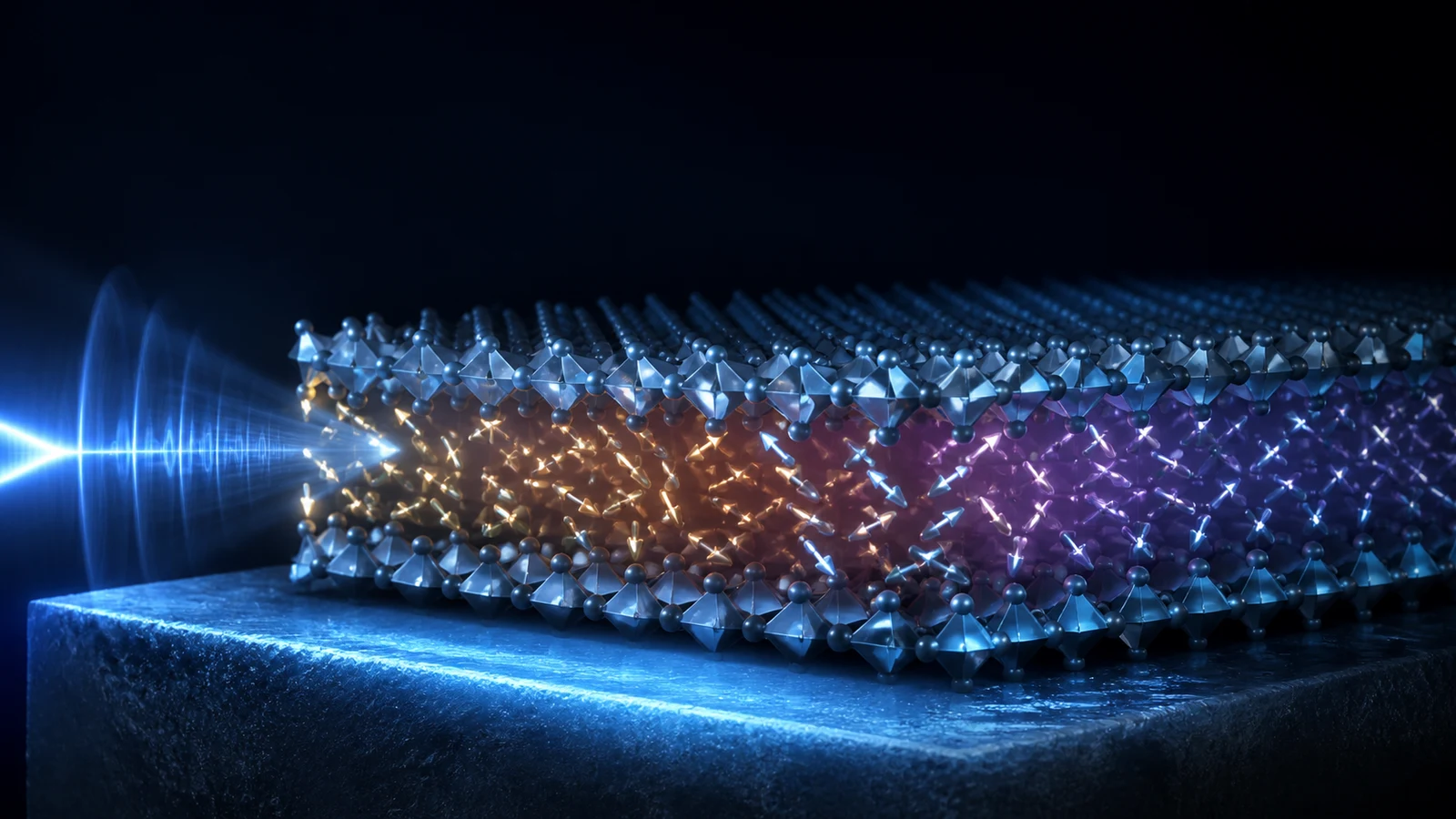
Batteries and electrochemical capacitors lose much of their performance when cold slows ion motion. An international team reports another route: a dielectric capacitor whose polar disorder remains useful at 4 K, about −269 °C. In a Pb0.6Sr0.4ZrO3 thin film, the authors keep efficiency above 88 % at 4 K under 9 MV/cm. The maximum recoverable energy density, 211 J/cm³ under the same field, is measured separately at 77 K.
Source: nature.com
In plain terms
A capacitor does not store energy by moving ions through a chemical reaction. An electric field slightly displaces bound charges in the material: it creates dipoles, and the energy is returned when the field falls. At very low temperature, dipoles can freeze into polar domains. Their switching then broadens the hysteresis loop and turns more energy into losses.
Here, the composition is tuned close to the boundary between an antiferroelectric phase and a paraelectric phase. The dipoles remain disordered down to the crystal unit-cell scale. According to the study, this local complexity prevents long-range ferroelectric order and preserves a narrow polarization loop in the cold.
| Parameter | Published result |
|---|---|
| Material | Approximately 160 nm epitaxial Pb0.6Sr0.4ZrO3 film, a lead-containing perovskite oxide deposited by pulsed laser |
| Structural characterization | Ptychography at 300 K and 95 K; electrical loops measured down to 4 K |
| Recoverable energy density | 211 J/cm³ at 77 K under 9 MV/cm |
| Efficiency | Above 88 % at 4 K under 9 MV/cm |
| Endurance | 10^8 cycles at 77 K under 6 MV/cm; changes below 4.5 % for density and 7.5 % for efficiency |
| Speed | About 1.5 µs from 300 K to 77 K under a 2 MV/cm pulse |
| Evidence level | Peer-reviewed article on a laboratory thin film; no integration into a complete device is reported |
Technical explanation
Storage without ion transport
The recoverable energy density of a dielectric is the useful area under its polarization–electric-field curve during discharge. Strong polarization and a high breakdown field enlarge this area. By contrast, a wide hysteresis loop means that more energy was dissipated during the cycle.
Conventional electrochemical systems become difficult to operate below about 230 K because ion mobility decreases. Dielectric capacitors avoid this transport of matter and can respond much faster. Yet relaxor dielectrics, efficient above about 200 K, experience freezing or growth of their polar nanodomains in the extended cryogenic regime, especially below 120 K.
Disorder at the right scale
The result does not arise from generally suppressing polarization. The authors design a dipole glass derived from an antiferroelectric, close to its boundary with the paraelectric state. In an ordered antiferroelectric, neighbouring dipoles oppose one another in a collective pattern. In the dipole glass studied here, the interactions remain polar but their orientation varies at the unit-cell scale.
This disorder increases the number of competing local configurations. The team interprets it as a way to frustrate the growth of coherent ferroelectric domains. The material can therefore polarize under the field without acquiring the strong collective memory that would broaden the return loop.
What the measurements clear
The technological gate is the combination of four properties that often conflict, but the maximum values do not all come from the same test. The recoverable density of 211 J/cm³ is measured at 77 K under the very high field of 9 MV/cm. Under that same field, efficiency remains above 88 % at 4 K. Endurance over 10^8 cycles is tested at 77 K under 6 MV/cm, with changes below 4.5 % for density and 7.5 % for efficiency. The discharge time of about 1.5 µs is measured from 300 K to 77 K under a 2 MV/cm pulse.
These numbers demonstrate a new material capability, not yet a system capability. Quantum or space electronics would also require electrodes, packaging, connections, thermal compatibility and reliability under real stresses.
Limits that must remain visible
- Thin film and extreme field. The volumetric result establishes neither the total energy of a component nor the behaviour of a thick layer or industrial stack.
- Lead content. Pb0.6Sr0.4ZrO3 contains lead; manufacturing, containment, end of life and compliance must be assessed for each use.
- Incomplete comparison. A density in J/cm³ cannot be converted directly into mass-specific or system performance without density, electrodes and packaging.
- Structure directly observed only down to 95 K. Ptychography images the disorder at 300 K and 95 K; its persistence at 4 K is supported by molecular dynamics and electrical measurements, not by direct atomic imaging at 4 K.
- Concentrated evidence. The publication is peer reviewed, but no independent replication was identified in the corpus consulted.
Proposed causal chain
Composition near the antiferroelectric–paraelectric boundary → competition among polar configurations → dipole disorder directly imaged down to 95 K → suppression of long-range ferroelectric order proposed by the authors → low hysteresis in the cold → efficiency above 88 % at 4 K under 9 MV/cm. The other measurements remain separate: 211 J/cm³ at 77 K under 9 MV/cm, 10^8 cycles at 77 K under 6 MV/cm and about 1.5 µs from 300 K to 77 K under 2 MV/cm.
The researcher’s view — next evidence
These experiments would extend the work; they are not part of the published result.
- Producing multiple batches and reporting yield, dispersion and defects would separate a remarkable sample from a reproducible process.
- Testing stacks, electrodes and thermal gradients would measure the energy actually available at component level.
- Tracking polar structure in situ during cycling at 4 K would directly test the proposed frustration mechanism.
- Comparing lead-free compositions under the same protocol would establish whether the dipole-glass principle is portable.
Sources
Primary reference consulted and verified on 25 August 2026.
- Yangyang Si et al., “Cryogenic energy storage enabled by dipole glass with unit-cell-level polar disorder,” Nature Nanotechnology, published 24 August 2026, peer-reviewed version of record. DOI: 10.1038/s41565-026-02260-8
- Yangyang Si et al., earlier author preprint of the same study, used for detailed figures and methods: arXiv:2606.27887
Confidence statement
Confidence is high in the composition and in each measurement when it remains tied to its own temperature and field. Confidence is moderate in the complete causal mechanism: disorder is directly imaged down to 95 K, while its persistence at 4 K combines simulation, electrical measurements and the authors’ interpretation. Uncertainty is high about volume manufacturing, system-level energy, space or quantum use and lead substitution: these steps are not demonstrated by the published result.