What the new study adds
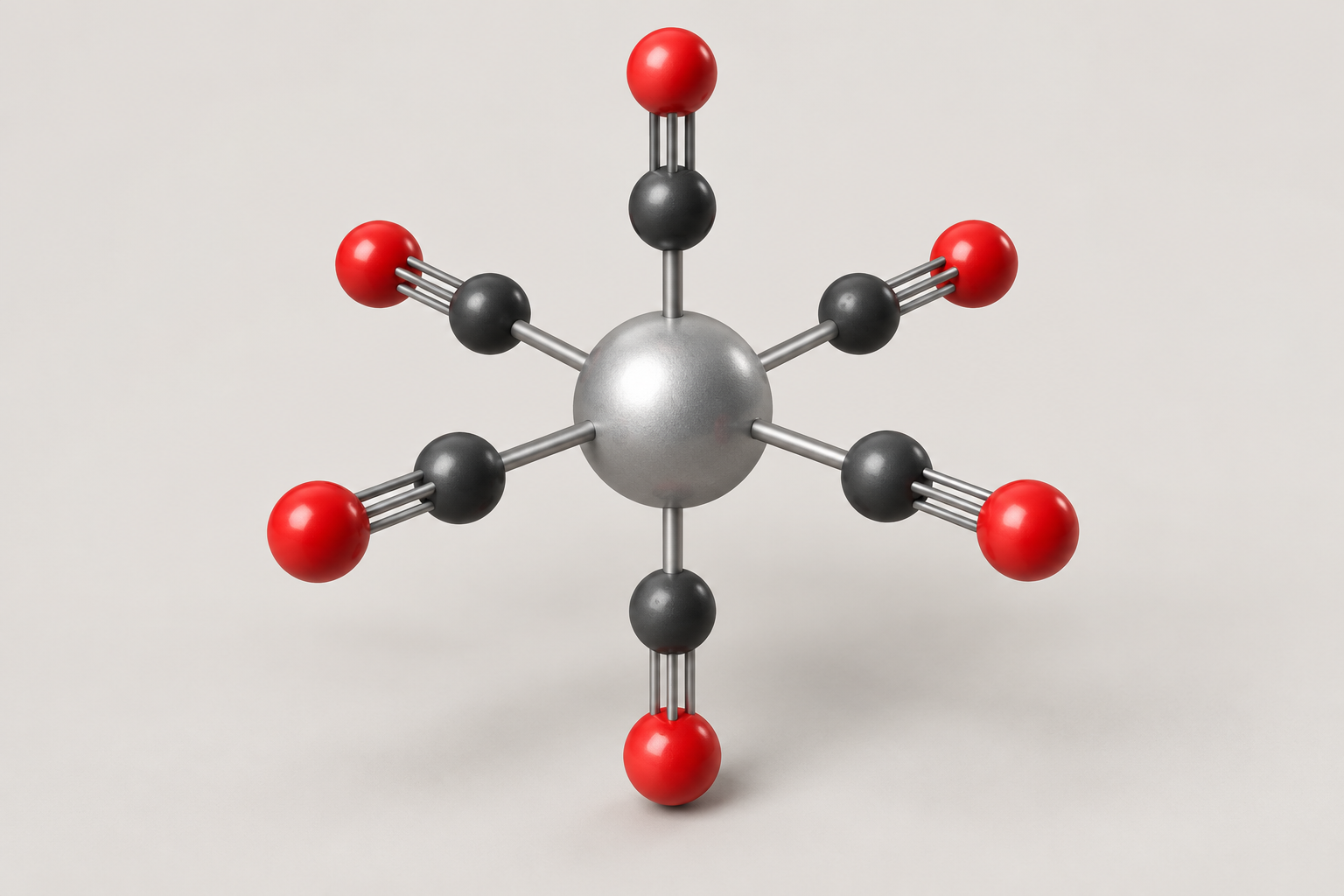
Seaborgium, symbol Sg, is synthetic element 106. Its short-lived nuclei make ordinary bottles of material impossible for this experiment: chemistry is investigated one atom at a time. A study published online on 7 October 2026 estimates the energy needed to detach one carbon monoxide molecule from Sg(CO)6, seaborgium hexacarbonyl. Six carbon monoxide molecules act as ligands, attached groups around the central metal.
This first bond dissociation energy, abbreviated FBDE, is reported as 188 ± 9 kJ mol−1. The authors infer a value 4 ± 2 kJ mol−1 below that of the related tungsten compound W(CO)6. This is a conditional estimate from formation yields, rather than a direct observation of a bond breaking. Sg(CO)6 was already reported in 2014; the new contribution is the quantitative energy estimate.
What was actually counted
At GSI in Germany, chromium-52 ions irradiated lead-208 targets to produce seaborgium-259. Nuclear decay chains identify the isotope. Gas carried the reaction products through two detector arrays: miniCOMPACT retained mainly nonvolatile species at room temperature; COMPACT collected volatile species on gold along a cooling gradient. The latter were assigned to hexacarbonyl molecules through their transport and adsorption behaviour, not direct molecular spectroscopy.
miniCOMPACT registered 126 chains or events: 72 began with a seaborgium decay, while 54 began with its daughter rutherfordium-255 or contained its spontaneous fission. COMPACT registered three additional seaborgium-starting chains. Only seaborgium-starting chains entered the comparison: three downstream events against 72 upstream, not three against 126. The authors report volatile-to-nonvolatile ratios of 0.20 ± 0.01 for tungsten and 0.04 with an uncertainty of −0.02/+0.05 for seaborgium.
Three counts carry substantial uncertainty. Their Poisson interval is 1.43–6.27 events at 68% confidence, as stated in the paper. That interval is not a five-standard-deviation discovery criterion.
Why relativity enters the interpretation
For chromium, molybdenum and tungsten, the energy needed to remove the first carbon monoxide ligand increases down this chemical group. The reported seaborgium estimate reverses that trend. Recent relativistic calculations cited in the article predict such a reversal because seaborgium’s 6d orbitals, electron states involved in bonding, become energetically less stable.
Bonding involves electron donation from carbon monoxide towards the metal and donation back from the metal towards the ligands. In the cited modern calculations, both contributions weaken. Agreement with that trend supports a theoretical interpretation; it does not independently establish the assumed molecular composition or kinetic model.
Method, assumptions and reproducibility
The primary article’s methods were read. The reported apparatus used TASCA, the TransActinide Separator and Chemistry Apparatus, and two arrays of silicon radiation detectors. The carrier mixture was helium/carbon monoxide 1:1 at 1 bar, flowing at 2.5 L min−1. Water contamination was about 1 ppm. The seaborgium run lasted two weeks; tungsten was studied in a separate two-hour run under nominally identical chemical conditions. These are author-reported conditions, not an experiment performed for this article. These campaign durations are distinct from the equal reaction times assumed by the model.
The inference reduces coupled formation and decomposition processes to a comparison of effective reaction rates. It assumes equal reaction times, carbon monoxide concentration and Arrhenius prefactors for the two complexes; the chosen numerical prefactor was 10^15.6, with no unit stated in that passage. With these assumptions, the reported ratio suggests:
ΔE = E(W) − E(Sg) ≈ R T ln[r(W)/r(Sg)].
Here E is FBDE, r is the reported yield ratio, R is the gas constant and T is absolute temperature. A fivefold ratio gives an energy difference of roughly 4 kJ mol−1 on a room-temperature scale. This explanatory calculation does not reproduce the full experiment.
The absolute estimate uses tungsten’s reference value, 192 ± 8 kJ mol−1. Its uncertainty dominates the resulting 188 ± 9 kJ mol−1. The relative difference and the two absolute values therefore cannot be treated as three independent measurements.
Monte Carlo transport calculations estimate about 16% probability of seaborgium decay in flight. The authors argue that the implied correction, less than one event, stays within the statistical interval. Tungsten isotopes were modelled separately with weights 25:75; seaborgium used an average half-life of 320 ms. Two detector components failed during the experiment. Raw events and simulation code are declared available through password-protected GSI Seafile links: neither was accessed or executed here.
What remains disputed
The public peer-review file records a substantive disagreement. One referee remained unconvinced that indirect molecular assignment and aggregate yields justified a quantitative bond energy. Another accepted the interpretation as the most plausible practically accessible account. The authors answered with comparative chemistry, earlier experiments and the distinction between relative and absolute uncertainties. Publication does not erase this disagreement.
More events would reduce counting uncertainty. Direct or better constrained chemical identification, and controlled tests of the rate-to-energy relation with known homologues under matched conditions, would address different, structural uncertainties. New experiments require a qualified nuclear laboratory, accelerator access and radiological authorizations; no physical experiment, raw-data reanalysis or independent replication was performed here. The result is a demanding experimental benchmark with an explicit model-dependent interpretation.
Sources
- Primary article, full text and methods, 7 October 2026.
- Primary peer-review reports and author responses.
AI contribution and visual status
Writing and translation of this article’s eight language versions are performed entirely with AI, using the primary text, methods, figures and peer-review record. Automated checks assess consistency; they do not constitute human editorial or scientific validation. No human validation or independent replication is claimed. Any accompanying molecular illustration is conceptual: its octahedral arrangement represents the proposed complex, not a photograph, measured atomic radii or experimental proof.
Update, 12 October 2026: the equation is now written in an equivalent linear form for accessible, verifiable rendering. The mathematical relation, scientific interpretation, sources and illustration are unchanged.