From a proposal to a working engine
An invention can be described and protected before a reliable machine exists. Diesel’s United States patent, published in 1895, describes compressing air before introducing fuel. Its proposed constant-temperature combustion is a design ideal, not a measured performance result.
The German patent certificate belongs to February 1893. The experimental-engine record distinguishes the prototype of 1893 from the functional engine of 1897.
Diesel’s 1893 book appeared with Springer in Berlin; it was not an Augsburg doctoral thesis.
The Deutsches Museum exhibition description associates 26.2% efficiency with the 1897 engine. That is a museum-reported result, not a measurement reproduced here.
These dates identify different achievements: articulating an idea, constructing experimental hardware and obtaining a functioning machine. A patent protects an invention; it does not certify that every promise in its description has been achieved.
How compression ignition produces work
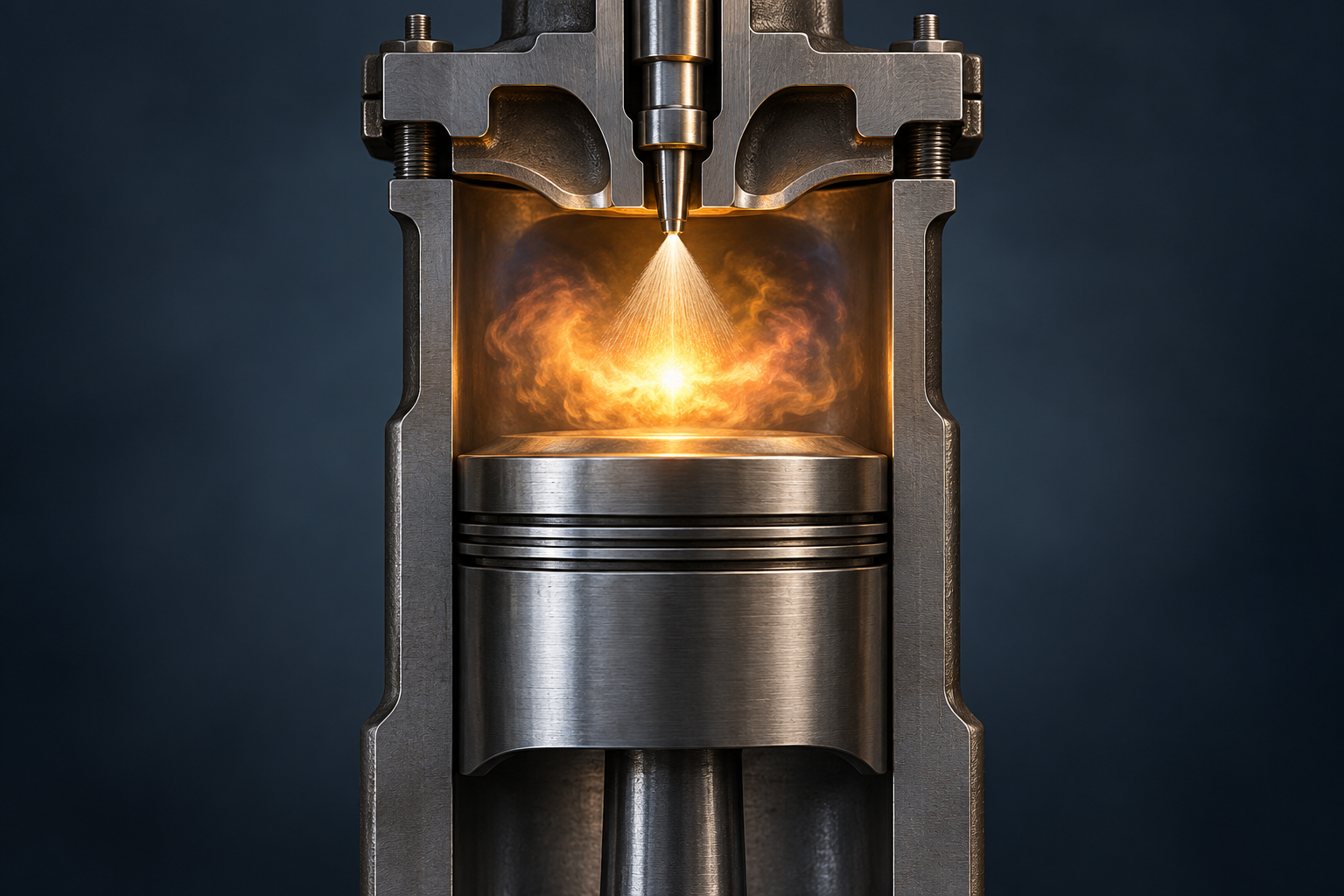
Imagine air confined above a piston, the moving part inside a cylinder. Compressing that air raises its temperature. Fuel is then injected into the hot air, where it can ignite without a spark: this is compression ignition. Combustion releases chemical energy, and the expanding gases push the piston. The connecting mechanism transfers that motion to a shaft.
Compression itself requires work. Useful output depends on the whole operating cycle, including the work recovered during expansion and the losses. Injection timing, mixing, heat transfer and friction therefore matter; a convincing explanation cannot stop at “the air becomes hot.”
This is a general explanation of the mechanism. It does not establish that the early patent’s idealised combustion was reproduced exactly in the working engine.
Technical dossier: distinguish a bound from a test
Thermal efficiency relates useful work to the energy supplied as heat. For a reversible heat engine operating between two fixed-temperature reservoirs, the MIT thermodynamics notes explain the Carnot upper bound:
ηCarnot=1−ThTc
Here, eta denotes efficiency, T_c the cold reservoir’s temperature and T_h the hot reservoir’s temperature. Both are absolute temperatures in kelvin. With hypothetical reservoirs at 600 K and 300 K, the bound is 50%. This teaching example describes neither the temperatures nor the measured efficiency of Diesel’s engine.
A compression ratio compares cylinder volumes before and after compression. It is not the temperature ratio in the Carnot expression. Neither that expression nor compression alone proves universal superiority over an Otto engine; a comparison needs stated operating conditions and a consistent definition of efficiency.
| Date | Documented milestone | What it establishes |
|---|---|---|
| 1893 | Patent, book and experimental prototype | A project and experimental construction |
| 1895 | United States patent US542846A | A description and claims, not a performance trial |
| 1897 | Functional engine | Efficiency of 26.2% reported by the museum |
The patent text and institutional notices were read; the original test report was not read or reanalysed. Its full measurement protocol, calibration, uncertainty and calculation boundary therefore remain unverified here. The patent’s machine-readable transcription contains optical character recognition errors; exact historical wording needs checking against its facsimile.
No experimental reproduction was performed. Building or testing a pressurised combustion engine requires qualified specialists and appropriate facilities; this documentary account is not a home experiment protocol.
Why the distinction matters
Compression ignition became a lasting way to convert fuel energy into mechanical power, with consequences for transport and industry. The achievement lies in making an engineering approach workable, rather than announcing a machine that reaches an ideal thermodynamic limit.
For readers, the important habit is to ask what each piece of evidence supports. A drawing can explain an arrangement; a patent can document a claim; a test can assess a particular machine under specified conditions. None automatically substitutes for the others. A historical efficiency figure also cannot establish fuel consumption or emissions for an unspecified modern application.
Correction and editorial record
Correction — 15 October 2026: chronology corrected; the 26.2% figure assigned to 1897; the 1893 book identified correctly; the Carnot bound separated from engine construction. Unsupported efficiency comparisons, the maritime market-share claim and the unsubstantiated account of Diesel’s death, including assassination speculation, were removed.
The cover is an AI-generated conceptual illustration of an injector and piston. It is neither a documentary photograph nor a reconstruction of the 1893 or 1897 machine; its geometry is not a measurement.
Writing and translation were assisted by artificial intelligence. No human validation or experimental reproduction is claimed.