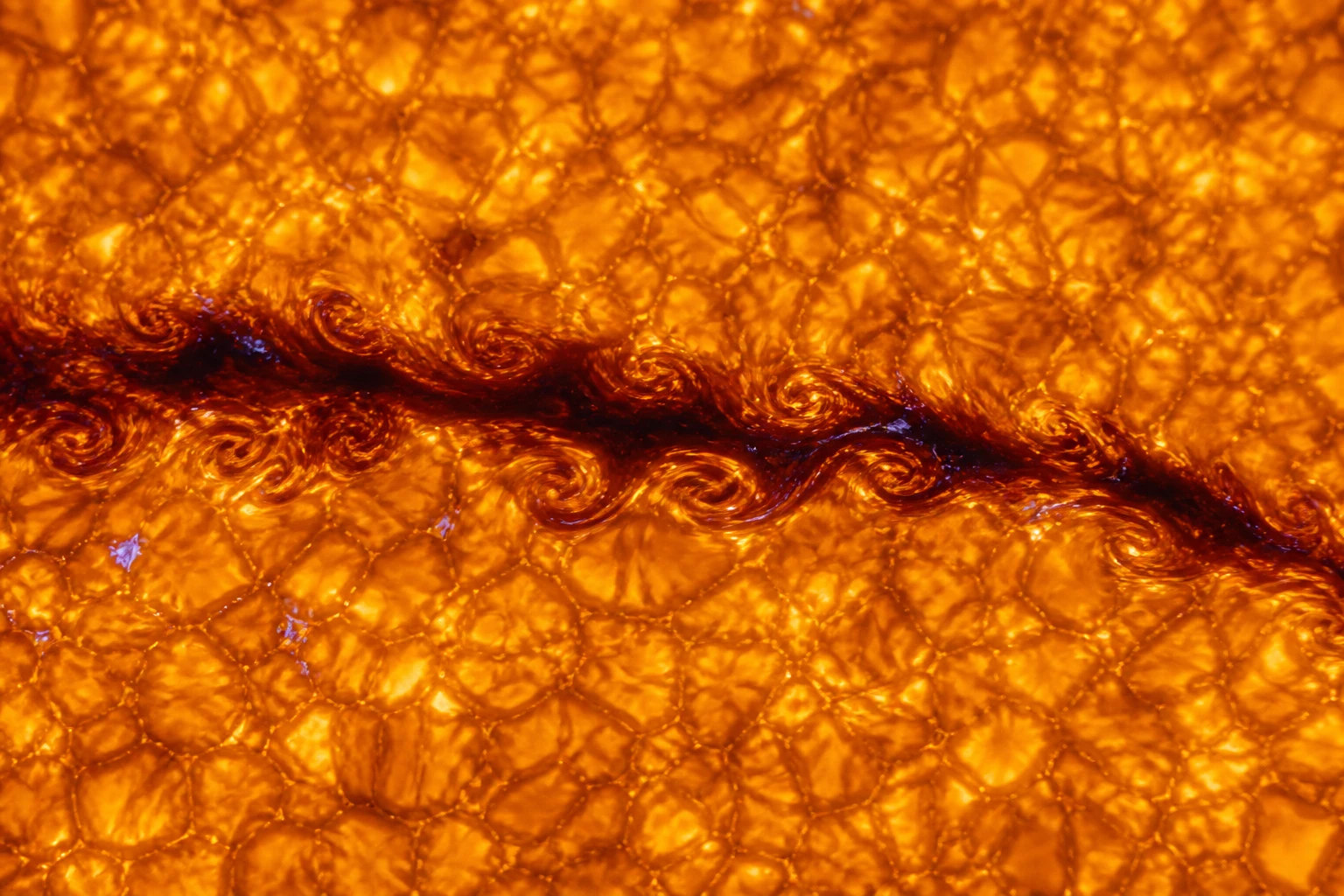
For the first time, a team has identified magnetized Kelvin–Helmholtz instabilities in the solar photosphere—the same type of instability that rolls up the interface between two shearing fluids. What changes is that the edges of magnetic-flux concentrations appear structured by small-scale vortices and striations. The authors propose that these vortices may contribute to magnetic-flux braiding; this study does not demonstrate a link with eruptions or coronal heating.
Source: nature.com
In plain terms
When two layers of a fluid slide past one another at different speeds, their interface can become unstable and curl into billows. This is what happens when candle smoke changes from a smooth thread into a turbulent plume, or when wind sculpts waves along the top of a cloud layer. An international team has now observed this phenomenon on the Sun's surface, at the edges of areas where the magnetic field is concentrated, using the Daniel K. Inouye Solar Telescope. Theory had predicted it since the decade beginning in 1990; a resolution of about 19 km now makes it possible to track the vortices over time. This is neither a solar eruption nor a space-weather forecast: it is the identification of a small-scale mixing mechanism whose consequences for coronal heating remain to be measured.
Technical brief — Discovery
| Parameter | Value |
|---|---|
| Publication date | 5 August 2026 |
| Journal | Nature (peer-reviewed article) |
| Title | Ubiquitous Kelvin–Helmholtz instabilities driving plasma mixing on the Sun |
| DOI | 10.1038/s41586-026-10871-3 |
| Joint first authors | David Kuridze and Friedrich Wöger (National Solar Observatory) |
| Collaboration | NSF NSO · NCAR High Altitude Observatory (HAO) · Max Planck Institute for Solar System Research (MPS) |
| Instrument | NSF Daniel K. Inouye Solar Telescope, 4 m primary mirror, Haleakalā (Maui) |
| Imaging wavelength | 416 nm |
| Key quantitative result | Observed characteristic wavelength of 65 km; vortex sizes from 25 to 170 km |
| Numerical cross-check | MURaM radiative MHD code (HAO/MPS/University of Chicago) |
| Status | Peer-reviewed article; experimental confirmation of an earlier theoretical prediction |
Technical explanation
What the Kelvin–Helmholtz instability (KHI) actually is. Two fluid layers in contact that move at different speeds create shear at their interface. If the destabilizing terms outweigh the restoring forces, a perturbation grows and the interface rolls into vortices. The spacing of this train—the instability wavelength—provides a quantitative signature: the study measures a characteristic value of 65 km across 47 observed vortices.
Why it is “magnetized.” In the photosphere, the magnetic field is not a spectator. A field parallel to the shear exerts tension along the field lines (the B2/μ0 term), opposing the roll-up. Magnetohydrodynamic KHI therefore appears only at the edge of flux concentrations, where the velocity contrast between the magnetized plasma, which is slowed down, and the freely boiling surrounding granulation is greatest, and where the field orientation does not completely suppress the instability. This is precisely where the team observes billows and fine dark striations at scales of a few tens of kilometres.
The driver: granulation against flux tubes. The solar surface is in permanent convection: cells of hot plasma rise, spread, cool and sink again—the “granulation.” As this horizontal flow fans out at the top of the granules, it encounters the walls of nearly vertical magnetic concentrations. The result is a continuously fed, stationary shear layer: the free-energy source that triggers KHI is not a rare event but the photosphere's normal regime.
What the methods prove—and how. The case does not rest on a single image.
- The Inouye's high-resolution time series (4 m mirror, imaging at 416 nm) resolve structures a few tens of kilometres across and follow their evolution. They show the billows forming and rolling like vortices, something a still image could not establish.
- The MURaM radiative-MHD simulations reproduce morphologically comparable structures in a high-resolution numerical model. This convergence strengthens the KHI interpretation without, by itself, constituting an independent observational replication.
- Agreement with linear KHI theory completes the triangle: observation, radiative-MHD simulation and theoretical prediction converge on the same kind of structure.
Why It Worked
What had made photospheric KHI invisible until now was its scale: the vortices unfold over a few tens of kilometres, below the resolution limit of earlier solar telescopes. The decisive leap is instrumental—a 4 m primary mirror brings the resolving power to about 19 km at 416 nm. Inouye therefore reveals distorted, striated edges of magnetic concentrations, with an observed characteristic wavelength of 65 km and vortex sizes between 25 and 170 km.
The gap between what is demonstrated and what is announced deserves to be stated clearly. In the single active field observed, KHI appears along many edges of flux concentrations, and the model shows how it can mix the plasma. The experimental scope remains bounded: about three minutes from a single active region, with 47 vortices selected visually; the MHD simulation is not an independent observational replication. What remains a hypothesis—and what the authors themselves phrase conditionally—is that this KHI is an important driver of “flux braiding” leading to reconnection, that it contributes to coronal heating, or that it supplies missing magnetic diffusion. These implications define the research programme, not the result.
Causal Chain
Photospheric convection (granulation) → flow along the edge of magnetic-flux concentrations → shear layer → magnetized Kelvin–Helmholtz instability → vortices (characteristic wavelength: 65 km) + striations → plasma mixing and flux transport → (hypothesis) contribution to field-line braiding → coronal consequences to be tested.
Anecdote
The phenomenon bears the names of two nineteenth-century physicists who were not studying the Sun. Hermann von Helmholtz investigated discontinuous fluid motions in 1868; William Thomson—the future Lord Kelvin—published his “hydrokinetic solutions” in 1871. A century and a half later, the same family of instabilities helps describe plasma vortices on the Sun, illustrating the reach of a physical mechanism that recurs in very different environments.
Legacy and Current Data
KHI was already studied in planetary magnetospheres and other astrophysical systems. Identifying it in the photosphere fills an observational gap at the Sun's visible surface. The long-term stakes concern the physics of solar activity and, indirectly, space weather. What the present work establishes is still upstream: the identification and characterization of the mechanism, not its energy contribution to coronal events.
The researcher's view — open questions
(Interpretation, not results of the study.) The decisive experiments that would extend this work are: (1) quantifying the energy flux carried by these vortices into the upper atmosphere; (2) a causal test linking the appearance of KHI to a downstream reconnection episode through coordinated photosphere–chromosphere–corona observations; and (3) automated mapping to determine whether vortex density covaries with local magnetic activity.
Sources
References verified during the fact-checking audit (accessed 6 August 2026).
- Kuridze, D., Wöger, F. et al. Ubiquitous Kelvin–Helmholtz instabilities driving plasma mixing on the Sun. Nature, published 5 August 2026. DOI: 10.1038/s41586-026-10871-3. (Peer-reviewed article.)
- National Solar Observatory. NSF Inouye Solar Telescope Enables Major Discovery of a Hidden Solar Process. Press release, 5 August 2026. nso.edu (Institutional release—cited for context and author quotations, not as the primary source for the result.)
Background references
(Context for the general mechanism, distinct from the study's primary sources.)
- Thomson, W. Hydrokinetic solutions and observations. Philos. Mag. 42, 362–377 (1871).
- Karpen, J. T. et al. Formation of current sheets in the solar corona. Astrophys. J. 403, 769–784 (1993).
- Hasegawa, H. et al. Transport of solar wind into Earth's magnetosphere through rolled-up Kelvin–Helmholtz vortices. Nature 430, 755–758 (2004).
Confidence statement. Solidly established: the identification of magnetized Kelvin–Helmholtz instabilities in the observed photospheric field, a characteristic wavelength of 65 km across 47 vortices, sizes from 25 to 170 km, and the reproduction of comparable structures in an MHD simulation (peer-reviewed Nature primary source). Limitations: about three minutes in one active region, visual selection of vortices and no independent observational replication. Uncertain: KHI's causal role in flux braiding and coronal heating. Technical checks: DOI resolved, authors and resolution corrected, formulas and dates consistent. Deduplication verdict: CONTROLLED BACKLOG RECOVERY—the DOI key already exists as A004 in the registry, but no corresponding bulletin exists in the database; this recovery restores the historical content without creating a new angle or registry entry.