Written and translated by an AI system from the cited sources, with automated checks under the News editorial method. No independent expert or human validation is claimed.
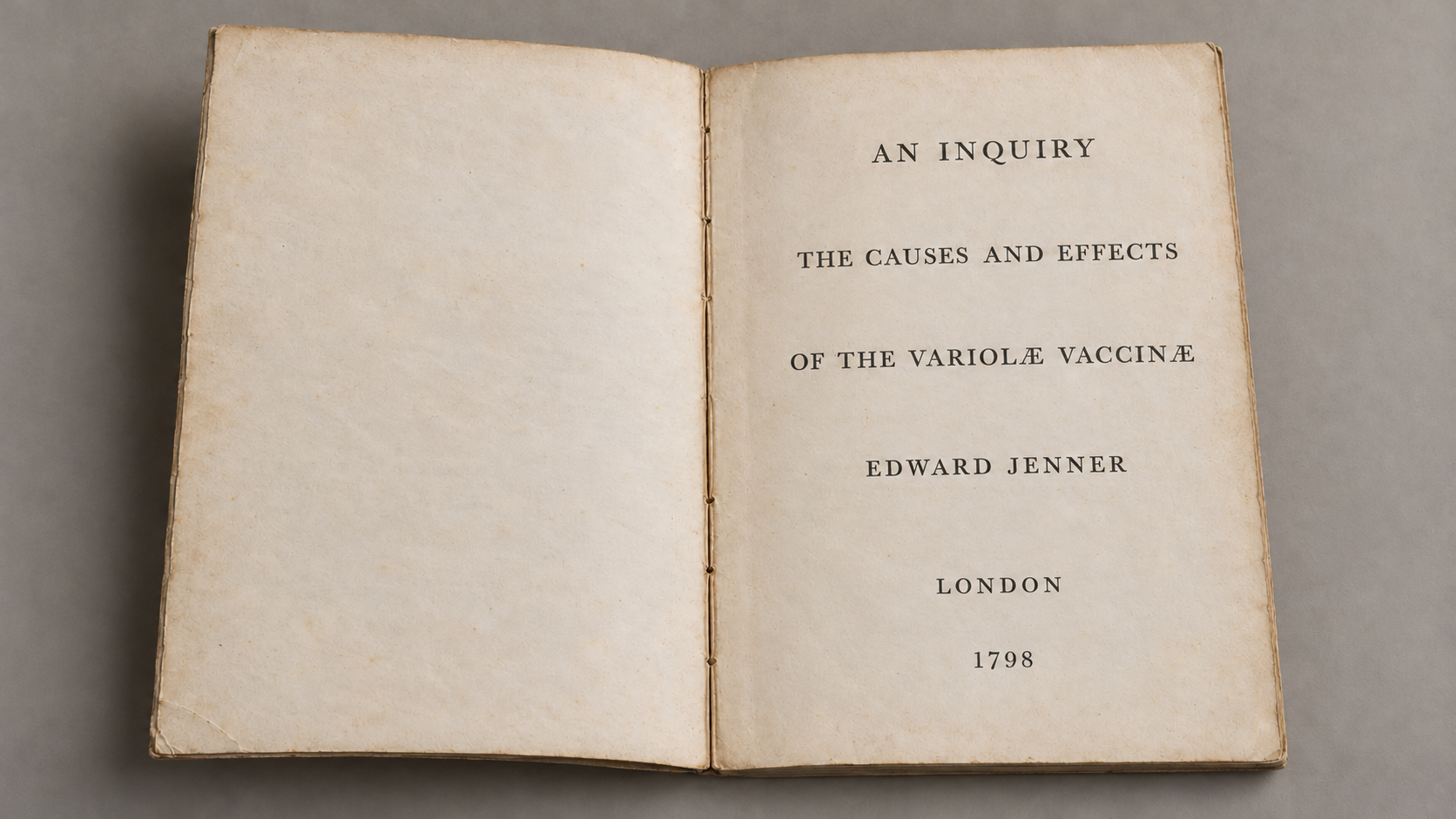
AI-generated conceptual evocation of Jenner’s 1798 publication, with an abbreviated title. This is not a photograph or facsimile of the original volume.
Vaccination aims to prepare the body to resist a disease before that disease does its damage. Edward Jenner’s book of 1798 helped turn that idea into a practical programme against smallpox. Its importance becomes clearer when we separate three things: the observations Jenner reported, their later immunological explanation, and the international effort that eventually eliminated the disease. None is interchangeable with the others.
The problem before Jenner
Smallpox was a contagious disease caused by variola virus. Survivors could carry permanent scars; severe disease could be fatal. Before vaccination, people in several regions already practised variolation: deliberately exposing a person to material from smallpox in the hope of producing a less dangerous infection and subsequent protection. Jenner therefore entered an existing history of attempts to prevent disease. He did not begin with an empty field. [1, 2]
Variolation contained a dangerous trade-off. The person being treated could develop serious smallpox, and could transmit it to others. Jenner investigated a different possibility suggested by experience in dairy communities: could an illness associated with cows protect a person against the much more dangerous human disease? The key change was the biological source used to seek protection, rather than the invention of deliberate immunisation from nothing. [1, 2]
An experiment in 1796, a publication in 1798
Jenner’s Inquiry describes a boy of about eight receiving material associated with cowpox on 14 May 1796. The account reports later exposure to smallpox material on 1 July without subsequent smallpox. The National Library of Medicine identifies the boy as James Phipps and the dairymaid supplying the initial material as Sarah Nelmes. The experiment and the book belong to different dates. [1, 3]
The edition printed in London by Sampson Low for the author in 1798 brought these observations into a sustained written argument. Surviving institutional catalogues identify a volume of 75 pages with four plates. Publication made the claims inspectable and shareable: readers could ask how the observations were obtained and whether the proposed protection really followed. That documentary step matters even though a book alone could neither standardise a vaccine nor organise its distribution. [3, 4]
What the early evidence could support
The book contains 23 numbered case sections, not a uniform trial of 23 participants. Some sections describe several people; their histories and follow-up differ. Jenner also states that he did not test every recipient in the later series. A reported comparison in Case XXIII used material that produced smallpox in a person without the relevant prior history. This helped address an alternative explanation for an apparently protected person: perhaps the exposure material was ineffective. [3]
That control is informative, but does not make the series a modern randomised trial. It cannot provide a defensible population-wide efficacy percentage. Jenner’s proposal of lifelong protection and his conjectures concerning disease arising in horses should also be distinguished from the central evidence for protection. A historically transformative result can coexist with incomplete data and incorrect or unestablished explanations. [3]
A later explanation: protection across related viruses
Modern immunology helps explain why protection against one infection can sometimes extend to a related one. Antibodies are proteins that recognise particular molecular features. When features are sufficiently similar across related viruses, part of the response induced by one virus can act against another. CDC guidance describes neutralising antibodies induced by vaccinia vaccination as cross-protective against other orthopoxviruses, including variola. “Cross-protective” describes this relationship; it does not mean protection against unrelated diseases. [5]
This explanation was not demonstrated by Jenner’s eighteenth-century vocabulary or instruments. Contemporary smallpox vaccines use vaccinia, a related virus, rather than variola itself. Their formulations differ, including in their ability to replicate. They should not be treated as an exactly characterised copy of material used in 1796, or as a single product with a single risk profile. Protection is also different from harmlessness: the safety of a vaccine depends on its formulation and the person receiving it. [5, 6]
From a preventive principle to eradication
The route from Jenner’s publication to a world without circulating smallpox took generations. Vaccines had to become reliable, available and deliverable. WHO’s account describes improved production and storage alongside health workers who searched for cases, traced contacts and contained outbreaks. Finding an infection and protecting the people around it complemented wider vaccination campaigns. The practical achievement depended on biology, manufacturing, surveillance, logistics and cooperation together. [7]
The global programme intensified in 1967. The last known naturally occurring case was recorded in Somalia in 1977; the World Health Assembly declared global eradication on 8 May 1980. These are distinct milestones. They explain why vaccination against smallpox durably changed humanity, while also showing why credit cannot stop at a single experiment or publication. [8, 9]
Documentary verification and limits
The appropriate reproduction task for this article is documentary. We read Jenner’s scientific text through a transcription prepared from Carnegie Mellon page images, and checked its edition against institutional records. The transcription incorporates the original errata and identifies additional typographical corrections. The full institutional facsimile was not received by our reader; a catalogue record is not evidence that its scanned pages were inspected. [3, 4]
Readers can check the reasoning by following the case numbers, separating observations from conjectures, and recording missing comparisons rather than treating them as successful tests. Modern explanations and the eradication chronology must be checked against their own later sources, not attributed retrospectively to the 1798 text.
| Item | Status in this review |
|---|---|
| Historical narrative and reported comparisons | Read in the identified transcription |
| Original physical volume and complete facsimile | Not inspected |
| Standardised raw participant dataset | Not available in the consulted material |
| Modern randomisation, blinding and statistical analysis | Not described for this historical series |
| Third-party code or numerical reanalysis | Not executed; no code was required for the documentary check |
| Physical reproduction or independent experimental replication | Not performed |
The historical human exposures are evidence to examine, not procedures to repeat. This article supplies no inoculation instructions. Its verification establishes what the sources report and what can reasonably be inferred from them; it does not constitute a new clinical experiment, independent replication or human peer review.
References
- National Library of Medicine. Smallpox: Vaccination. Last reviewed 5 March 2024.
- National Library of Medicine. Smallpox: Variolation. Last reviewed 5 March 2024.
- Edward Jenner. An Inquiry into the Causes and Effects of the Variolae Vaccinae. London, Sampson Low, 1798; identified transcription, eBook 29414, released 15 July 2009. Relevant locations: Case XVII, pp.32–34; Cases XVIII–XXIII, pp.36–44; concluding observations, pp.45–75; errata and transcriber’s note.
- Wellcome Collection / London School of Hygiene & Tropical Medicine Library & Archives Service. 1798 edition catalogue and digitised-copy record. Bibliographic check; the complete facsimile was not inspected.
- CDC, Advisory Committee on Immunization Practices. Vaccinia (Smallpox) Vaccine. 2001. Used for the explanatory cross-protection passage, not as current treatment advice.
- CDC. Smallpox Vaccine Safety. Dated 4 September 2025.
- WHO. History of smallpox vaccination. Institutional history of the eradication programme.
- WHO. Smallpox. Institutional programme overview, consulted 8 October 2026.
- World Health Assembly. WHA33.3: Declaration of global eradication of smallpox. 8 May 1980. Official publication notice and date checked; its PDF was not received by the reader.