
Neuroengineering · clinical research
Neuralink N1/R1: the PRIME clinical study
Neuralink is testing an implanted interface that translates brain activity into commands for external devices, with the aim of increasing autonomy for people with severe paralysis. Human use has been reported since 2024; lasting safety and comparative clinical benefit remain to be established.
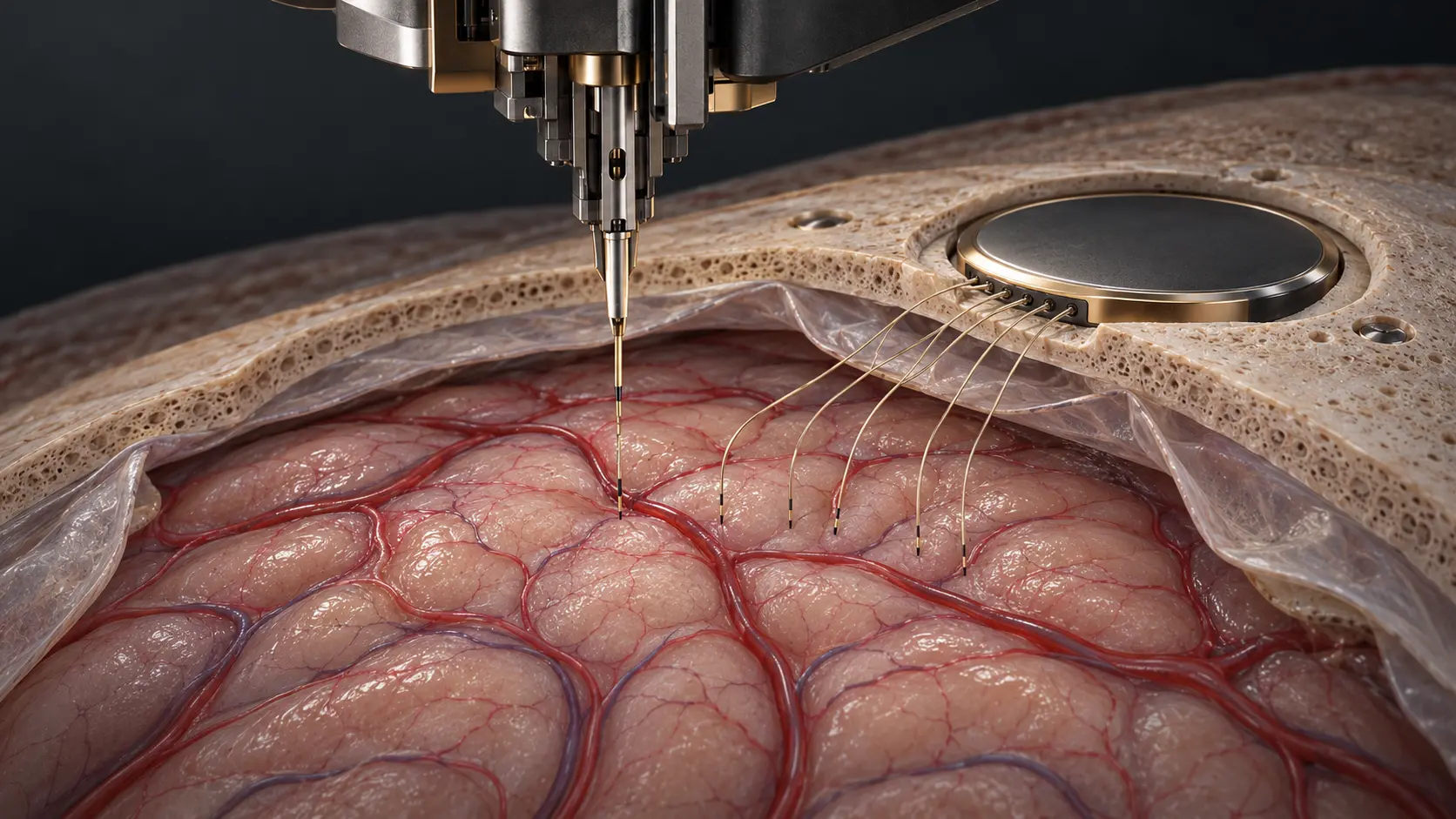
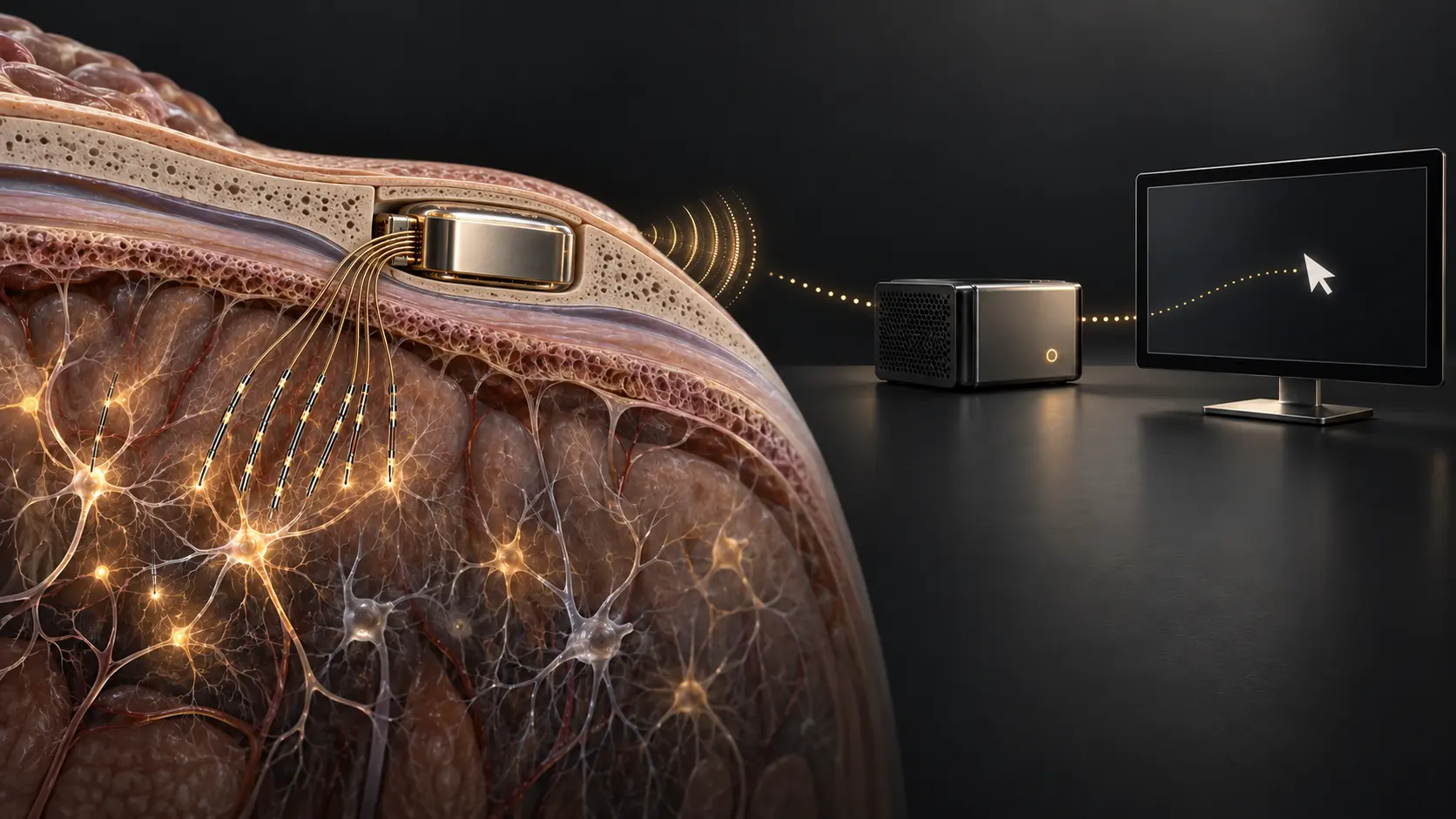
AI-generated conceptual illustration: not a photograph, experimental data, a simulation or an exact anatomical or engineering diagram.
How it worked
Acquire neural signals
R1 inserts N1’s flexible electrode threads; implant electronics process the recorded signals. This is an invasive investigational system, not a non-invasive headset.
Decode commands and assess use
Wireless data are decoded into external-device commands. Functional use and clinical safety must be evaluated separately; a cursor demonstration alone is not clinical validation.
Purpose
Neuralink is testing an implanted interface that translates brain activity into commands for external devices, with the aim of increasing autonomy for people with severe paralysis. Human use has been reported since 2024; lasting safety and comparative clinical benefit remain to be established.
1024 electrodes — N1 design described in April 2024[N2]
15 participants planned — PRIME registry estimate[N1]
21 participants — developer’s worldwide-trials announcement, January 2026[N5]
AI-assisted writing, translation and review; no human or independent expert validation is claimed. The English text is the reference version. Editorial method
Status, results & limitations
Functionality reported; long-term benefit unresolved
Human computer control is reported by the developer. PRIME’s registry still has no posted results; safety over time and comparative clinical benefit remain unresolved. The 21-person worldwide announcement is not the 15-person estimated PRIME cohort.
Read the evidence and caveatsPeople & organisations
Roadmap & legacy
Milestones are ordered; spacing is not a time scale.
Programme
2019–2026
- 2019Preclinical platform published; rat research, not human N1.2019 — Preclinical platform published; rat research, not human N1.[N3]
- 2024PRIME actual study start: 2024-01-09; first human implantation reported for January.2024 — PRIME actual study start: 2024-01-09; first human implantation reported for January.[N1][N2]
Technical publications
Technical follow-up
- 2024Thread retraction and software mitigation reported in May.2024 — Thread retraction and software mitigation reported in May.[N4]
- 2026Registry updated 2026-01-09; June 2026 primary-completion estimate now past, actual status unresolved.2026 — Registry updated 2026-01-09; June 2026 primary-completion estimate now past, actual status unresolved.[N1]
- 202621 participants across worldwide trials announced on 2026-01-28; not a PRIME cohort count.2026 — 21 participants across worldwide trials announced on 2026-01-28; not a PRIME cohort count.[N5]
Independent extensions
Separate research programmes
Resources & evidence
Purpose and scope
PRIME (NCT06429735) is one early-feasibility study within Neuralink’s broader N1/R1 programme, not the whole brain-computer-interface field. It studies initial device safety and functionality in people with severe paralysis. The intended benefit is control of external devices, not proven restoration of natural limb movement or general cognitive enhancement.
[N1][N2]How the system works
The N1 design described on 2024-04-12 has 1024 electrodes on 64 flexible threads, inserted into the cortex by the R1 robot. Electronics process neural signals and transmit them wirelessly to software that decodes commands such as cursor movement; an implanted battery is recharged inductively. The 2019 paper instead describes a preclinical research platform, including a 3072-channel configuration tested in rats. It is not the human N1 specification. Electrode count alone does not measure usable information, independence or clinical benefit.
[N2][N3]What PRIME actually measures
The registry consulted on 2026-09-14 lists an open-label, single-group device-feasibility study, with 15 participants estimated, not a confirmed enrolled total. Primary outcomes concern device- and procedure-related adverse events at 12 months; secondary safety follow-up extends to 72 months after implantation. Without a comparison group, this design does not establish comparative efficacy.
[N1]Reported results, not clinical validation

Neuralink reported first human implantation in January 2024 and subsequent computer control. On 2026-01-28 it reported 21 participants across trials worldwide, not 21 participants confirmed in this PRIME record. These developer reports describe use, not an independently replicated clinical assessment. The PRIME registry still displays no results posted. That does not mean no results exist elsewhere, and it does not invalidate the reported demonstrations.
[N1][N2][N5]Risks and remaining uncertainties
In May 2024 Neuralink reported thread retraction, fewer effective electrodes and reduced cursor performance in the first participant; software changes were reported to improve performance. In January 2026 it still described variability between participants and work on thread retention and surgical procedures. These reports do not establish long-term safety or a reliable population-wide benefit. Absence of posted registry results cannot be treated as proof of safety.
[N1][N4][N5]Actors and resources
Neuralink Corp sponsors PRIME and develops the device. The registry lists Barrow Neurological Institute in Phoenix and University of Miami in Miami as US study sites, with Francisco Ponce and Jonathan Jagid respectively as principal investigators. Clinical teams and participants contribute the procedures, use and follow-up; their work is not attributed to a company executive. A verified PRIME-specific budget, expenditure total and cost per participant are not available in the sources reviewed.
[N1][N2]Dated milestones and forecasts
The registry gives 2024-01-09 as the actual study start, distinct from the developer’s January 2024 implantation announcement and the registry’s first posting on 2024-05-28. Its last posted update is 2026-01-09. Primary completion remains estimated at June 2026 and study completion at January 2031. The June 2026 estimate is now past; the registry still says recruiting. This documentary mismatch does not establish completion, abandonment or clinical failure. Roadmap positions are ordinal, not a time-to-completion scale.
[N1][N2]Boundaries and next checks
Scope: N1/R1 with emphasis on US PRIME; international trials and other applications are not merged into one population. In January 2026 Neuralink announced work toward increasing electrode count from approximately 1000 to 3000; this is not evidence that an upgraded implant has been delivered. A general bidirectional interface is a broader ambition, not PRIME’s demonstrated outcome. Next checks: registry revisions, cohort-specific results, adverse-event follow-up and documented hardware changes.
[N1][N2][N5]Sources
- [N1] PRIME: An Early Feasibility Study of a Precise Robotically Implanted Brain-Computer Interface for the Control of External Devices — NCT06429735; record update 2026-01-09
- [N2] PRIME Study Progress Update — Neuralink, 2024-04-12
- [N3] An Integrated Brain-Machine Interface Platform With Thousands of Channels — Musk & Neuralink, JMIR 21(10):e16194, 2019-10-31; doi:10.2196/16194
- [N4] PRIME Study Progress Update — User Experience — Neuralink, 2024-05-08
- [N5] Two Years of Telepathy — Neuralink, 2026-01-28
Editorial method
Grands projets method 0.12.9 — primary-source reading, claim-to-source mapping and cross-language checks. Registry entries are sponsor reports; company demonstrations are not independent replication. No patient-level data reanalysis was performed. Source publication dates are distinguished from the consultation dates listed in the bibliography.
AI-assisted writing, translation and review; no human or independent expert validation is claimed. The English text is the reference version.
Revision 1 ·
Correction prepared 2026-09-14: PRIME study start restored to 2024; device generations and study populations separated. The inherited 2027+ clinical-standardisation forecast is not retained as an evidenced schedule. Earlier wording is preserved in the private correction record.