Correction — 14 October 2026. This revision corrects the chronology and attribution, replaces inadequately linked references and removes unsupported failure-rate calculations and the misleading comparison between historical dimensions and a modern node name.
From separate parts to a circuit
A transistor controls current; resistors and capacitors perform other circuit functions. Putting them together creates a useful electronic system. The difficulty was producing both the components and their connections reliably.
On 12 September 1958, Jack Kilby at Texas Instruments demonstrated an oscillator assembled from germanium semiconductor elements and fine gold connections. It established a practical route to semiconductor circuits, but its “flying wires” did not provide a scalable interconnection process. Kilby’s patent US3138743 describes active and passive elements in semiconductor material. A patent describes a design and claims; it does not by itself measure production yield.
Milestones: demonstrations and patent filings
| Milestone | Contribution |
|---|---|
| 1958 — Kilby | A working semiconductor circuit demonstration |
| 1959 — Hoerni | A planar process retaining protective oxide over junction edges; US3025589 filed 1 May 1959 |
| 1959 — Noyce | Metal connections supported by insulating oxide; US2981877 filed 30 July 1959 |
| 1960 — Fairchild teams | Working monolithic circuits and development of component isolation |
Hoerni’s later process cannot be a prerequisite for Kilby’s earlier experiment. Noyce built on the planar route to address interconnections. These contributions solved related problems; they were not one invention by one person.
Why the oxide matters
Doping changes the electrical behavior of selected semiconductor regions. A p–n junction joins a p-type region, where holes are the majority carriers, to an n-type region, where electrons are the majority carriers. Hoerni retained silicon oxide over the surface edges of junctions instead of leaving them exposed.
Noyce used the oxide as insulation beneath metal strips. Selected openings let the metal contact semiconductor regions without shorting intervening junctions. Insulating surface wiring does not automatically isolate components inside the silicon: that required additional engineering.
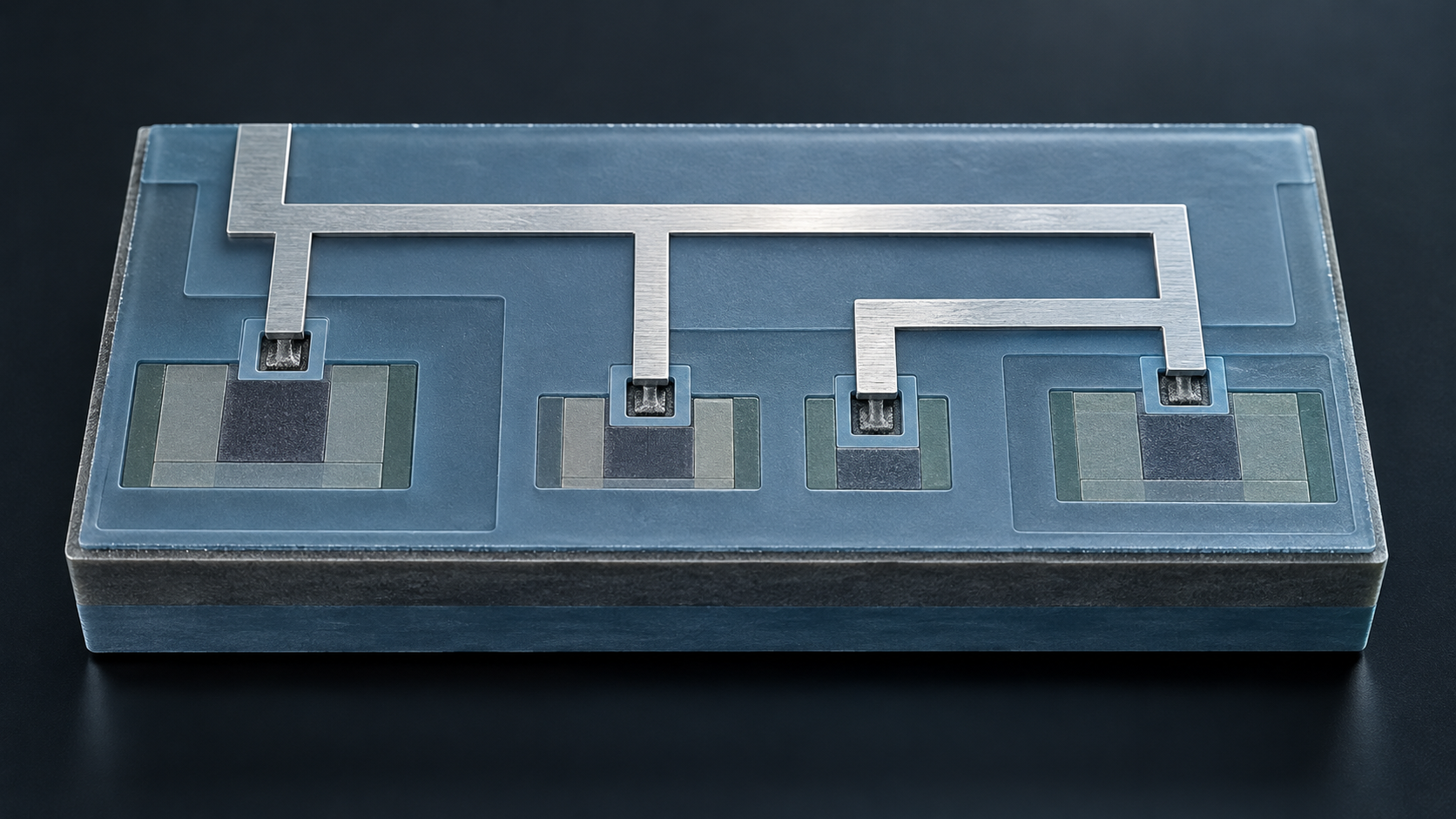
The process combines patterning, diffusion, contact openings and metallization. Fabricating from the same face does not mean completing everything in one lithographic operation. The cover illustrates the metal-over-insulator idea; it is neither a historical device nor a working circuit diagram.
Methods, evidence and limitations
The linked patent descriptions and claims were examined alongside the Computer History Museum chronology. The museum distinguishes early physical isolation from later junction isolation in Fairchild circuits. This reconstruction does not report a semiconductor experiment, fabrication run or reliability replication.The preserved record supports the chronology and mechanisms. It does not supply a common measurement proving a numerical reliability gain for every early circuit. Modern process-node names are not directly comparable to historical feature measurements; no such scale comparison is made here. Integration enabled increasingly complex electronics, through later work on materials, isolation, manufacturing and design.
AI assisted this scientific correction and its translations; automated checks do not constitute human review. The generated cover is a conceptual illustration. The previous revision is retained in the editorial history.