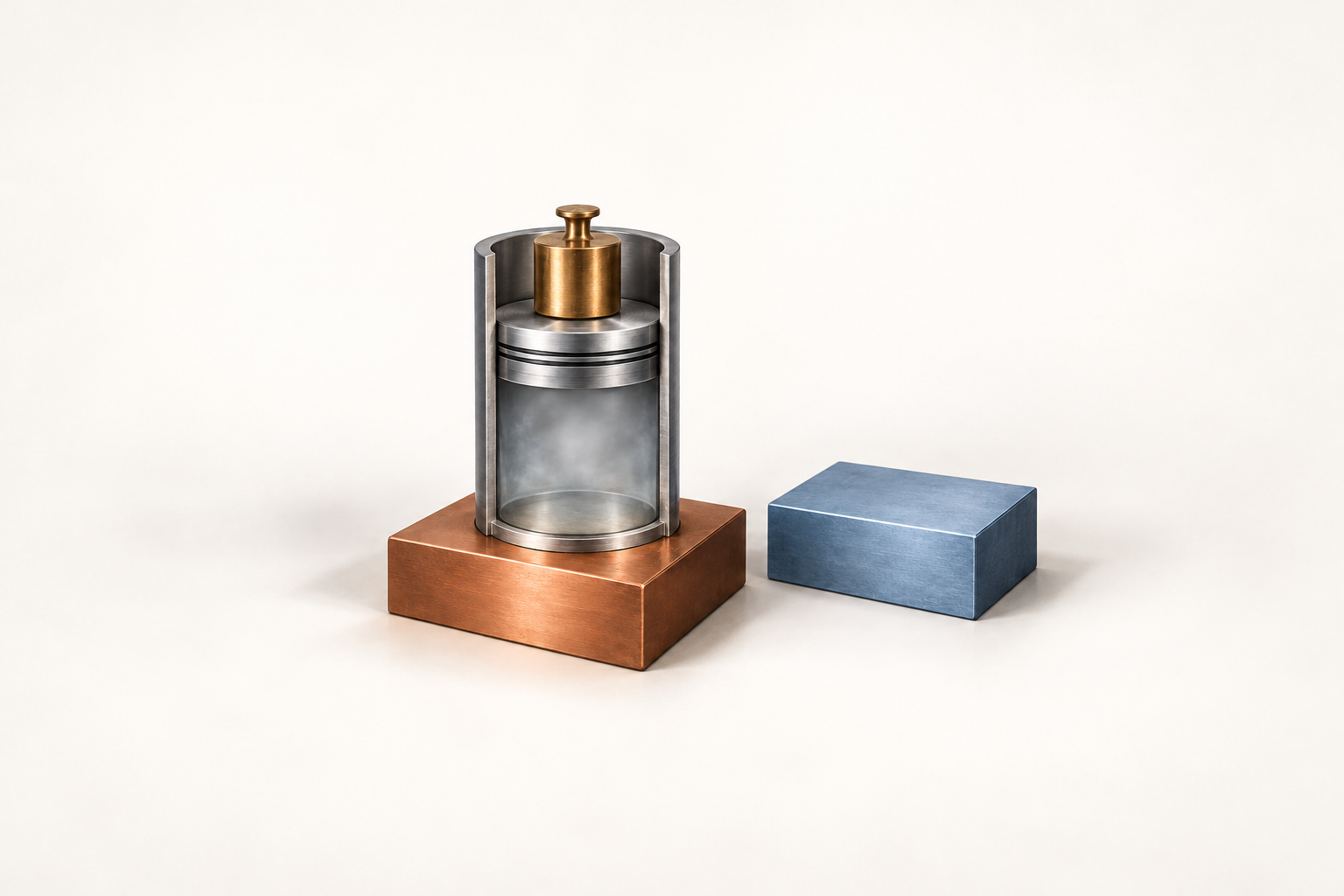
AI-generated conceptual illustration. The warm block beneath the cylinder and the separate cold block represent thermal contacts to be used alternately; colours are not measured temperatures. It shows neither a complete cycle nor a historical photograph, exact reconstruction or measurement.
A question beyond improving one machine
A steam engine can turn heat into useful motion. But how much of the heat supplied could any engine turn into work, even if its engineering were perfected? In his 1824 Réflexions sur la puissance motrice du feu, Sadi Carnot approached that question through ideal operations rather than a performance test of a particular machine.
The distinction starts with his vocabulary. “Puissance motrice” refers here to useful mechanical work, illustrated by lifting a weight through a height. Work measures an amount of energy transferred. Modern power measures how quickly work is done, in watts. Translating the historical expression directly into watts would change the question Carnot was asking.
His achievement was therefore a way to compare possibilities, not a promise that a real engine could meet an ideal limit. The relevant historical publication is the book of 1824; the date of a later digital edition does not make its central advance a current discovery.
Why compare an engine with its reverse?
Picture a gas enclosed in a cylinder with a movable piston, together with a hot body and a colder body maintained at fixed temperatures. Expansion can push the piston and provide work; compression requires work. A complete cycle restores the working substance to its initial state, so useful output must be assessed over the whole cycle.
Carnot considered ideal operations that could also be reversed. In his historical argument, running the reverse sequence would consume the work obtained in the forward sequence and undo the associated thermal transfers. Pairing such an ideal engine with a supposedly better one provided a way to challenge the claimed superiority.
Under these ideal conditions, changing the working substance does not improve the maximum. It does not say that every substance or every practical engine performs equally well. Reversibility is stronger than moving a piston backwards: it requires ideal control of the operations and the associated exchanges, without dissipative losses.
The 1897 translated collection and commentary includes William Thomson’s 1849 account. Its sections 12–14 and 29–30 explicitly develop this ideal-engine reasoning. Thomson’s commentary, later corrections dated 1881 and Carnot’s posthumous writings are separate documentary layers, not parts to attribute indiscriminately to the published 1824 text.
The useful comparison required a different theory of heat
Carnot’s published reasoning assumed that caloric was conserved as it passed from a hot body to a colder one. That physical premise is incorrect. In modern thermodynamics, an engine can convert part of the energy received as heat into work; the heat rejected need not equal the heat received.
The MIT thermodynamics treatment reconstructs the comparison using energy conservation and the second law. For a cyclic engine, the working substance returns to its initial state. Energy accounting relates heat received, heat rejected and net work. Entropy accounting distinguishes a reversible process from one with irreversible losses.
For a reversible heat engine exchanging heat only with the same two fixed-temperature reservoirs, the modern maximum thermal efficiency is:
ηCarnot=1−ThTc
Here, eta is useful net work divided by heat received, T_h is the hot reservoir temperature and T_c the cold reservoir temperature. Both temperatures are absolute temperatures in kelvin. For those same reservoirs, irreversibilities reduce real efficiency below this reversible bound.
With hypothetical reservoirs at 600 K and 300 K, the expression gives 50%. This arithmetic is a teaching calculation, not a historical measurement or the efficiency of a particular engine. The formula in kelvin is a modern reconstruction; it is not attributed to Carnot’s 1824 publication. Nor does it specify power output, operating speed or an attainable engineering design.
A durable benchmark, with evidence kept in proportion
The lasting contribution is the use of an ideal reversible comparison to separate a general limit from the shortcomings of one machine. Thomson’s discussion and the modern teaching treatment document conceptual continuity. They do not quantify the book’s immediate industrial impact, an economic benefit or a measured improvement in an actual engine.
The source layers matter when following that continuity:
| Documentary layer | What is read here | Attribution limit |
|---|---|---|
| 1824 | Carnot’s published argument | Its conserved-caloric premise is not modern physics |
| 1849 | Thomson’s later account | Commentary on Carnot, not the original book |
| 1897 | Translated composite volume | Includes distinct later material and corrections dated 1881 |
An ideal limit remains useful precisely because its assumptions are visible. Applying it to a practical system requires checking the heat exchanges and operating conditions; a named cycle alone is not evidence of performance.
Article method and documentary limits
This is a documentary historical assessment. Relevant passages in the French transcription of the published original were read, including the work terminology, direct and reverse operations, and reservations about the theory. They were compared with Thomson’s specified commentary and the modern MIT energy and entropy treatment. The accessible transcription was not exhaustively checked against every facsimile page; exact historical quotations or numerical conversions would require that additional comparison.
Verification here means tracing each central claim to the appropriate source layer, keeping the incorrect caloric premise visible and checking the conditions of the modern formula. The 600 K/300 K example was calculated and recorded as 50%. It does not reproduce a historical numerical experiment.
No physical experiment, study-code reanalysis, simulation or independent replication was performed. Experimental equipment, participant inclusion, randomisation and blinding are not applicable to this documentary comparison; no experimental effect is being estimated. A real heat-engine test would require a separate protocol, instruments and qualified facilities, which this article does not provide.
The English text and seven translations were prepared using artificial intelligence. The conceptual cover was also generated using artificial intelligence. No human expert validation is claimed. The cover is not a historical photograph, an exact reconstruction, a complete depiction of the cycle or a measurement. Its coloured blocks represent hot and cold contacts to be used alternately; their colours do not measure temperature.