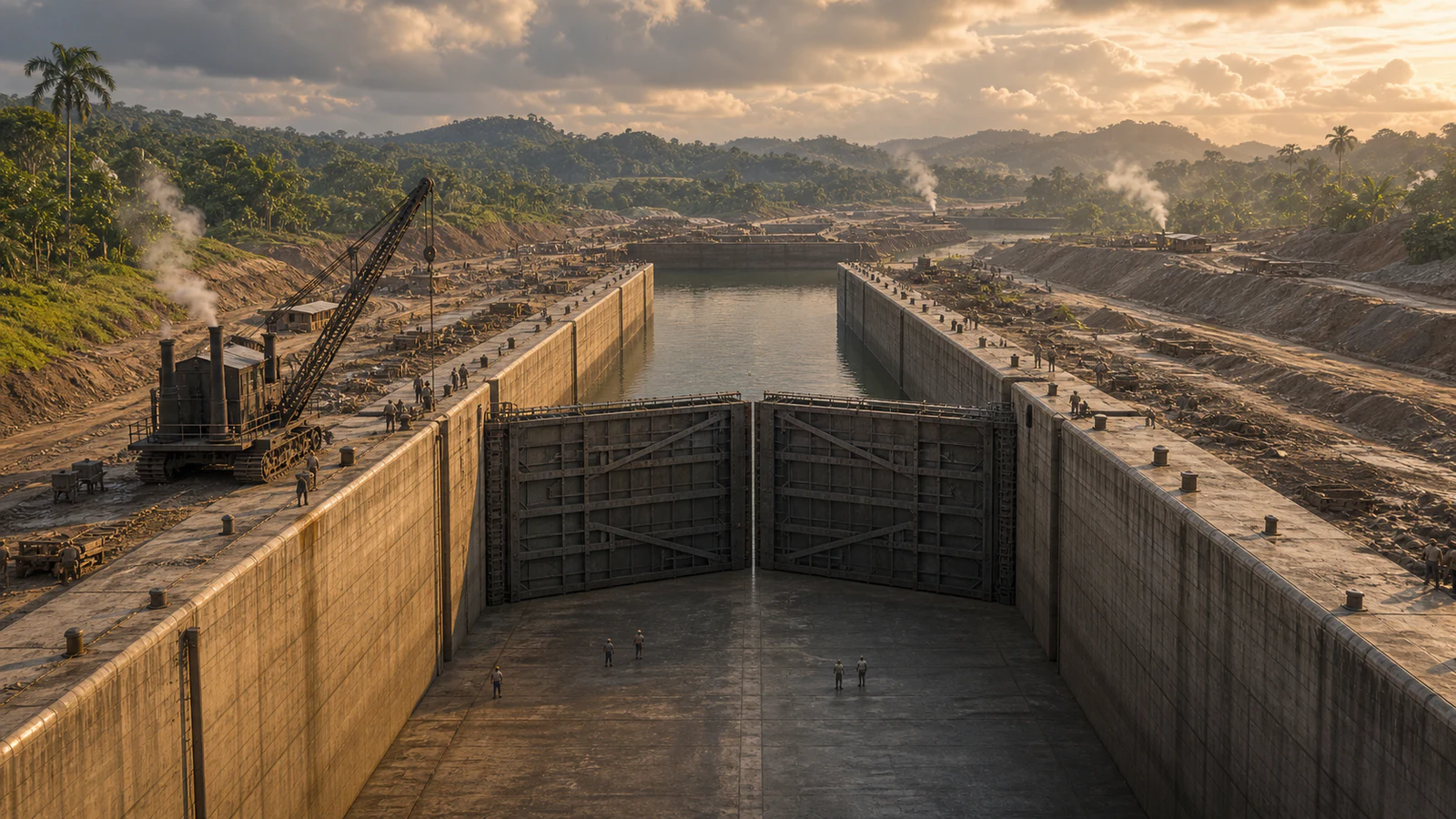
On 15 August 1914, the SS Ancon made the first official transit of the Panama Canal: 80 km of isthmus, three sets of locks and a ship lifted 26 m above sea level. Behind that inaugural passage lie 33 years of construction carried out in two phases, ~310.7 million cubic yards of earth moved and 27,609 deaths.
Source: uflib.ufl.edu
In plain terms
In Panama the land rises: the two oceans cannot be joined by a simple ditch dug at sea level. The canal therefore works like a staircase of water — three series of basins lift the ship up to the artificial lake that occupies the summit of the route, 26 metres higher, then lower it again on the other side. No pump is involved: it is the lake, sitting high above, that fills the basins by gravity alone, at a cost of 202 million litres of fresh water per passage. The first attempt, the French one, had tried precisely to dig at sea level, without locks and without any campaign against mosquitoes; it collapsed in 1889. The human price was considerable: 27,609 deaths across all phases, 22,000 during the French years alone.
Discovery
| Parameter | Value |
|---|---|
| Inauguration | 15 August 1914 (SS Ancon, first official transit) |
| Construction start | 1881 (French phase, Ferdinand de Lesseps) |
| Completion | 1914 (American phase, George W. Goethals) |
| Length | 80 km |
| Elevation | 26 m above sea level (Gatún Lake) |
| Locks | 3 sets: Gatún (3 chambers), Pedro Miguel (1), Miraflores (2) |
| Lock dimensions | 33.5 m × 304.8 m × 12.6 m deep |
| Total excavation | ~310.7 million yd³ (~238 million m³) across all phases; American phase alone: 232.4 million yd³ (~178 million m³) |
| Total cost | ~645 million USD across all phases; ~375 million USD for the American phase alone (~12 billion USD today) |
| Human toll | 27,609 deaths across all phases; 22,000 for the French phase alone (1881–1889) |
Structures and specifications
| Structure | Specifications |
|---|---|
| Gatún locks | 3 chambers |
| Pedro Miguel locks | 1 chamber |
| Miraflores locks | 2 chambers |
| Lock gates | 730 tonnes each, 19.5 m high; opening and closing in 2 minutes (25 hp electric motors) |
| Gatún Dam | 2,300 m long, 32 m high |
| Gatún Lake | 425 km², the largest artificial lake in the world at the time; summit level at 26 m; fed by 2,600 mm of rainfall per year |
| Culebra Cut (Gaillard Cut) | 14 km of channel carved through unstable shales and mudstones, down to 94 m deep |
| Extra excavation caused by landslides | 76 million m³ beyond the plan |
| Fresh water consumed | 202 million litres per transit |
Technical explanation
1. Gravity-fed locks — Each lock chamber operates by gravity: water from Gatún Lake (26 m above sea level) flows naturally into the lower chambers. The gates (mass: 730 tonnes each, height: 19.5 m) open and close in 2 minutes thanks to 25 hp electric motors. No pump is needed — the system uses 202 million litres of fresh water per transit.
2. The Culebra Cut (Gaillard Cut) — Crossing the continental divide required the largest earthmoving operation in history: 14 km of channel carved through unstable shales and mudstones to a depth of 94 m. Landslides (deslizamientos) forced the excavation of 76 million m³ more than planned.
3. Gatún Lake — The Gatún Dam (2,300 m long, 32 m high) created the largest artificial lake in the world at the time: 425 km². Fed by tropical rainfall (2,600 mm/year), it forms the summit level of the canal and the water reservoir for the locks.
4. The war against mosquitoes — Colonel William C. Gorgas applied on site two medical discoveries that were then recent:
| Vector identified | Disease | Researcher | Year |
|---|---|---|---|
| Anopheles mosquito | Malaria | Ronald Ross | 1897 |
| Aedes aegypti | Yellow fever | Walter Reed | 1900 |
On that basis: swamp drainage, oil spraying on standing water, mandatory mosquito nets. Mortality fell from 40 per thousand (French phase) to 6 per thousand (American phase).
Why it worked
| Criterion | French phase (1881–1889) | American phase (1904–1914) |
|---|---|---|
| Project leadership | Ferdinand de Lesseps | George W. Goethals; John Frank Stevens, chief engineer (1905-1907) |
| Design chosen | sea-level canal, like Suez | lock canal |
| Vector control | none | drainage, oil on standing water, mosquito nets (Gorgas) |
| Mortality | 40 per thousand | 6 per thousand |
| Human toll | 22,000 deaths in 8 years | included in the 27,609 deaths across all phases |
| Excavation | included in the ~310.7 million yd³ across all phases | 232.4 million yd³ (~178 million m³) |
| Cost | included in the ~645 million USD across all phases | ~375 million USD |
| Outcome | bankruptcy in 1889, political scandal | inauguration on 15 August 1914 |
The French phase (1881–1889) failed for two reasons: the choice of a sea-level canal (like Suez) through volcanic terrain at 94 m elevation, and the absence of any anti-malaria campaign (22,000 deaths in 8 years). The Americans corrected both errors: a lock canal (shorter, less earthmoving) and tropical medicine.
John Frank Stevens, chief engineer (1905-1907), designed the logistics for removing the spoil by rail: 160 trains a day carried the excavated earth to the fill zones. This railway logistics operation was the decisive factor — without it, the site would have silted up just as the French phase had.
Causal chain
Balboa discovers the Pacific (1513) → Charles V considers a canal (1534) → De Lesseps succeeds at Suez (1869) → De Lesseps attempts Panama (1881) → French bankruptcy (1889, political scandal) → Panamanian independence (1903, backed by the USA) → American takeover (1904) → Inauguration (1914) → Handover to Panama (31 December 1999)
Anecdote
The Panama Canal scandal (1892) was the largest corruption affair of the French Third Republic. Of the 1.4 billion francs raised from 800,000 small investors, only 600 million actually reached the construction site. Several deputies and ministers were convicted. Ferdinand de Lesseps, the hero of Suez, died in disgrace in 1894.
Limits and controversies
This bulletin recounts a simplified historical narrative. The contributions of many actors, the intermediate failures and the priority controversies are not covered exhaustively. The modern figures cited in the references come from institutional sources and may vary depending on which reference bodies are consulted.
Sources
References verified during the August 2026 fact-checking audit: these are the pages
against which the claims of this bulletin were checked.