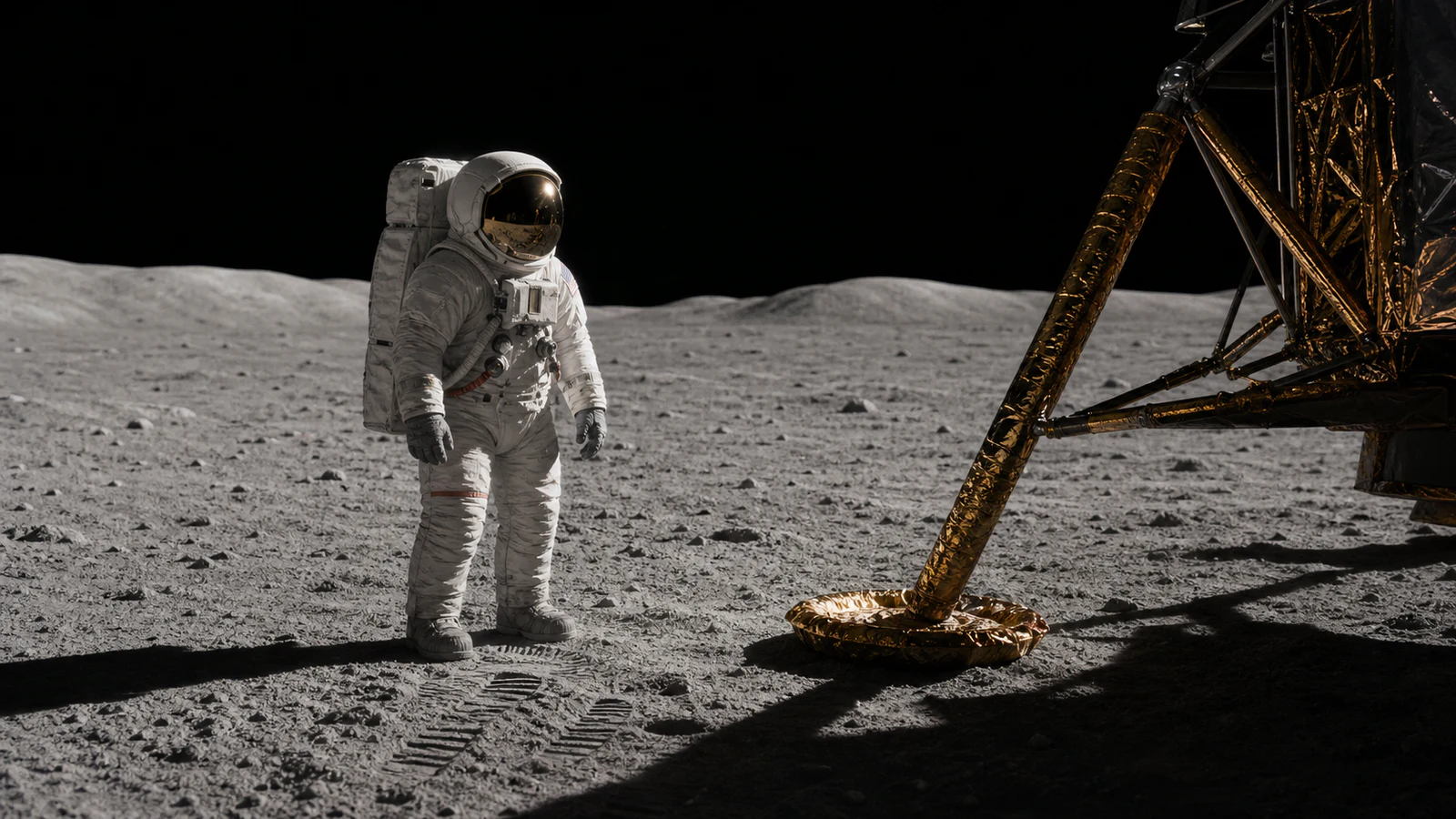
In Plain Terms
Putting two men on the Moon and bringing them home meant launching a machine 111 metres tall, discarding almost all of it along the way, and then making two spacecraft find each other 384,400 km from Earth. The decisive trick was not building an even bigger rocket, but sending only a small module down to the surface while the main spacecraft waited in lunar orbit: the mass to be landed drops from ~45 t to ~15 t. On July 20, 1969, Armstrong took manual control to avoid a boulder field and touched down just as Houston called out "30 seconds" — a countdown to the mandatory abort call, not a fuel gauge. The onboard computer, 74 KB and 2 MHz, sounded its alarms because it was saturated; it held because it had been designed to drop secondary tasks and keep the vital ones. Twelve humans walked on the Moon between 1969 and 1972, and none since.
Discovery — The Moon Landing (1969)
On May 25, 1961, President Kennedy sets the objective: "landing a man on the Moon and returning him safely to the Earth" before the end of the decade. NASA's Apollo program mobilizes 400,000 people across 20,000 companies.
Mission Parameters
| Parameter | Value |
|---|---|
| Landing date | July 20, 1969, 20:17 UTC |
| Location | Sea of Tranquility, Moon |
| Crew | Armstrong (commander), Aldrin (LMP), Collins (CMP, in orbit) |
| Total mission duration | 8 days, 3 hours, 18 minutes |
| Earth-Moon distance | 384,400 km |
| Time on the surface | 21 hours 36 minutes |
| Launch mass | 2,970 tonnes (Saturn V) |
| Program cost | $25.4 billion (~$175 billion adjusted 2024) |
| Key innovation | Lunar Orbit Rendezvous (LOR) |
Technical Explanation — Lunar Orbit Rendezvous
Before Apollo, two approaches were considered: direct ascent (giant rocket) or Earth orbit assembly. John Houbolt (Langley) proposes the third way: Lunar Orbit Rendezvous (LOR), which reduces the mass to be sent by ~80%.
1. Saturn V — The most powerful launcher ever built, and the only one whose flight record remained perfect for the entire duration of the program.
| Characteristic | Value |
|---|---|
| Stages | 3 |
| Height | 111 m |
| Launch mass | 2,970 t |
| Thrust | 34,000 kN |
| First-stage engines | 5 × F-1 |
| Propellants | RP-1 (kerosene) + liquid oxygen |
| First-stage consumption | ~13 t of propellant/s, of which ~4 t/s is kerosene |
| Flight record | 13 launches, 0 failures |
2. Command/Service Module (CSM) — The spacecraft Columbia remains in lunar orbit with Michael Collins. The service module's propulsion system (SPS) provides the deceleration for lunar orbit insertion and the acceleration for the return — with a single engine and no redundancy (success mandatory).
3. Lunar Module (LM) — The Eagle separates from the CSM and descends in 2 phases: powered braking, then final approach. Armstrong takes manual control at ~150 m to avoid a boulder field. He lands just as Houston has called out "30 seconds" — a countdown to the mandatory abort call, not a measure of the fuel remaining; later reconstructions estimate that ~45 s of hovering was still possible.
4. Apollo Guidance Computer (AGC) — Designed by MIT (Margaret Hamilton, software director), the AGC is one of the first computers built with integrated circuits. 74 KB of memory, 2 MHz. During the descent, it triggers "1202" alarms (execution queue overflow) but keeps running thanks to its task priority architecture — the first mission-critical real-time system in history.
Why It Worked
The key is Lunar Orbit Rendezvous (Houbolt): instead of sending a giant rocket directly to the Moon, a small module lands while a spacecraft stays in orbit. Without this idea, Saturn V would not have been enough.
| Mission architecture | Mass to be landed on the Moon |
|---|---|
| Direct ascent | ~45 t |
| Lunar Orbit Rendezvous (LOR) | ~15 t |
The other key is reliability engineering: every component is tested for a reliability >0.99999.
Causal Chain
Sputnik (1957) → NASA created (1958) → Kennedy speech (1961) → Gemini (orbital rendezvous, 1965-66) → Apollo 11 (1969) → Derived technologies (integrated circuits, materials, software engineering) → ISS space station → Artemis II (crewed lunar flyby, April 2026) → crewed landing deferred to Artemis IV
Margaret Hamilton and Software Engineering
Hamilton and her MIT team develop the AGC software with unprecedented rigor. She coins the term "software engineering" to give software the same status as hardware. The task priority system she designs saves the Apollo 11 mission when the AGC is overloaded during the descent.
Legacy and Current Data
Apollo proved that humanity can carry out engineering projects of unprecedented complexity. 12 humans walked on the Moon (1969-1972), none since.
Limitations and Controversies
Mission data comes mainly from the space agencies involved (NASA, ESA, Roscosmos). The technical specifications correspond to the publicly available data. Some operational details remain classified or have been revised after declassification.
Sources
References verified during the August 2026 fact-checking audit: these are the pages
against which this bulletin's claims were checked.