In plain terms
Making steel means, first of all, removing carbon: pig iron contains 3 to 4.5%, steel 0.1 to 1.5%. Until the middle of the 19th century this was done by hand — stirring the metal for hours, or heating it in contact with charcoal for days — for a few hundred kilograms a day at best. Bessemer's idea comes down to a single image: blow air through the molten metal, the way you fan a fire, so that the carbon burns off on its own; the heat released by that combustion is enough to keep the bath liquid, without adding a scrap of fuel. The result: five tonnes of pig iron become steel in about twenty minutes. The process was not universal at the outset, however: the phosphorus contained in many ores was not removed and made the steel brittle — it would take the basic lining of 1878 to clear that obstacle.
Discovery
| Parameter | Value |
|---|---|
| Patent date | 17 October 1855 (patent no. 2321) |
| Public presentation | 13 August 1856 (Cheltenham) |
| Inventor | Sir Henry Bessemer (1813–1898) |
| Chemical principle | Decarburization of pig iron by oxidation: C + O₂ → CO₂ |
| Temperature | ~1,600 °C (exothermic, no external fuel) |
| Capacity | 5 to 30 tonnes per "blow" |
| Duration | 15–20 minutes per blow |
| Resulting carbon content | 0.1–1.5% C (steel) vs 3–4.5% C (pig iron) |
Technical explanation
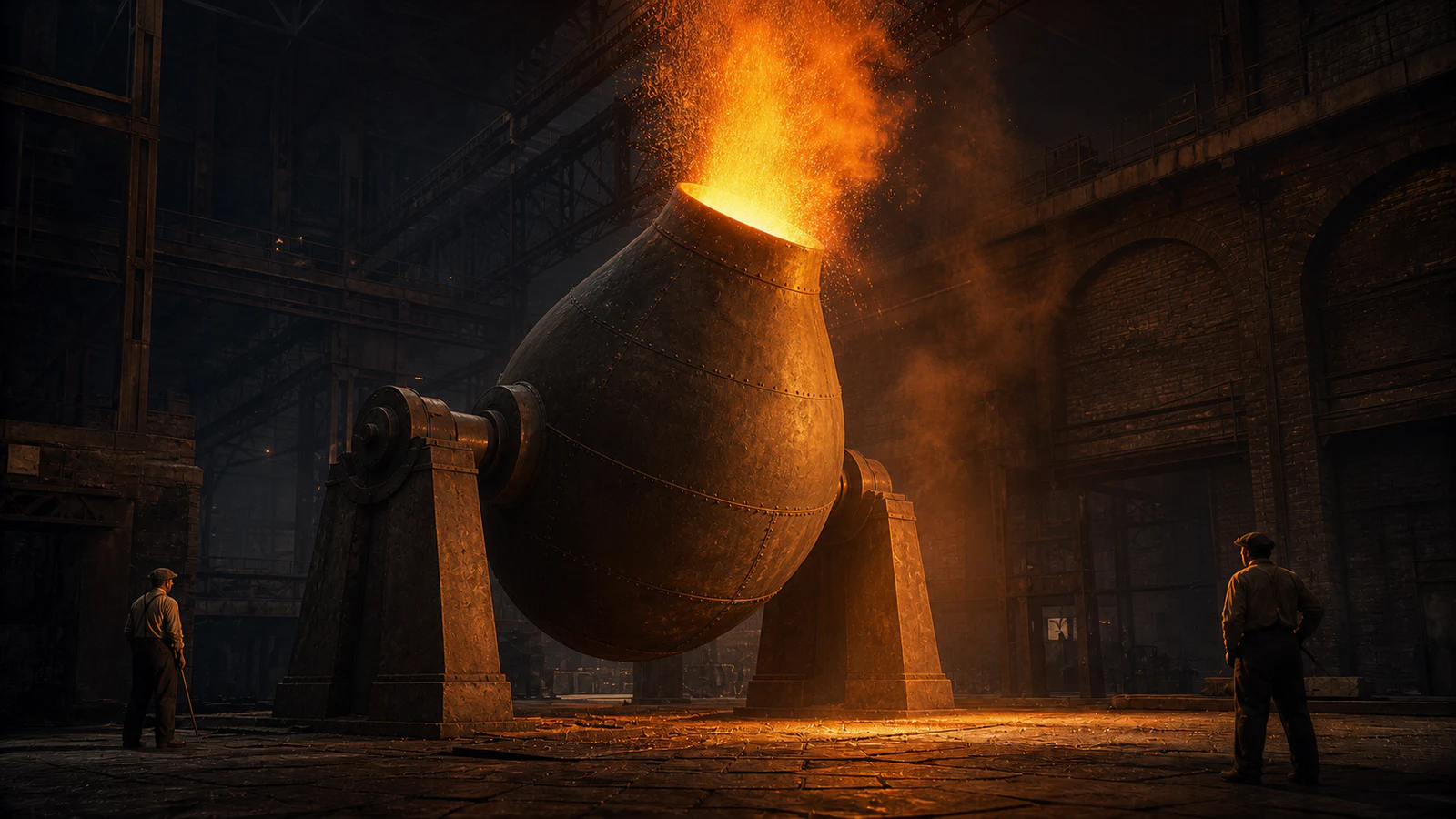
1. Charging the converter — Molten pig iron at ~1,300 °C is poured into a pear-shaped converter, a steel vessel lined with acid refractory bricks (silica) with a capacity of 5 to 30 tonnes.
2. Air blowing — Compressed air is blown through tuyères in the bottom of the converter, up through the molten pig iron. The oxygen in the air reacts with the carbon (C + O₂ → CO₂), the silicon (Si + O₂ → SiO₂) and the manganese present in the pig iron. These reactions are violently exothermic: the temperature rises to ~1,600 °C with no external heat input.
3. Controlled decarburization — The operator watches the flame coming out of the converter. When the flame weakens (drop in CO), the carbon is almost entirely gone. He stops the blow, then recarburizes the steel by adding spiegeleisen (an iron-manganese-carbon alloy) to reach the desired content (0.1–1.5% C).
4. Tapping — The converter tilts and pours the liquid steel into ingot moulds. The slag (SiO₂ + MnO) floats and separates naturally.
Why it worked
Before Bessemer, steel was produced by puddling or by cementation — two slow, low-output processes. Bessemer automated refining by using the chemical energy of the pig iron itself: the impurities (carbon, silicon) serve as fuel.
| Process | Principle | Duration of one operation | Output |
|---|---|---|---|
| Puddling | Manual stirring of the pig iron | A few hours | A few hundred kg/day at best |
| Cementation | Heating wrought iron in contact with charcoal | Several days | A few hundred kg/day at best |
| Bessemer converter | Blowing air through the molten pig iron, the impurities serving as fuel | 15–20 minutes | 5 to 30 tonnes per blow |
The main initial limitation was phosphorus: the acid Bessemer process does not remove it, which makes the steel brittle. Sidney Gilchrist Thomas solved this problem in 1878 with a basic lining (dolomite), allowing the use of phosphoric ores, widely available in Europe.
Causal chain
Cort's puddling (1784) → Need for steel armour for the Crimean War (1853) → Bessemer invents the converter (1856) → Thomas solves the phosphorus problem (1878) → World steel production explodes: 0.5 Mt (1870) → 28 Mt (1900) → Skyscraper construction (Home Insurance Building, Chicago, 1885) → Brooklyn Bridge (1883) → Eiffel Tower (7,300 tonnes of puddled iron, 1889) → Steel ships
Anecdote
Bessemer developed his process while looking for a better metal for cannon. During the Crimean War, his spinning shell required a barrel stronger than cast iron. The foundries refused to make steel pure enough, which pushed Bessemer to invent his own process — a classic case of military necessity driving civilian innovation.
Sources
References verified during the August 2026 fact-checking audit: these are the pages
against which this bulletin's claims were checked.