In nineteenth-century surgery, treating an injury could create another danger: a wound might deteriorate after an apparently successful operation. Joseph Lister’s contribution was to make that deterioration a problem with a proposed mechanism and a practical point of intervention. Instead of treating putrefaction as an unavoidable consequence of exposure to air, he sought to prevent living contaminants from acting on injured tissue.
In a paper presented in Dublin on 9 August 1867 and published in the British Medical Journal on 21 September, Lister described this antiseptic principle and its application to wounds. “Antiseptic” here means an attempt to destroy the organisms associated with decomposition. The article is a historical account, not a description of present-day treatment. Original publication, accessible authorized reprint.
From the air itself to living contaminants
Lister explicitly credited Louis Pasteur’s investigations. As he understood them, the air’s ability to initiate decomposition depended on small living organisms carried in it, rather than on oxygen itself. This changed the practical question: a surgeon did not necessarily have to exclude all air; the task could be to stop living contaminants from initiating decomposition in the wound.
His chosen agent was carbolic acid, also called phenic acid or phenol. He described both destroying contamination already introduced and preventing subsequent contamination. Those are different tasks. A protective dressing could limit new contamination while failing to reach material already present deep inside a wound.
This was a consequential bridge between a biological explanation and a surgical practice. It should not be presented as proof that Lister independently discovered microorganisms, invented every hygiene measure or established all the mechanisms of infection. His paper’s explanations of inflammation and pus also contained assumptions that extended beyond the observations he reported.
Why open fractures mattered
An open fracture connects a broken bone and damaged tissues to the outside through a wound. Lister began with this difficult class of injuries. It offered a sharp contrast with a closed fracture, in which the broken bone remained beneath intact skin.
One example in the 1867 paper was a boy admitted with an open leg fracture eight and a half hours after the accident. Lister reported that local and general disturbances were avoided and that the bones were firmly united five weeks after admission. This illustrates the outcome he was trying to achieve. It is a case report: there is no untreated counterpart establishing what would have happened to that same patient.
Other examples concerned extensive arm injuries, abscesses and an injured hand. Lister’s statements that amputation could have been avoided compared actual outcomes with his clinical judgment about earlier practice, not with randomized treatment allocation. That distinction preserves the historical importance without making the evidence stronger than it was.
A system of protection, with a chemical cost
The dressing evolved as Lister encountered practical difficulties. An earlier arrangement used acid-treated lint beneath a tin cover. Larger wounds produced more fluid, which could carry away the agent and complicate protection. He then described a paste retained between thin sheets of calico, with a treated rag underneath. The intended function was to maintain an antiseptic barrier while avoiding repeated exposure during dressing changes.
These details show that the innovation involved managing a changing wound environment, not merely selecting a chemical. The retained material, escaping fluid, persistence of the agent and handling of the dressing were interdependent.
Lister also acknowledged a crucial complication: carbolic acid could injure tissue and stimulate the production of pus. Therefore, visible pus did not by itself distinguish chemical irritation from the process he was trying to prevent. Conversely, a cleaner-looking wound did not prove that all contamination had been eliminated. These are historical observations about his system; they provide no recipe or clinical recommendation.
What the numbers actually show
In 1867, Lister reported no cases of pyæmia, hospital gangrene or erysipelas in his wards during the preceding nine months. These are the disease categories used in his account. The paper supplies no complete denominator for that interval, and the observation should not become a claim that every surgical infection had disappeared.
A later booklet, published in 1870 and dated December 1869, included a comparison of major amputation outcomes. Its tables give:
| Recorded period | Amputation cases | Deaths |
|---|---|---|
| 1864 | 17 | 7 |
| 1866 | 18 | 9 |
| 1867 | 7 | 0 |
| 1868 | 17 | 3 |
| 1869 | 16 | 3 |
The earlier group therefore contained 16 deaths among 35 cases; the later group, six among 40. Dividing deaths by recorded cases gives approximately 45.7% and 15.0%. These are descriptive proportions calculated from Lister’s tables, not estimates of a universally applicable treatment effect.
Why is 1865 absent? Lister expressly said that the hospital records were incomplete for one of the three preceding years. The table is not a complete comparison of 1864–1866 with 1867–1870, and its population is not all surgical patients. Primary booklet and tables.
Read the failures as well as the successes
Lister himself considered the numbers too small for a satisfactory statistical comparison. The groups came from different periods, with no randomization or blinded assessment reported. Differences in injuries, selection for amputation, experience and accompanying changes could influence outcomes. His developing willingness to preserve severely injured limbs could itself change which cases entered an amputation series.
The later paper also describes deaths, putrefaction and difficulties reaching organisms in complicated tissue passages. Its broader account does not support a simple story of permanently zero complications. Nor does a comparison of different periods isolate the contribution of the chemical from the complete care system.
For a historical reader, these limitations are informative. They show an emerging practice being argued for, revised and evaluated with incomplete records, rather than a finished modern trial appearing in 1867.
A durable contribution, beyond one substance
The lasting contribution was the view that contamination could be deliberately controlled as part of surgery. The Royal College of Surgeons’ archival account describes Lister’s work as a foundation for changes in surgical practice and improved patient outcomes. This is an institutional historical assessment, distinct from the measurements in his original papers. Royal College of Surgeons archive and library account.
The historical system should also be distinguished from later aseptic practice: destroying contaminants and preventing their introduction are related aims, but a nineteenth-century phenol dressing is not equivalent to a modern sterile operating environment. No single observed percentage captures the entire transformation.
Method, access and reproducibility
The 1867 text was read through an authorized full-text reprint explicitly identifying the original BMJ article. The directly hosted original scan was not accessible through the reading tools used here; the reprint is a copy of the same account, not an independent corroboration. The 1870 booklet was read as a digitized primary text. Its numerical totals were checked arithmetically; no individual patient records were reconstructed.
These sources provide author-described procedures, selected cases and aggregate outcomes. They do not provide a complete modern dataset, prespecified eligibility criteria, calibrated microbiological measurements or an executable analysis package. No historical treatment was performed or independently replicated for this article. Rechecking the table is a documentary calculation, not a clinical experiment.
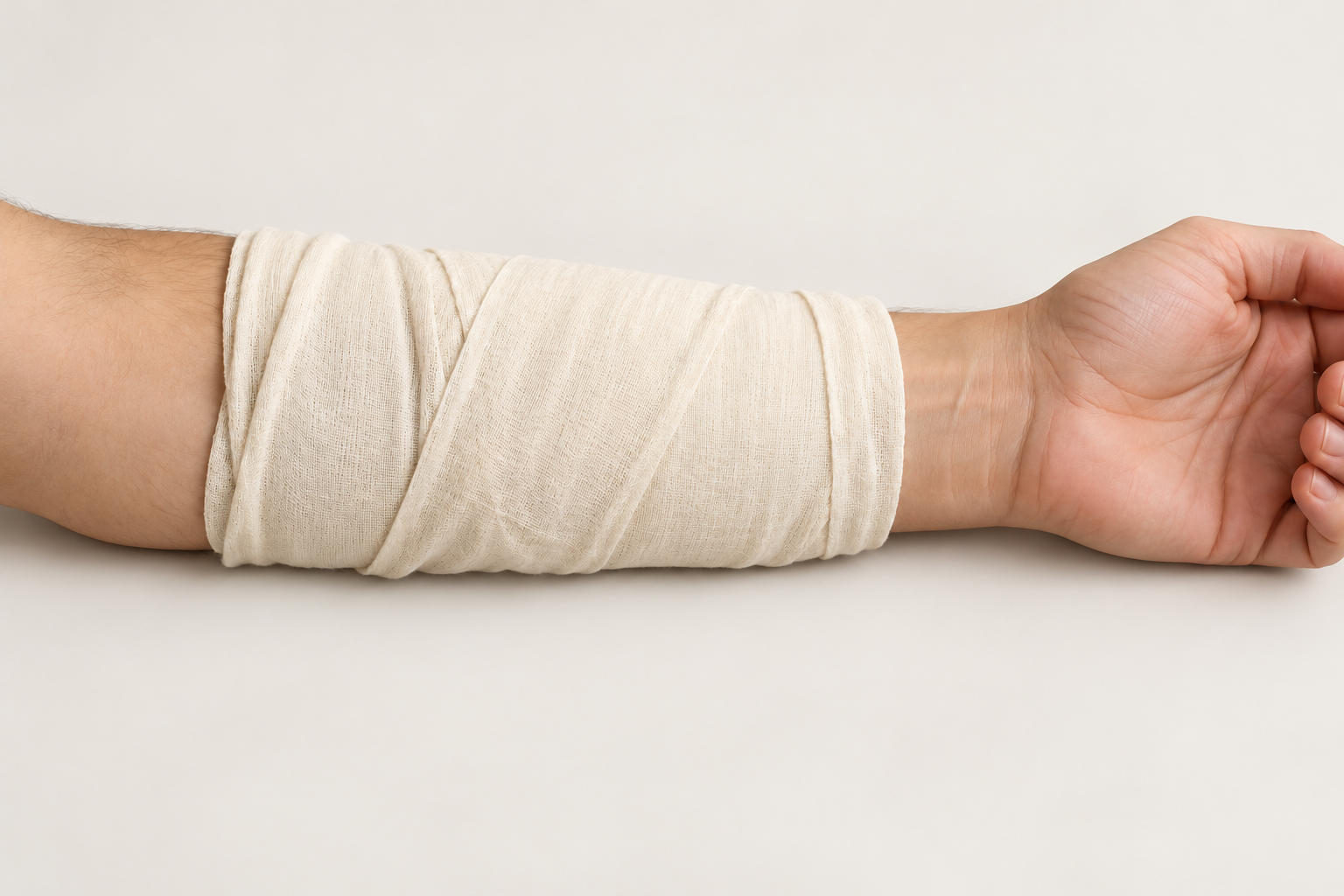
Cover: AI-generated reconstructed illustration of the protective-dressing principle using calico; not a documentary photograph or clinical observation.
This article was written and translated by an AI system from the cited sources, with automated checks under the News editorial method. No human review, independent clinical replication or peer review of this article is claimed. The historical limits and missing records remain explicit.