Magnesium metal could store charge in rechargeable batteries, but repeatedly adding and removing metal from its surface is difficult. Uneven growth and reactions with the electrolyte can waste charge or obstruct transport. In a peer-reviewed study published on 4 September 2026, Guodong Zou and colleagues investigate a way to improve this interface by mechanically changing the metal’s crystal structure.
Their contribution connects controlled deformation, microscopy, electrochemical comparisons and modelling. It provides a laboratory route worth investigating, with specific cell conditions and remaining engineering questions.
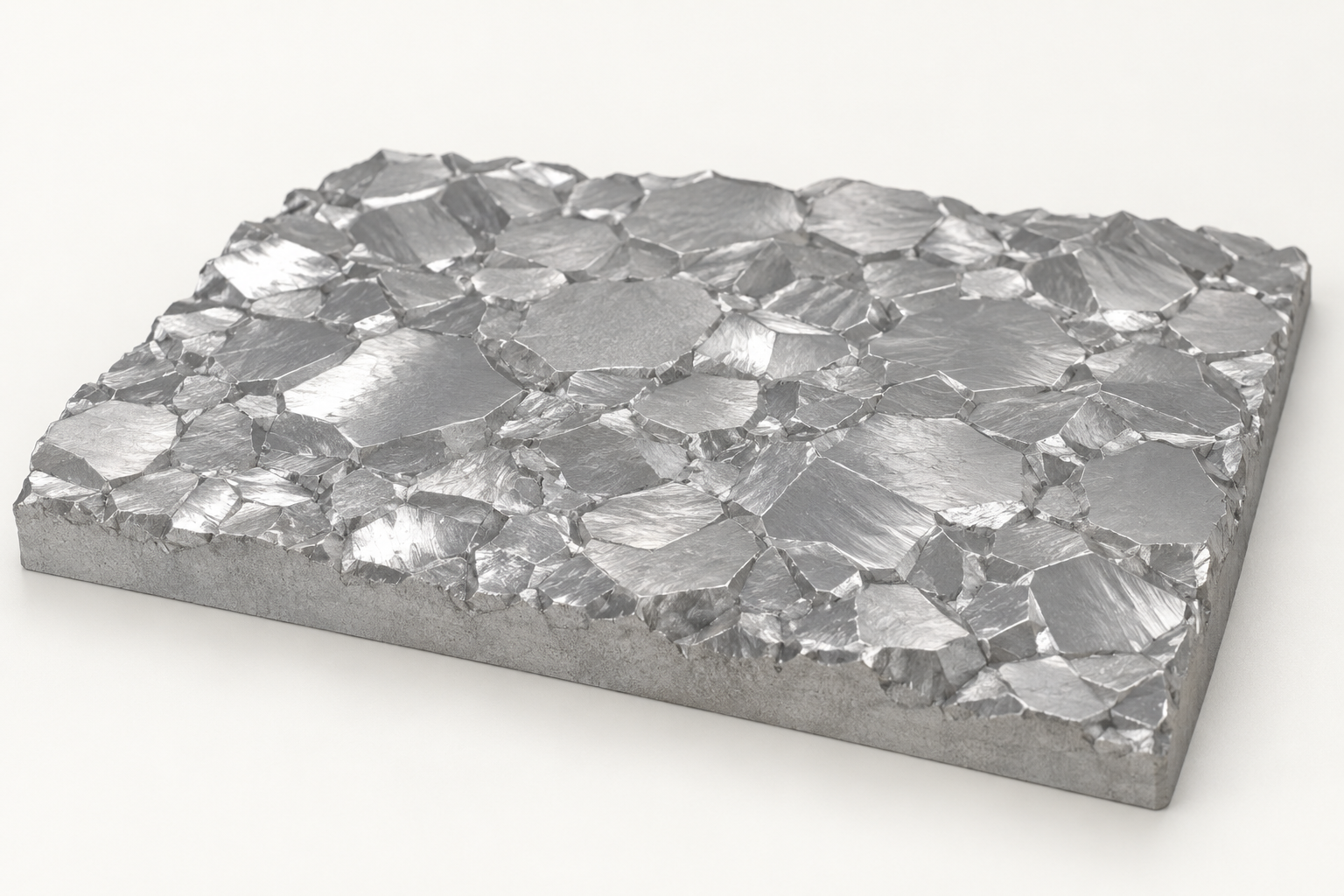
Cover: AI-generated conceptual illustration of a compact silver-grey magnesium deposit. Microscopic internal crystal twins are not represented. This image is not a micrograph, simulation or experimental observation.
Why the surface matters
During plating, dissolved magnesium ions gain electrons and become solid metal. Stripping reverses the process. A rechargeable electrode must repeat both steps while keeping the deposit connected and accessible. If material grows into isolated protrusions, or an obstructive surface layer forms, the next reversal becomes harder.
A useful analogy is resurfacing a road repeatedly: where new material settles affects whether the next layer remains even. The analogy explains the importance of growth patterns; it supplies no evidence about the underlying electrochemistry.
The researchers introduce crystal twins: neighbouring regions whose atomic arrangements have a mirror relationship across an interface. These internal boundaries are microscopic structural features. Orientation maps colour them to reveal their geometry; those colours do not represent the metal’s appearance.
Three compression cycles produced the strongest tested condition
The team compressed magnesium along three perpendicular axes. Electron backscatter diffraction, which measures local crystal orientation, found twin boundaries occupying approximately 50%, 70% and 40% of the measured interface length after one, three and five cycles, respectively.
The label “70-twinned Mg” therefore refers to boundary length in the analysed maps. It does not mean 70% of the electrode’s atoms or volume. Grain size changed little, helping distinguish the twinning effect from grain refinement. Five cycles caused detwinning as the dominant deformation mechanism changed: extra compression did not keep increasing the desired structure.
Electron microscopy and diffraction confirmed the mirror relationship. The investigators compared uncompressed magnesium and the three compressed conditions, then examined the 70% condition in detail. Plating on this surface produced compact, laterally growing hexagonal domains. Uncompressed magnesium developed less uniform deposits.
What the cells achieved
All values below are reported by the authors at 25 °C. They describe different experiments and cannot be combined into one battery specification.
| Experiment | Conditions | Reported result |
|---|---|---|
| Magnesium–copper asymmetric cell | 30 mA/cm²; 2 mAh/cm² per plating step | Mean coulombic efficiency 99.53% over more than 2,000 cycles |
| Two matching magnesium electrodes | 10 mA/cm²; 5 mAh/cm² | Stable operation for 800 hours |
| Magnesium–Mo6S8 complete cell | 10 C; 1 C defined as 128 mA/g of cathode active material | 71.8 mAh/g after 10,000 cycles; 84.7% capacity retention |
| Deposited layer imaged by X-ray tomography | 10 mA/cm²; 10 mAh/cm² | Approximately 0.78% porosity for twinned Mg versus 17.9% for uncompressed Mg |
Coulombic efficiency compares recovered charge with charge used for plating:
CE=100QplatedQstripped.
Here both charges use the same units, such as milliampere-hours. Recovering 99.53 units from 100 illustrates the reported mean. This charge ratio alone does not measure energy efficiency, which also depends on voltage.
Current density, in mA/cm², expresses current relative to electrode area; areal capacity, in mAh/cm², expresses charge per area. Their ratio gives a nominal plating duration: 2 mAh/cm² divided by 30 mA/cm² is four minutes. This calculation describes that electrode test, without establishing a consumer battery’s charging time.
A supported mechanism with modelling limits
Density functional theory, or DFT, estimates electronic energies for specified atomic structures. The calculated magnesium migration barriers were 0.43 eV across a twin boundary and 0.56 eV along it, compared with 0.75–0.85 eV for the selected non-twinned crystal surfaces. An electron-volt is an energy unit used at atomic scales.
The authors interpret these results as easier redistribution of deposited material. They also analyse the competition between reaction and transport through a dimensionless Damköhler number: the ratio of an electrochemical reaction rate to a surface diffusion rate. Faster redistribution can favour flatter growth in this model.
Surface spectroscopy and impedance measurements support reduced accumulation of obstructive interfacial products. Their agreement with the calculations strengthens the interpretation, while leaving the causal contribution of each coupled process open to further testing.
An early nucleation model fitted to current transients describes how deposits initially appear. The paper expressly limits that model’s ability to predict their eventual long-term shape. Finite-element simulations support the proposed growth picture; they remain simulations.
Methods and reproducibility
The consulted primary Methods section specifies 99.9 wt.% magnesium homogenised at 450 °C for 24 hours, water-quenched, then extruded at 360 °C with an extrusion ratio of 36 and speed of 1 mm/s. Compression used 15 mm cubes, a strain rate of 0.001 s⁻¹, and alternating 3% and 6.5% strains. Test electrodes were polished discs 10 mm across and 0.7 mm thick. Reproduction requires qualified metallurgy and electrochemistry laboratories with controlled atmospheres, thermal processing and materials characterisation.
CR2032 coin cells were assembled in argon with oxygen and water below 0.1 ppm. The APC electrolyte contained 0.4 M phenylmagnesium chloride and 0.25 M aluminium chloride in tetrahydrofuran. Kinetic measurements used magnesium counter and quasi-reference electrodes in a three-electrode configuration with 200 µL electrolyte.
For complete cells, the Mo6S8 cathode, conductive carbon and polymer binder had an 8:1:1 mass ratio on nickel foil. Active material loading was 1.5 mg/cm², with cycling between 0.2 and 2.0 V. These parameters matter when judging transport, usable capacity and practical scaling.
The microstructure statistics report three samples for twin fraction and 20 for grain size, with mean and standard deviation. The main text does not specify independent cell counts for every long-duration cycling curve. Consequently, those curves do not establish a distribution of device lifetimes.
The DFT protocol declares VASP with PAW/PBE, a 400 eV cutoff, D3(BJ) dispersion correction, 15 Å vacuum and 0.04 Å⁻¹ sampling spacing. Electronic and force convergence criteria were 0.00001 eV and 0.03 eV/Å; migration paths used climbing-image nudged elastic bands. Transport modelling used COMSOL 6.1, Nernst–Planck transport and Butler–Volmer reaction kinetics. Complete software versions, meshes and execution inputs require further checking. VASP and COMSOL require appropriate licences or institutional access. Laboratory cost and total preparation time are not quantified in the consulted Methods.
What remains to be established
The result motivates work with thinner magnesium inventories, higher cathode loading, restricted electrolyte quantities and manufacturing-scale control of twins. This study does not provide a qualified comparison of practical pack energy density, manufacturing cost or operation across a broad temperature range. Zinc experiments are a preliminary extension; their full mechanism remains future work.
The article links DFT data and Source Data, and declares additional data available on reasonable request. An institutional supplementary archive lists PDFs, spreadsheets and calculation files. Its contents were not examined for this article. Claims requiring those detailed inputs remain author-reported; a full computational reanalysis still needs them.
This article was written and translated by an AI system from the cited sources, with automated checks under the News editorial method. No human review, peer review of this article or independent experimental reproduction is claimed. The primary Results and Methods were consulted through the institutional paper and publisher HTML. No third-party code, simulation or laboratory experiment was executed here, and no independent replication was identified in this limited search.
Update (2026-10-11): The method section markup and navigation anchor were corrected. The reported scientific results and their limitations are unchanged.