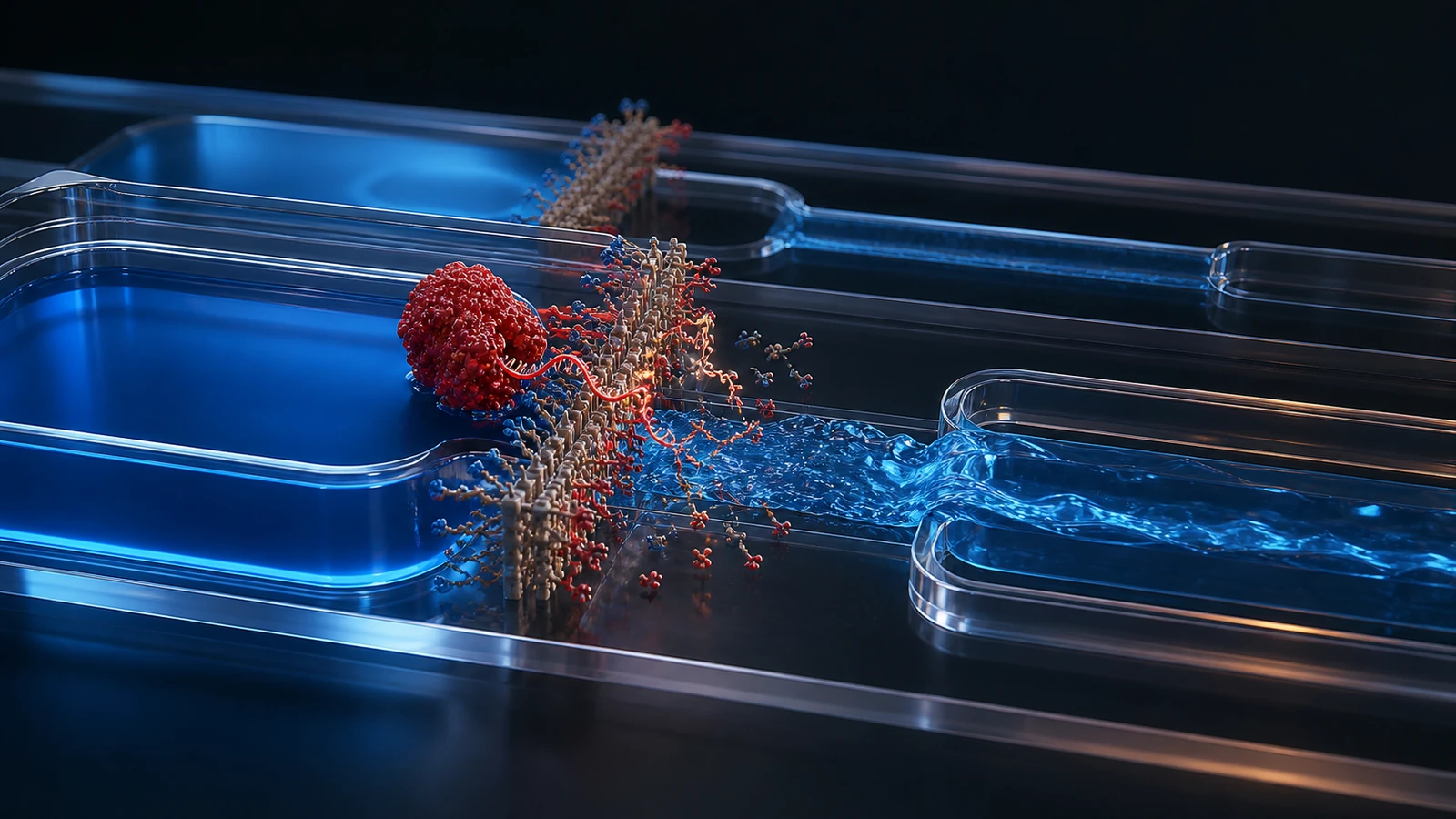
An invisible molecular reaction can now make a liquid barrier give way before the naked eye. A chip coupling CRISPR-Cas13a to a wettability threshold detects laboratory-prepared N RNA at 10 aM in 2 min, or two viral fragments at 100 aM in 5 min, with no readout instrument or action after loading.
Source: nature.com
In plain language
The device works like a dam set just below its breaking point. Without target RNA, a hydrophobic strip holds back the droplet; if Cas13a recognizes the target, it cuts molecules in the barrier, which becomes wettable and lets the liquid flow into a visible channel. The result is therefore read as a yes/no answer without an optical reader. But the 2 or 5 min refer to the on-chip readout: the nasal-swab protocol notably adds 10 min of lysis at room temperature and an RNase inhibitor.
| Parameter | Value |
|---|---|
| Primary source | Nature Communications, peer-reviewed and citable Article in Press, accepted on 11 August 2026 and published online on 22 August 2026; final edited version forthcoming; DOI 10.1038/s41467-026-77042-w |
| Principle | Target RNA activates Cas13a, which cuts a tri-block probe and switches the barrier from hydrophobic to hydrophilic |
| Single-plex chip | 600 µL loaded; dam 90 µm wide and 0.27 mm high |
| Single-plex sensitivity | Laboratory-prepared N RNA: reported limit of 10 aM; visual decision in 2 min; blanks observed for 10 min |
| Duplex chip | 1 mL loaded; two specific dams, replenishment reservoir with a 2:3 radius ratio |
| Duplex sensitivity | 100 aM for IAV-PB2 and IBV-PB1 fragments; decision in 5 min |
| Clinical samples | SARS-CoV-2: 19 positive and 21 negative samples classified by RT-PCR; the article reports complete agreement, but also assigns the RT-PCR kit 95 % sensitivity and 97.5 % accuracy without resolving this ambiguity in the main text |
| Pretreatment | Nasal swab in 3 mL of buffer, lysis for 10 min at room temperature, then 2 µL of RNase inhibitor per 100 µL of lysate |
| Reported cost | USD 0.20 per single-plex test and USD 0.30 per duplex test; authors’ estimate, not independently audited |
| Evidence level | Authors’ experimental workflow without independent external validation; no randomization, blinding, or predetermined sample size |
Technical explanation
A Cas13a-sensitive molecular barrier. The tri-block probe carries a 5′ amine and is immobilized on APTES-aminated glass through glutaraldehyde crosslinking. Two PEG6 chains then form the proximal hydrophilic motif. In the center, six uridines form an RNA segment that Cas13a can cut; at the other end, a C12H25 chain makes the surface hydrophobic. A complementary target activates the Cas13a-crRNA complex. Its collateral activity then cuts many 6U probes: the hydrophobic tail detaches, the interfacial energy changes, and water can wet the dam.
The mechanical threshold amplifies the molecular signal. Detection does not depend on the enzyme alone. The 600 µL droplet sits in a hydrophilic reservoir bordered by a superhydrophobic outer region that prevents lateral collapse, and it is held at the brink of flow by a composite dam combining a glass ridge and a molecular layer. At 600 µL, three independent chips retain the liquid; at 700 µL, it spills over spontaneously. A width of 90 to 100 µm is the useful window: if narrower, the barrier leaks without a target; if wider, Cas13a does not make it wettable within the 10 min window. The chip therefore converts a small local loss of hydrophobicity into a nonlinear macroscopic transition.
Why 10 aM becomes visible. Cas13a chemically amplifies the recognition event because one activated complex cuts multiple reporter RNAs. The dam adds a second amplification, this time fluidic: the system does not need to measure every cut proportionally, only to cross a threshold. With SARS-CoV-2 N-gene RNA prepared and transcribed in the laboratory, all positive concentrations tested from 10 aM triggered drainage in less than 2 min across three independent experiments, while blanks remained confined for 10 min. This analytical limit is not a clinical limit of detection for a swab. The output is qualitative; it does not quantify viral load.
Neutralizing RNases in the sample. An RNase present in a specimen would also cut the 6U segment and create a false positive. The authors therefore compared matrices and treatments. For the nasal swabs tested, 10 min of lysis at room temperature followed by an RNase inhibitor is sufficient without heating and remains compatible with Cas13a activity. This detail prevents the readout time from being mistaken for the full sample-to-result interval.
Making two dams independent. In a shared solution, any activated Cas13a could cut both dams. Each crRNA is therefore anchored to its own dam with a 6U linker. Kinetic measurements on glass, repeated three times, show more efficient cleavage with this linker than with an anchored crRNA lacking a spacer. The authors attribute this increase to Cas13a cutting the linker and then releasing the complex, which would reach more neighboring probes; the kinetics are consistent with this model without directly visualizing the release. The architecture creates spatial selectivity rather than relying on two different enzymes.
Resetting the threshold after the first break. If a first channel empties the reservoir, the second dam is no longer close to its threshold and can produce a false negative. A small lateral reservoir then supplies liquid through a surface-energy difference. With a 2:3 radius ratio between the replenishment and main reservoirs, transfer is fast enough and retains enough volume to enable the second break. IAV-PB2 and IBV-PB1 fragments, alone or mixed, are distinguished at 100 aM within the 5 min window.
What the ex vivo evaluation means. For SARS-CoV-2, the article classifies 19 residual specimens as positive and 21 as negative by RT-PCR and reports that the chip distinguishes all of them, including positive samples up to a Ct of 35. Yet the same passage then assigns the RT-PCR kit 95 % sensitivity, 100 % specificity, and 97.5 % accuracy, even though the chip’s confusion matrix uses RT-PCR results as its reference. The main text does not explain what other ground truth would make both descriptions simultaneously compatible; this ambiguity prevents the evidence from being summarized as simple agreement. The duplex chip was also tested against IAV- and IBV-positive specimens and pools. Sample size depended on availability, no size was predetermined, experiments were neither randomized nor blinded, and several repeats were technical. This evaluation therefore does not establish generalizable clinical sensitivity with a narrow uncertainty margin.
Why it worked
The new capability is not a raw record in sensitivity, speed, or cost. On prepared fragments, the tube-based sensor published by the same team in 2025 reported 0.25 aM in Ho→Hi mode and 1 aM in Hi→Ho mode, a 1 min readout excluding pretreatment, and a stated laboratory cost of USD 0.10. For clinical lysates, its protocol notably added 5 min of heating. It also required manual inversion whose angle and speed affected triggering. The current chip replaces this gesture with a fixed boundary: after loading, near-threshold geometry converts partial cleavage into a binary decision with no further action. It also organizes two distinct outputs within one system, which the tube did not demonstrate.
The authors’ comparison places the standalone Cas13a reaction at 10 pM in 40 min and a commercial RT-PCR kit at 100 aM in 35 min, versus 10 aM in 2 min on the single-plex chip. These values are not strictly equivalent to a complete clinical workflow: specimen preparation, reagent mixing, and chip fabrication remain outside the readout.
The limitations rule out calling this a deployment-ready test. The demonstration is qualitative and only duplex; it includes no prospective multicenter study, blinding, stability beyond 2 h, mass manufacturing, or reagent shelf-life assessment. The study was funded by the National Natural Science Foundation of China (22234001) and the National Key Research and Development Program of China (2023YFC2413001). Four authors are inventors on a patent application related to the technology, filed by their university and licensed to Geneis (Beijing) Co., Ltd.
Causal chain
Complementary viral RNA → local activation of the crRNA-Cas13a complex → collateral cleavage of the 6U segment in tri-block probes → detachment of hydrophobic C12H25 tails → reduction of the wetting barrier → 600 µL droplet already placed near the threshold → visible dam break in less than 2 min → for two targets, crRNAs anchored with a 6U linker, whose self-release is the proposed mechanism, + replenishment reservoir → threshold maintained after the first drainage → two channels distinguished in less than 5 min → initial analytical evaluation on residual clinical samples, with an internal ambiguity in RT-PCR metrics → next steps: blinded multicenter study, industrialization, and reagent stability.
Anecdote
The same team had published a tube-based sensor in 2025 that reported, on prepared fragments, 0.25 aM or 1 aM depending on the mode, a 1 min readout excluding pretreatment, and a stated laboratory cost of USD 0.10. The lysate protocol notably added 5 min of heating, and the tube had to be inverted to observe whether the droplet fell or remained retained. The current chip does not improve on these numbers: it replaces the angle and speed of the human gesture with a fixed boundary and adds an organized duplex. DOI of the prior work: 10.1126/sciadv.adu2271.
Legacy and current data
The article provides source data for the figures and the sequences of the crRNAs, tri-block probes, and targets. It also reports a focused robustness test between 0 and 2 h after collection on 60 samples, with positive samples simulated by adding known RNA to negative swabs. The authors correctly present it as a short-term check rather than a complete preanalytical stability study.
What remains to be established matters more than any market figure: shelf life of chips and proteins, tolerance to transport temperatures, manufacturing lots, readout by untrained users, and prospective performance at real-world prevalence. None of these points is measured here.
The researcher’s view — open questions
These proposals are decisive experiments, not findings from the study.
- Independent clinical validation. A prospective multicenter cohort, randomized in reading order and assessed blind, with predetermined confidence intervals, would test real sensitivity at low viral loads.
- Broader specificity control. Panels of respiratory viruses, variants, and RNase-rich matrices should measure false positives, cross-reactions, and pretreatment failures rather than only selected cases.
- Multiplexing. Adding a third dam is a falsifiable test of the architecture: each break must preserve the threshold of subsequent dams without cross-talk or visual ambiguity.
- Complete product. Lysis, RNase inhibition, Cas13a mixing, and loading should be integrated and timed as one workflow; the relevant interval is sample to result, not merely dam-break time.
Sources
Reference verified during the fact-checking audit of 24 August 2026.
- Kai Liu et al., “A CRISPR-based ‘dam-break drainage’ sensing architecture for rapid, affordable and ultrasensitive pathogen detection,” Nature Communications, accepted on 11 August 2026 and published online on 22 August 2026 — peer-reviewed and citable Article in Press, before the final edited version. Funding: National Natural Science Foundation of China (22234001) and National Key Research and Development Program of China (2023YFC2413001). Four authors disclose the patent application and its license to Geneis. DOI: 10.1038/s41467-026-77042-w
Background references
- Yang Sun et al., “A tube-based biosensor for DNA and RNA detection,” Science Advances 11, eadu2271 (2025) — earlier manually inverted proof of concept cited by the study. DOI: 10.1126/sciadv.adu2271
Confidence statement
Confidence is high in the reported architecture, analytical limits, and readout times reproduced from the peer-reviewed article. Confidence is moderate in performance on residual specimens: the article reports complete agreement with RT-PCR classifications but also reports, without sufficient explanation in the main text, 95 % sensitivity and 97.5 % accuracy for the RT-PCR kit. Sample size was not predetermined, experiments were not randomized, investigators were not blinded, and no independent external validation is reported. The stated cost has not been audited as the total cost of the workflow. Uniqueness, DOI, dates, concentrations, times, links, funding, competing interests, and limitations were checked; no topic with the same key or central result appears in the Pulse registry.