Why cells that stop dividing can become a problem
Cellular senescence is a state in which cells stop dividing and change their behavior. It can help coordinate tissue repair, but persistent senescent cells can release signals that sustain inflammation or influence neighboring cells. Their fate depends on both the cells themselves and the immune cells around them.
This study asks how protein maintenance affects that relationship. A cell constantly replaces proteins: some are damaged, while others must be removed as its state changes. Chaperone-mediated autophagy, abbreviated CMA, directs selected soluble proteins to lysosomes, compartments where proteins are broken down. A protein-folding assistant, heat shock cognate protein (HSC70), recognizes a short molecular motif and delivers the protein to the lysosomal receptor lysosome-associated membrane protein 2A (LAMP2A). The protein must then unfold and cross the membrane before degradation.
That description concerns individual proteins. It does not mean a lysosome swallows an entire senescent cell. Removing cellular material from a tissue involves macrophages and other immune cells. The new work connects these two levels of clearance. Study: Main and Discussion
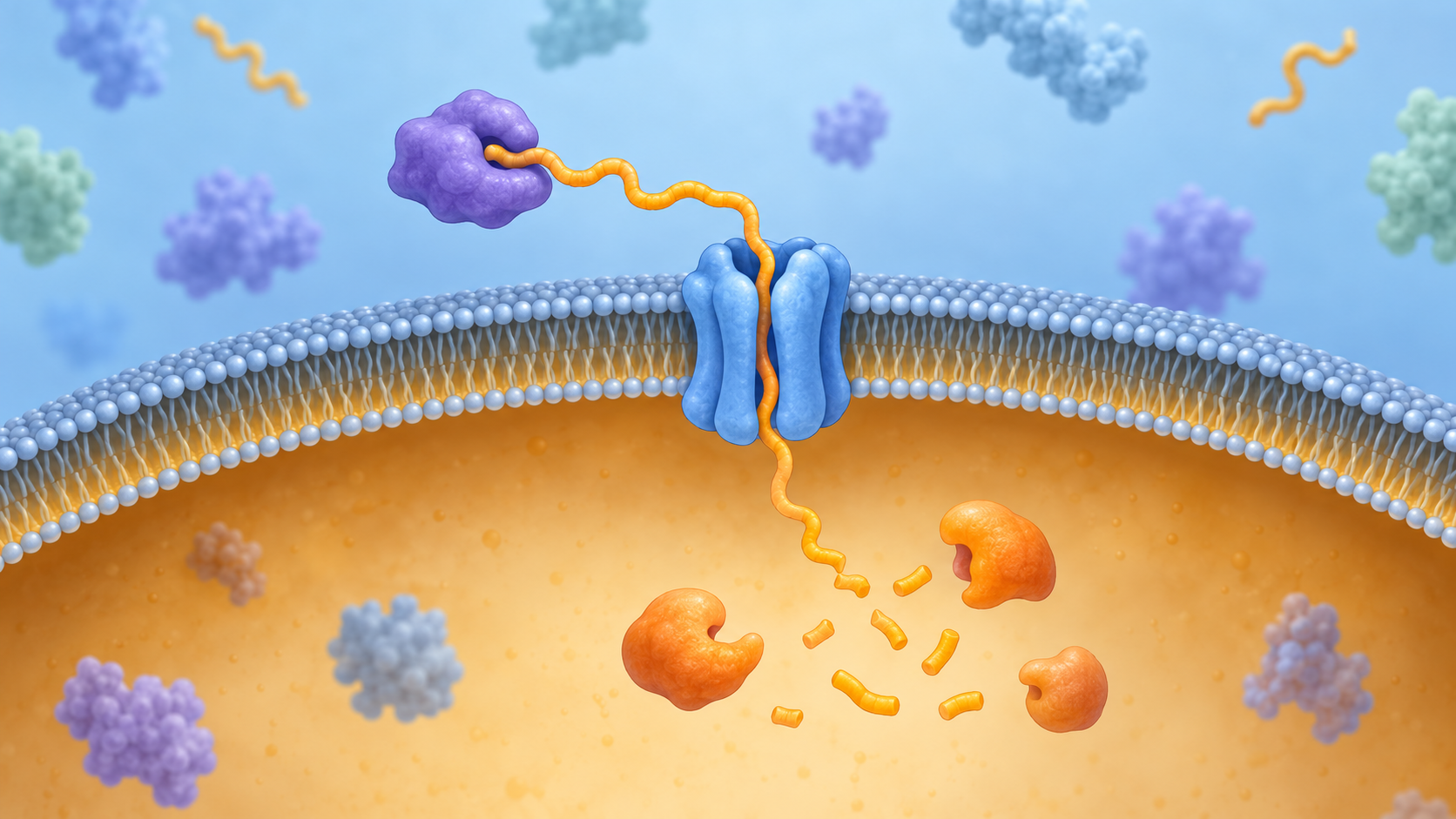
AI-generated qualitative illustration of CMA: a soluble chaperone (purple) delivers a substrate (orange) to a membrane complex (blue); the chain enters the lysosomal lumen and is broken down. Shapes, colors, scales and subunit counts are illustrative. This is neither an atomic structure nor experimental evidence.
Two sides of an impaired clearance system
The researchers compared fibroblasts, cells involved in connective tissue, from young and aged mice. They also reduced LAMP2A in cultured cells or genetically deleted it in mouse models. This allowed them to distinguish changes associated with age from consequences of a defined disruption to CMA.
CMA-deficient fibroblasts developed several features associated with senescence, but continued to proliferate under baseline conditions. The distinction matters: disabling CMA alone did not establish the complete senescence phenotype used in this study. When senescence was induced, deficient cells responded differently from controls, including changes in their proteins, metabolites and secreted material.
To test whether those secretions mattered, the team transferred conditioned culture medium between cells. Medium from CMA-deficient cells changed senescence-associated measurements in neighboring fibroblasts. It also reduced macrophage function; secretions from deficient cells induced into senescence could be particularly harmful to macrophage survival. These experiments support a mechanism involving communication between cells, rather than an explanation based solely on changes inside one cell. Study: Figures 1–4
Macrophages also needed their own CMA machinery. Macrophages lacking LAMP2A engulfed fewer coated beads and were less effective at taking up experimentally induced apoptotic cell material. The second process is efferocytosis, the clearance of cells undergoing programmed death. It is related to immune clearance of senescent cells, but the assays are not interchangeable: bead uptake does not by itself demonstrate removal of living senescent cells from an organ.
One mechanistic lead involves signal regulatory protein α (SIRPα), a receptor that helps macrophages interpret signals that inhibit engulfment. CMA-deficient macrophages accumulated more SIRPα and its associated signaling enzyme, the phosphatase SHP-1. Experiments inhibiting endocytosis supported impaired receptor internalization as part of the explanation. The authors therefore propose that reduced CMA leaves an inhibitory signal active for longer. Other effects of the secretome remain relevant: activating CMA only partially rescued macrophage phagocytosis when the cells were exposed to the deficient secretome. Figure 4 and its source data
What changed in mice
In mice carrying a myeloid-cell LAMP2A deletion, several tissues showed increased senescence-associated measurements during aging. Effects differed by tissue, sex and marker. A wound-healing experiment also found delayed closure in the deletion group. The genetic system uses LysM-Cre, which can affect monocytes and granulocytes as well as macrophages; experiments with isolated macrophages strengthen the macrophage interpretation, but do not remove that in-vivo limitation.
The pharmacological experiments used CA77.1, an existing experimental CMA activator. In the aging experiment, treatment started at 18 months and continued for five months. The Methods specify 30 milligrams per kilogram of body weight, five days per week. The comparison included aged vehicle-treated animals and young animals assessed at six months.
The authors report improvements across several senescence and tissue measurements. These should not be read as a uniform reversal of aging. The source workbook includes direct aged-vehicle versus aged-treated comparisons that are not statistically significant. Moreover, a treated group being statistically indistinguishable from young controls does not establish equivalence to young animals. The paper did not measure lifespan extension. Figure 6, Methods and source workbook
A separate experiment tested chemically induced lung injury in male mice. CA77.1 began either two or seven days after bleomycin administration. Early treatment produced a clearer reduction in the trichrome fibrosis measurement than later treatment. The source workbook reports a significant early-treatment versus vehicle contrast, while the corresponding late-treatment contrast is not significant. This is evidence about timing in a particular injury model, not a demonstration that established human idiopathic pulmonary fibrosis (IPF) can be reversed. Figure 7 and source data
What the human findings establish
The human analyses add relevance without providing a clinical intervention. A transcriptional score based on CMA-related genes declined with age in particular lung cell types, with different patterns in males and females. Lung tissue from people with idiopathic pulmonary fibrosis also showed lower CMA-related measurements. Experiments on isolated human lung lysosomes found reduced substrate uptake and changes in LAMP2 protein abundance.
The lysosome experiments used four healthy and four IPF tissue donors; the expression analyses used separate datasets. These measurements do not show that CMA decline caused the disease, or that increasing CMA would safely improve patient outcomes. A gene-expression score is a predictive surrogate for pathway activity. The authors explicitly identify the human findings as correlative and call for validation in patients. Human tissue Methods and study limitations
Methods and reproducibility
The technical question is whether CMA affects the state of senescent cells and the capacity of immune cells to clear cellular material. The comparisons combine young versus aged primary cells, LAMP2A-deficient versus control cells, transferred secretomes, and experimental activation versus vehicle. Most cultured-cell senescence experiments used palbociclib; selected checks used other inducers, including etoposide.
The reporter KFERQ-Dendra measures delivery to lysosomes. Reporter expression checks and experiments with lysosomal proteolysis inhibitors address the important alternative explanation that puncta counts merely reflect reporter abundance or faster degradation. Macrophage experiments include bead uptake, apoptotic-cell uptake, viability, receptor turnover, and controls for other uptake or autophagy processes. These complementary measurements strengthen interpretation; none is a universal test of senescence. Methods and supplementary information
The authors report treatment randomization, littermate controls for genotype comparisons, blinded image and functional analysis, and power-based animal sample planning. Normality was assumed rather than formally tested. Group sizes vary by experiment. Cells or image fields sampled within the same animal are not additional independent animals; a robustness analysis should preserve that sampling hierarchy.
| Resource or control | Status in this editorial assessment |
|---|---|
| Main Results, Discussion, Methods and limitations | Read and checked against the claims above; experiments themselves were not observed. |
| Supplementary notes, reagent tables and reviewer exchanges | Read; the exchanges document added controls and a partial rescue. |
| Source workbooks for Figures 4, 6 and 7 | Relevant tables read; inconsistencies remain unresolved. |
| PRIDE proteomics accession PXD071137 | Deposition declared by authors; archive files were not inspected. |
| Public CMA-score repository | README, license and current commit checked; exact correspondence to the new human-lung analyses is unverified. |
| Independent replication or experimental reproduction | Not performed in this assessment. |
The deposited workbooks allow a focused numerical reanalysis. Begin by reconciling group labels and biological units, then compare treatment directly with its matched vehicle control and preserve the specified correction for multiple comparisons. Report effect sizes and uncertainty alongside P values. A nonsignificant contrast is not evidence of equivalence, and an image field should not be silently counted as an independent mouse.
Several source details require clarification before a complete reproduction. Figure 6 workbook sex labels conflict with the published panel labels. Some sample counts and a phagocytosis P value also differ. The liver single-cell analysis gives four mice per group in the main legend but two per condition in the supplementary legend, whose workbook has two columns per condition. Some printed culture concentrations and the age/time labels in the lung-injury protocol need reconciliation. These are unresolved reporting issues; they do not establish that the underlying experiments were performed incorrectly.
The cited code repository concerns an earlier aging atlas. Its observed commit was 87e245e36304ec0805cddc8f74ef3fa95ffbad25, dated 10 March 2025, under a BSD 3-Clause license. No third-party code was downloaded or executed here. A complete computational reproduction would need the matching inputs, scripts, dependency versions and analysis settings for the 2026 results. New animal or human-tissue experiments would require qualified laboratories, equipment, material access and ethics approvals. Their cost is not established by this assessment; the five-month treatment duration is an experimental condition, not an estimate of total project time.
Why this result matters
The contribution is a mechanistic link between selective protein turnover, cell-to-cell signaling and immune clearance. It helps explain how two processes associated with aging might reinforce one another, while providing experimentally testable points at which that cycle could be interrupted.
The next scientific challenge is to establish which effects persist across cell types, sexes, disease stages and independent laboratories, and whether intervention can be safe and useful in humans. The study advances that question through mouse experiments and human tissue measurements. It does not settle it. The authors disclose patent interests involving CA77.1 and related commercial relationships, which readers can review in the competing-interests statement.
Editorial method and limits
This article was drafted and translated by an AI system from the primary publication, its supplementary materials and selected source-data tables. The assessment distinguishes source inspection from experimental reproduction and retains unresolved reporting discrepancies. It has not received an independent human scientific review or reader trial.