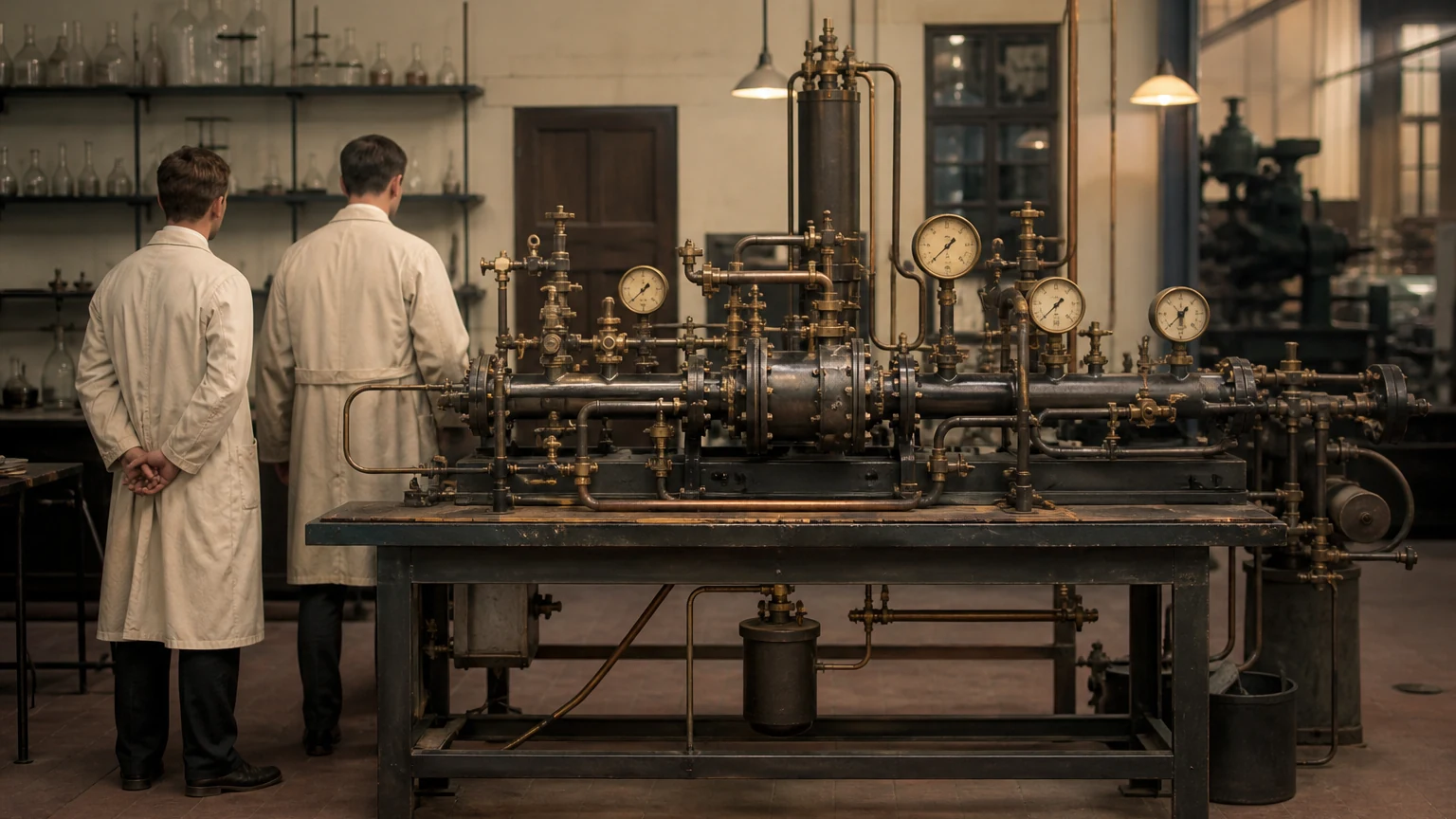
Ammonia synthesis is often reduced to one equation and two names. That account is too short to explain the technical leap. The reaction between nitrogen and hydrogen was known to be chemically possible; the decisive problem was turning it into a continuous, stable, repairable process. The 1908 milestone lies in the machine’s architecture: compress the gases, react them over a catalyst, recover heat, remove the ammonia that forms, and return unconverted gases to the loop. Fritz Haber and Robert Le Rossignol established this logic in the laboratory. Carl Bosch, Alwin Mittasch, and the BASF teams then had to invent the materials, catalyst, and industrial operation able to survive those conditions.
In plain terms
A single pass through the reactor converts only part of the mixture. Discarding the remainder would waste pressure, energy, and feedstock. The loop changes the economics of the system: ammonia is separated when the stream cools, while unreacted nitrogen and hydrogen return to the catalyst. Circulation accumulates useful production without demanding perfect conversion on every pass. The process is therefore less a spectacular reaction than a carefully maintained compromise among thermodynamics, kinetics, heat transfer, separation, and the mechanical endurance of metals.
Quantitative profile
The following profile gathers the quantitative markers used directly in the analysis of the process and its legacy.
| Marker | Value | What it establishes |
|---|---|---|
| Loop patent filing | 1908 | A continuous pressurized configuration is described |
| Oppau start-up | 1913 | The principle reaches industrial scale |
| Stoichiometric H2:N2 ratio | 3:1 | The feed follows the composition of NH3 |
| Reported experimental temperature | 500–600 °C | Useful reaction rate requires high temperature |
| Reported experimental pressure | 200 atmospheres | Pressure shifts equilibrium toward NH3 |
| Share of global final energy | 2 % | Ammonia remains energy intensive |
| Share of energy-system CO2 emissions | 1.3 % | The climate legacy is measurable |
| Share used for fertilizers | 70 % | Agricultural use still dominates |
| IEA net-zero scenario horizon | 2050 | The production pathway must change |
Technical explanation
Prepare the mixture. Nitrogen and hydrogen must enter in a controlled ratio and be stripped of impurities that poison the catalyst. Industrial chemistry therefore begins before the reactor: purification, compression, and flow control determine how long the plant can operate. An unwanted trace species can reduce catalytic activity without producing an immediately visible failure.
Balance equilibrium and rate. Forming NH3 from the gases reduces the number of free molecules, so high pressure favors the product. Lower temperature also favors equilibrium, but it slows activation of nitrogen’s exceptionally stable bond. The plant needs a temperature high enough for a useful rate without moving so far that equilibrium cancels the benefit. The catalyst does not change the final equilibrium; it accelerates the approach to it.
Manage heat. The reaction releases heat. Without recovery, that energy is wasted; without control, it can shift the local reactor regime, damage the catalyst, or generate mechanical stress. The regenerator described in the patent preheats incoming gas with outgoing gas. This thermal integration reduces energy demand and stabilizes the loop.
Separate without depressurizing. Cooling allows ammonia to be condensed or absorbed. The remaining gases should retain as much pressure as possible so that the plant does not repay the full compression cost. Separation is therefore not a peripheral step: it enables selective recovery of the product and recycling of the reactants.
Recycle and purge. A circulation pump returns unconverted gases. A controlled purge is still necessary to prevent inert species from accumulating. The real loop must balance recovery against feed purity. Its performance belongs to the entire system: compressor, heat exchanger, reactor, separator, pump, instrumentation, and materials.
This architecture explains why a laboratory demonstration was not enough. At industrial scale, hydrogen can weaken steels, heat distributes unevenly, seals must remain tight, and the catalyst must be available in large quantities. Bosch and BASF converted a physicochemical diagram into a production system, while Mittasch and colleagues explored catalyst families compatible with industrial cost and supply.
Why It Worked
Success came from combining several modest gains, not from miraculous yield in one pass. At 200 atmospheres and within the 500–600 °C range reported by the ACS account, the system finds a compromise between rate and equilibrium. Recycling compensates for partial conversion; heat recovery limits thermal cost; separation removes NH3 from the mixture and lets the reaction begin again. The interval from a patent date in 1908 to the Oppau plant in 1913 nevertheless shows that proof of principle was not proof of industrialization. The main limit of any heroic narrative is attribution: the patent illuminates the loop, but it does not by itself establish the metallurgy, final catalyst, plant safety, or organization of work. Historical consensus supports a collective lineage. Global food effects are plausible and enormous, but a precise counterfactual — how many people would have lived without this process — remains uncertain because farming, distribution, diets, and policy changed together.
Causal Chain
Atmospheric nitrogen that is difficult to fix → purified and compressed feed → catalyst that accelerates activation → controlled exothermic reaction → ammonia separated during cooling → unconverted gases recycled → continuous production → large-scale nitrogen fertilizers → higher yields alongside energy dependence and disruption of the nitrogen cycle.
Anecdote
The ACS account preserves a useful dispute: Walther Nernst measured less favorable equilibrium data and considered the industrial conditions unrealistic. Haber persisted with Le Rossignol, increasing pressure and improving the apparatus. The episode is not simply a skeptic versus a visionary. It shows how measured constants, instrument limits, and experimental-system choices determine whether a pathway looks impossible or merely difficult. Engineering then had to answer the question the laboratory could not settle alone: how can the experiment be made to last?
Limits, evidence, and consensus
The evidence is not uniform. The patent is a primary source for the claimed configuration, not a complete photograph of every contribution. The American Chemical Society account corroborates the actors, experimental conditions, and transition to BASF, but remains a historical synthesis. The International Energy Agency documents the modern industry, not the laboratory details. Together these sources separate what is established — continuous looping, recycling, industrialization, and today’s energy footprint — from interpretation: the relative importance of each person and the exact size of the demographic counterfactual. No marketing announcement is needed to qualify the milestone; its materiality appears in the infrastructure and costs that persist.
Legacy and Current Data
Ammonia still connects atmospheric nitrogen to most mineral fertilizers. The IEA estimates that production represents about 2 % of final energy consumption and 1.3 % of energy-system CO2 emissions, while 70 % of ammonia goes to fertilizers. Those orders of magnitude create a double legacy. The process relaxed a major constraint on usable nitrogen, yet it also locked in a fossil-dependent chain when hydrogen comes from gas or coal. Current routes — electrolytic hydrogen, carbon capture, higher efficiency, and more precise fertilizer management — do not replace the loop’s logic; they seek to change the origin of energy and the externalities around it.
What the milestone closed and what it opened
The milestone closed the assumption that low conversion per pass necessarily condemns a reaction: a continuous system with separation and recycling can make locally unfavorable chemistry useful. It opened a general engineering method now visible across chemical plants. The important research questions are no longer limited to making NH3, but include doing so with less energy and carbon, in more flexible plants, and using it more precisely in agriculture. Researchers must also measure reactive-nitrogen leakage, nitrous oxide, and ecosystem effects. Progress is therefore neither blanket celebration nor blanket condemnation. It is preserving the food-production capability while reducing the costs that the older configuration displaced beyond the factory gate.
Sources
- Patent DE235421C — continuous pressurized loop
- American Chemical Society — from laboratory to BASF
- International Energy Agency — Ammonia Technology Roadmap
Background references
- Encyclopaedia Britannica — Haber-Bosch process
- Smil, Enriching the Earth, MIT Press, ISBN 9780262693134.