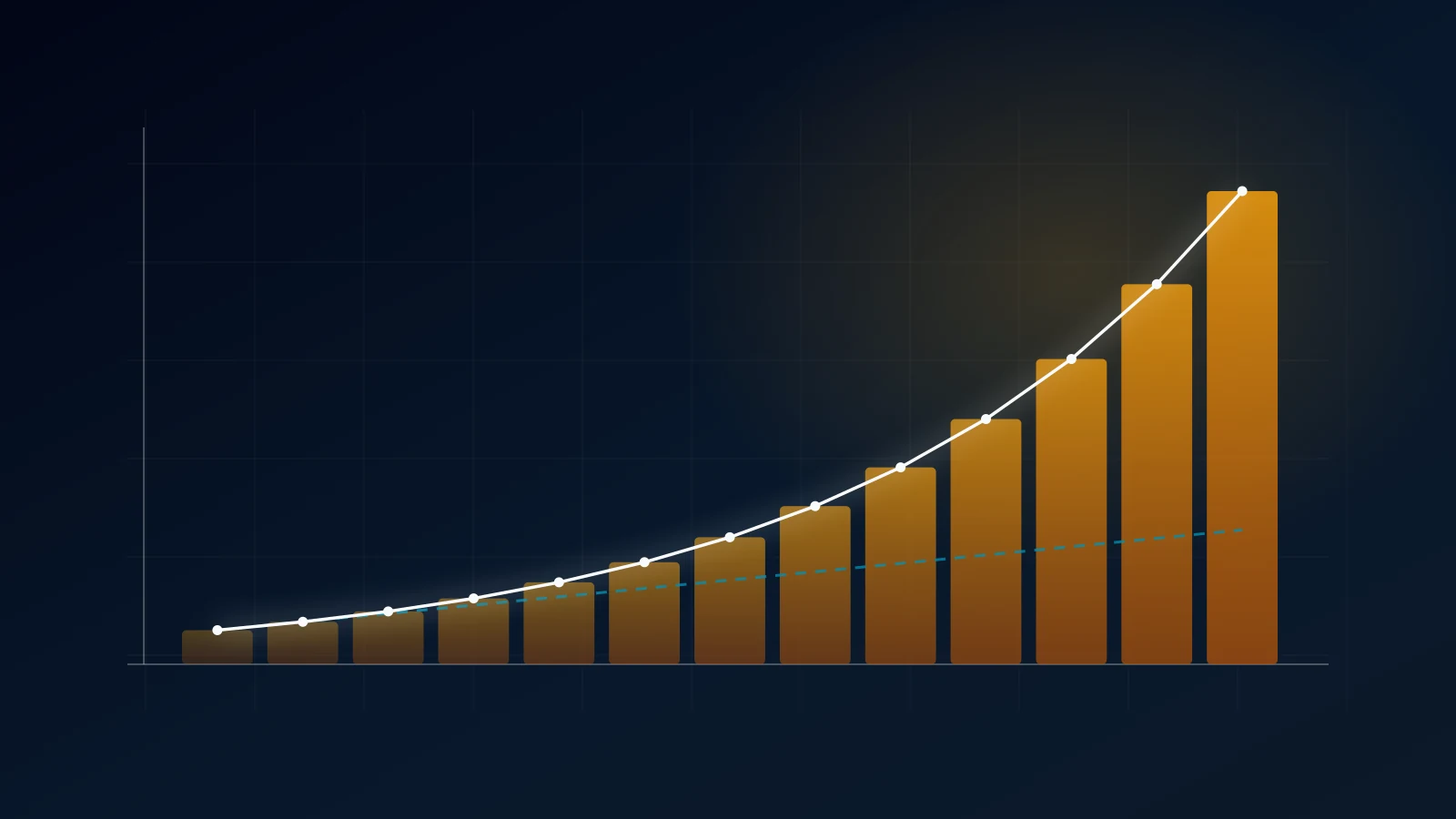
Compound interest
Definition
One hundred euros lent at 5 % a year earn 5 € in the first year. What remains is to decide the fate of those 5 €. If they are withdrawn, the principal lent stays at 100 € and the second year will again earn 5 €. If they are left in place, the principal becomes 105 € and the second year earns 5,25 € — because the first year's interest now earns interest too.
Compound interest is interest computed on a principal to which the interest of the preceding periods has been added. That addition has a name: compounding.
The mechanism is therefore contained entirely in a rule for handling accrued interest: pay it out to the beneficiary, or fold it into the principal. Nothing else distinguishes the two modes of calculation.
Simple interest and compound interest
Write C for the initial principal, i for the rate per period expressed as a fraction (5 % is written 0,05) and n for the number of periods.
Under simple interest, each period earns the same amount Ci, always computed on the initial principal:
Vn=C(1+ni)
Under compound interest, each period multiplies the accumulated sum by the same factor 1+i — the common ratio of the progression:
Vn=C(1+i)n
| Simple interest | Compound interest | |
|---|---|---|
| Basis of calculation | The initial principal, unchanging | The principal increased by the accrued interest |
| What stays constant | The amount earned per period | The multiplying factor per period |
| Progression | Arithmetic | Geometric |
| Over a single period | C(1+i) | C(1+i) — identical |
The two modes coincide over one period, since no interest has yet been able to be compounded. What separates them is duration, and the gap is no small matter. For 100 € at 5 % a year:
| Duration | Simple interest | Compound interest |
|---|---|---|
| 1 year | 105,00 € | 105,00 € |
| 10 years | 150,00 € | 162,89 € |
| 30 years | 250,00 € | 432,19 € |
| 50 years | 350,00 € | 1 146,74 € |
As soon as the rate is positive, the ratio between the two columns grows without bound with n: the numerator (1+i)n grows geometrically, with common ratio 1+i>1, while the denominator 1+ni grows only affinely. No duration therefore bounds the lead that compounding takes — it keeps widening for as long as the principal stays in place.
Why the progression is geometric
The value at the end of a period is always obtained in the same way from that of the preceding period:
Vk+1=Vk+iVk=Vk(1+i)
The interest produced in each period is proportional to the sum currently present, and that sum increases: the amount earned therefore grows along with it, whereas it stayed fixed under simple interest. Since the factor 1+i depends neither on k nor on Vk, applying the relation n times in succession gives Vn=C(1+i)n — a proof by induction, whose inductive step is this equality and whose base case is V0=C.
This property — an increase proportional to the quantity already present — is the characteristic property of exponential growth, provided the coefficient of proportionality stays the same in every period. In discrete time, period by period, it takes the form of a geometric progression.
The doubling time
How many periods does it take for the principal to double? It is enough to solve (1+i)n=2:
n=ln(1+i)ln2
This number does not depend on the principal: doubling 100 € or 100 million takes the same time, because the formula is multiplicative.
Since ln2≈0,693 and ln(1+i)≈i for small rates, one first obtains n≈69,3/(100i). Common practice raises this number to 72, which gives the approximation known as the rule of 72: the doubling time is about 72/(100i), that is, 72 divided by the rate expressed as a percentage. This substitution is a computational convenience, not an exact result: 72 is divisible by more integers than 69 or 70, the two integers that bracket 69,3. The upward adjustment also corrects the bias left by the approximation ln(1+i)≈i — it cancels it around 8 %, overshoots it for lower rates, and does not quite close it for higher ones.
| Rate per period | Exact doubling | Rule of 72 |
|---|---|---|
| 2 % | 35,00 periods | 36,00 |
| 5 % | 14,21 periods | 14,40 |
| 8 % | 9,01 periods | 9,00 |
| 12 % | 6,12 periods | 6,00 |
| 20 % | 3,80 periods | 3,60 |
The approximation is excellent around 8 % and degrades at both ends: it overstates the time for lower rates and understates it for higher ones. It is an instrument for mental arithmetic, not a substitute for the formula.
The compounding frequency
A quoted rate is not enough to determine a return: one has to know at what pace the interest is folded into the principal. By convention, an annual nominal rate i compounded m times a year applies, m times over, the periodic rate i/m — nothing in mathematics requires this, it is a market convention. At the end of a year, that is after m compounding periods, the principal is therefore worth:
C(1+mi)m
The annual effective rate is the increase actually obtained over the year, namely (1+i/m)m−1. For a nominal rate of 10 %:
| Compounding | Annual factor | Effective rate |
|---|---|---|
| Annual (m=1) | 1,100000 | 10,0000 % |
| Half-yearly (m=2) | 1,102500 | 10,2500 % |
| Quarterly (m=4) | 1,103813 | 10,3813 % |
| Monthly (m=12) | 1,104713 | 10,4713 % |
| Daily (m=365) | 1,105156 | 10,5156 % |
At a positive nominal rate, compounding more often therefore raises the effective rate. Two nominal rates are thus comparable only once brought to the same frequency — or converted into effective rates.
But the gain runs out: the sequence does not take off, it converges. Its limit as m grows without bound defines continuous compounding:
m→∞lim(1+mi)m=ei
where e≈2,71828 is the notable number obtained in the case i=1, namely limm→∞(1+1/m)m. Here e0,1≈1,105171, that is 10,5171 % effective. Between daily compounding and continuous compounding, less than two thousandths of a percentage point remains: past a certain pace, raising the frequency changes almost nothing.
This limit has a value of its own that the calculation at finite m does not give: ei no longer depends on m. It therefore supplies a single reference, independent of the compounding pace, and an expression CeiT — where T is the duration counted in years, that is n=mT compounding periods — which is easier to handle than C(1+i/m)mT.
The snowball image
Compounding is often described as a snowball: as it rolls it picks up snow, grows, and its increased surface makes it pick up still more. The image renders the essential feature faithfully — the increase depends on the size already reached.
It stops being faithful on one point: a real slope has a length, snow comes in finite quantity, and the ball ends up stopping or breaking apart. The formula C(1+i)n, for its part, contains no saturation term: nothing in it bounds the growth. The analogy illuminates the mechanism; it proves nothing, and must not be taken for a description of the limits of the real mechanism.
What the formula assumes
The equality Vn=C(1+i)n is exact under four conditions, and its result is correctly interpreted only under two others.
For the formula to apply:
- A constant rate over the whole horizon. If the rate varies from one period to the next, the factors have to be multiplied one by one: Vn=C(1+i1)(1+i2)⋯(1+in). The power is only the special case where all the rates are equal.
- Compounding that actually takes place. Interest paid out and withdrawn each period falls under simple interest, whatever name the product is given.
- A principal left intact. Any contribution or withdrawal of capital along the way falls outside the formula: each flow must then be compounded separately, from its own date.
- Proportional deductions only. A fixed charge per period takes the value out of the form C(1+i)n, since one then subtracts an amount the factor cannot absorb. A proportional deduction, by contrast, preserves the form — but changes the rate to be used, as the next condition states.
For the result to mean something:
- The right rate. Proportional charges and taxes levied each period reduce the factor: it is the net rate that must appear in the formula. The gap between gross and net then widens with duration, their ratio growing like the n-th power of (1+i)/(1+inet).
- A stable unit of measure. A return of 5 % in current euros, when prices rise by 3 %, does not leave 2 % of additional purchasing power, but 1,05/1,03−1≈1,94%: rates compound, they do not add. Subtraction is only an approximation of this, and all the cruder the higher the rates. (The word nominal here takes on a second sense — before correction for inflation, as opposed to a real return — not to be confused with the nominal rate of the section on compounding frequency, which stands opposed to the effective rate.)
Two remarks, finally. The mechanism is indifferent to which side of the loan you are on: a debt whose unpaid interest is added to the principal grows according to exactly the same formula. And if i lies between −1 and 0, the factor 1+i lies between 0 and 1: the same geometric progression then describes an erosion, ever slower in absolute value.
Summary
Compound interest makes interest bear on the interest already earned: the sum follows a geometric progression of common ratio 1+i, whose lead over simple interest, as soon as the rate is positive, grows without bound with duration.