1. Goal and prerequisites
Prerequisites: calculate a rate of change between two points and understand a simple limit. The goal is to build the derivative from those two ideas, then interpret it as both a slope and instantaneous change.
By the end, you should be able to explain the difference quotient, compute a simple derivative from first principles, and write a tangent equation.
2. From secants to the tangent
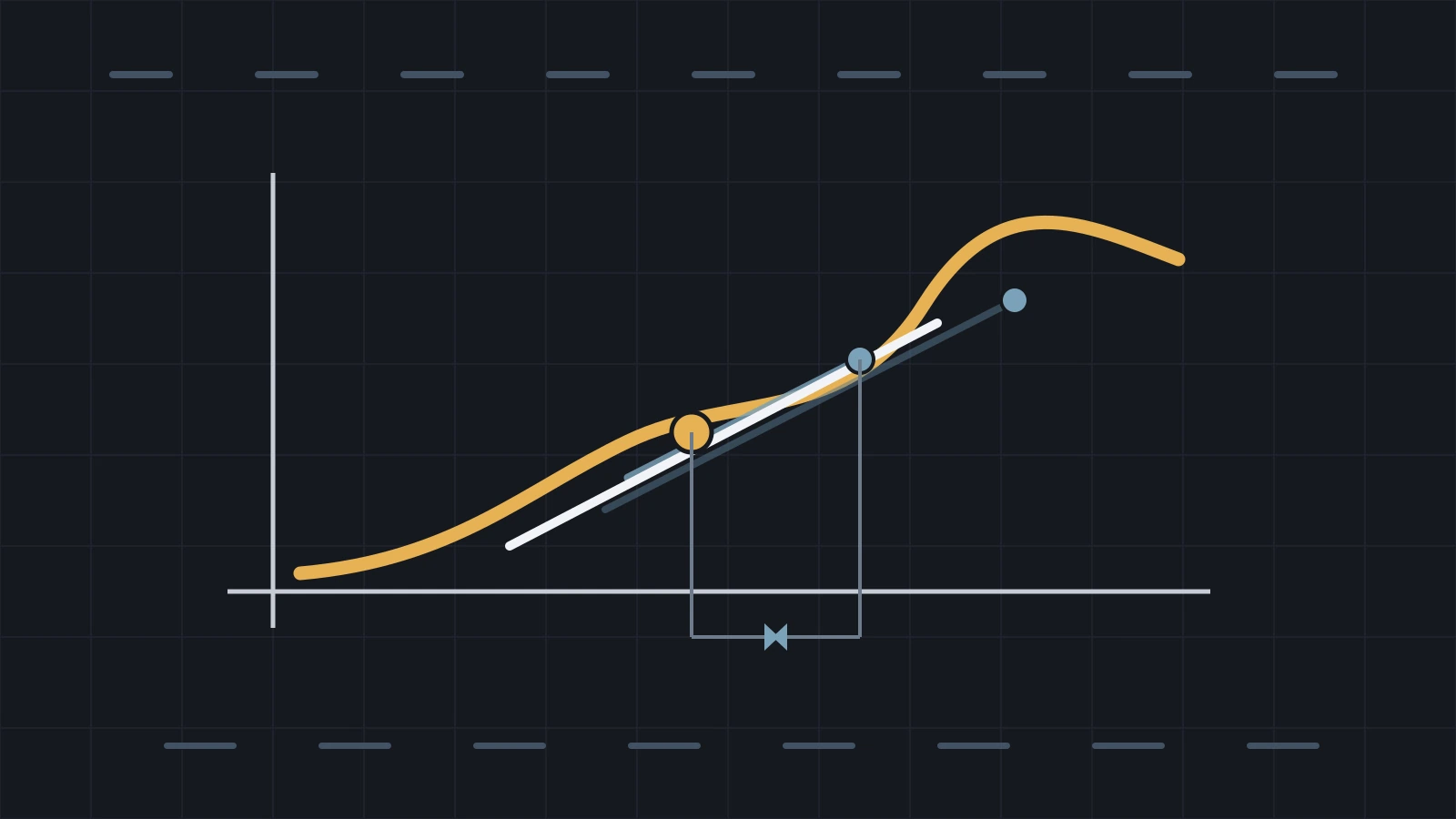
For a function f and an input a, choose a second input a+h. The rate of change between the two points is
(f(a+h)-f(a))/h, with h≠0.
Geometrically, this is the slope of the secant through (a,f(a)) and (a+h,f(a+h)). As h becomes smaller, the second point moves toward the first. If the secant slopes approach one unique value, that value describes the local slope of the curve.
3. Definition of the derivative at a point
The function f is differentiable at a if the limit
f'(a)=lim_{h→0}(f(a+h)-f(a))/h
exists and is finite. The number f'(a) is the derivative of f at a.
This is a local statement. It does not say the function is exactly linear near a. It says that on sufficiently small scales, the change in f is well approximated by a line with slope f'(a).
4. Geometric meaning and tangent equation
The tangent to the graph of f at A=(a,f(a)) has slope f'(a). Its equation is
y=f(a)+f'(a)(x-a).
The sign of f'(a) gives local information: positive means the graph rises near the point, negative means it falls, and zero means the tangent is horizontal. A zero derivative alone does not prove that the point is a maximum or minimum.
5. Resolved example from first principles
Let f(x)=x² and a=2.
(f(2+h)-f(2))/h = ((2+h)²-4)/h.
Expanding gives (4+4h+h²-4)/h=(4h+h²)/h=4+h for h≠0.
As h tends to 0, 4+h tends to 4. Therefore f'(2)=4.
The tangent goes through (2,4) with slope 4:
y=4+4(x-2)=4x-4.
The calculation exposes the logic of differentiation without assuming the rule (x²)'=2x.
6. Instantaneous change and units
If f represents position in metres and the input is time in seconds, an average rate of change has units m/s. The derivative keeps the same contextual units but describes the instantaneous limiting value.
A derivative does not directly measure what happened over a finite interval. It is the value approached by average rates as the interval shrinks around the point.
7. Practice
7.1. Differentiate from first principles
For f(x)=x², compute f'(3) from the limit of (f(3+h)-f(3))/h as h tends to 0. Expand and simplify before taking the limit, then interpret the result as a slope.
Guided correction. For h≠0 the quotient simplifies to 6+h, so the limit is 6; the tangent at x=3 has slope 6.
7.2. Observe instantaneous velocity
Model position by s(t)=t² metres, with t in seconds. Compute the average velocities from t=2 to t=2+h for h=1, 0.5, and 0.1. Compare them and explain what their convergence suggests.
Success criteria. The quotients use the correct time intervals, units are m/s, and the explanation distinguishes interval average from an instantaneous limiting value.
7.3. Recover a derivative without a ready-made rule
For g(x)=x³, determine g'(1) from first principles using (g(1+h)-g(1))/h. Then give the tangent equation at x=1 and justify every step.
Success criteria. The response expands the cube, factors h before the limit, obtains the correct slope, and builds the tangent through (1,1) without directly invoking (x³)'=3x².
8. Summary
A derivative at a point is a limit of rates of change. Those rates are secant slopes; their limit gives the tangent slope. The same number can describe instantaneous change, with units inherited from the context.
9. Curriculum sources
- French Ministry of Education — 2026 Première générale mathematics specialty curriculum, “Dérivation”: official bulletin.
- UK Department for Education — GCE AS and A level Mathematics, section G “Differentiation”: official subject content.
10. Revision note
Lesson prepared on 26 September 2026 from two official frameworks in different countries. Calculations were recomputed and all eight language versions were reviewed in two passes by the same model; no independent human validation or measured learning gain is claimed.