Vom Entwurf zum funktionsfähigen Motor
Eine Erfindung kann beschrieben und geschützt werden, bevor eine zuverlässige Maschine existiert. Diesels 1895 veröffentlichtes US-Patent beschreibt, wie Luft zunächst verdichtet und erst danach Brennstoff zugeführt wird. Die darin vorgeschlagene Verbrennung bei konstanter Temperatur ist ein Entwurfsideal, kein gemessenes Leistungsergebnis.
Die deutsche Patenturkunde stammt aus dem Februar 1893. Der Eintrag zum Versuchsmotor unterscheidet den Prototyp von 1893 vom funktionsfähigen Motor von 1897.
Diesels Buch von 1893 erschien bei Springer in Berlin; es war keine Augsburger Doktorarbeit.
Die Ausstellungsbeschreibung des Deutschen Museums ordnet dem Motor von 1897 einen Wirkungsgrad von 26,2 % zu. Das ist eine Angabe des Museums, keine hier reproduzierte Messung.
Diese Daten stehen für unterschiedliche Leistungen: eine Idee formulieren, Versuchstechnik bauen und eine funktionsfähige Maschine erhalten. Ein Patent schützt eine Erfindung; es bestätigt nicht, dass sämtliche Versprechen seiner Beschreibung erfüllt wurden.
Wie Selbstzündung durch Verdichtung Arbeit erzeugt
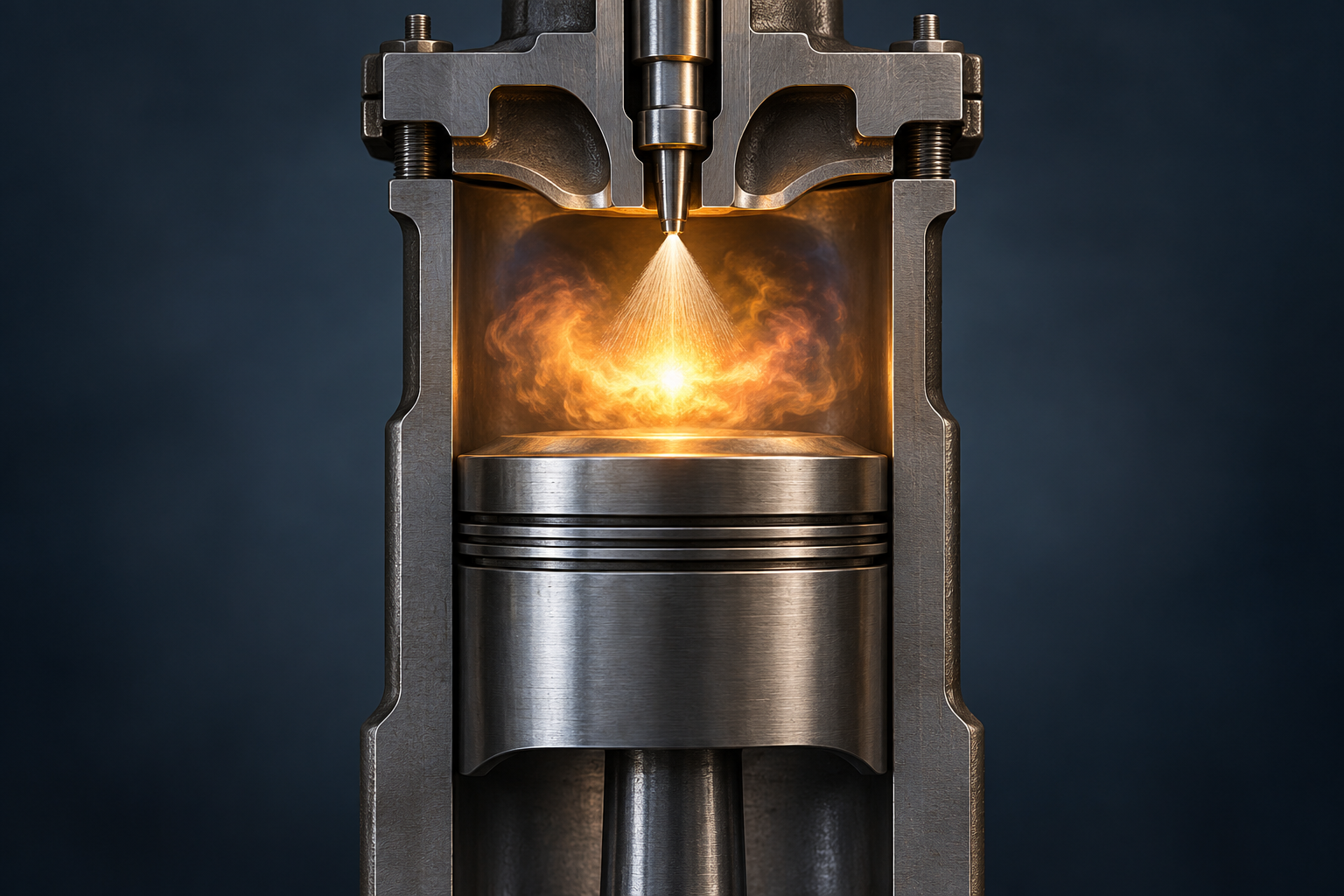
Man stelle sich Luft oberhalb eines Kolbens vor, des beweglichen Bauteils im Zylinder. Wird diese Luft verdichtet, steigt ihre Temperatur. Anschließend wird Kraftstoff in die heiße Luft eingespritzt, wo er sich ohne Zündfunken entzünden kann: Das ist Selbstzündung durch Verdichtung. Die Verbrennung setzt chemische Energie frei, und die expandierenden Gase drücken auf den Kolben. Der Verbindungsmechanismus überträgt diese Bewegung auf eine Welle.
Auch die Verdichtung selbst benötigt Arbeit. Die nutzbare Arbeit hängt vom gesamten Arbeitszyklus ab, einschließlich der bei der Expansion zurückgewonnenen Arbeit und der Verluste. Einspritzzeitpunkt, Gemischbildung, Wärmeübertragung und Reibung sind daher wichtig; eine tragfähige Erklärung darf nicht bei „die Luft wird heiß“ enden.
Das ist eine allgemeine Erklärung des Mechanismus. Sie belegt nicht, dass die idealisierte Verbrennung des frühen Patents im funktionsfähigen Motor exakt verwirklicht wurde.
Technisches Dossier: eine Grenze von einem Versuch unterscheiden
Der thermische Wirkungsgrad setzt die nutzbare Arbeit zur als Wärme zugeführten Energie ins Verhältnis. Für eine reversible Wärmekraftmaschine zwischen zwei Reservoirs mit festen Temperaturen erläutern die Thermodynamik-Unterlagen des MIT die Carnot-Obergrenze:
ηCarnot=1−ThTc
Dabei bezeichnet eta den Wirkungsgrad, T_c die Temperatur des kalten Reservoirs und T_h die Temperatur des heißen Reservoirs. Beide sind absolute Temperaturen in Kelvin. Bei hypothetischen Reservoirs mit 600 K und 300 K beträgt die Grenze 50 %. Dieses Lehrbeispiel beschreibt weder die Temperaturen noch den gemessenen Wirkungsgrad von Diesels Motor.
Das Verdichtungsverhältnis vergleicht die Zylindervolumina vor und nach der Verdichtung. Es ist nicht das Temperaturverhältnis in der Carnot-Formel. Weder diese Formel noch die Verdichtung allein belegen eine allgemeine Überlegenheit gegenüber einem Ottomotor; ein Vergleich braucht angegebene Betriebsbedingungen und eine einheitliche Definition des Wirkungsgrads.
| Datum | Dokumentierter Meilenstein | Was er belegt |
|---|---|---|
| 1893 | Patent, Buch und Versuchsprototyp | Ein Projekt und einen Versuchsaufbau |
| 1895 | US-Patent US542846A | Eine Beschreibung und Ansprüche, keinen Leistungsversuch |
| 1897 | Funktionsfähiger Motor | Vom Museum angegebener Wirkungsgrad von 26,2 % |
Der Patenttext und die institutionellen Einträge wurden gelesen; der ursprüngliche Versuchsbericht wurde weder gelesen noch neu ausgewertet. Sein vollständiges Messprotokoll, die Kalibrierung, die Unsicherheit und die Bilanzgrenze der Berechnung bleiben hier deshalb ungeprüft. Die maschinenlesbare Abschrift des Patents enthält Fehler der optischen Zeichenerkennung; der genaue historische Wortlaut muss am Faksimile überprüft werden.
Eine experimentelle Reproduktion wurde nicht durchgeführt. Bau oder Prüfung eines unter Druck arbeitenden Verbrennungsmotors erfordern qualifizierte Fachleute und geeignete Einrichtungen; diese dokumentarische Darstellung ist keine Anleitung für einen Versuch zu Hause.
Warum diese Unterscheidung wichtig ist
Die Selbstzündung durch Verdichtung wurde zu einem dauerhaften Weg, Brennstoffenergie in mechanische Arbeit umzuwandeln, mit Folgen für Verkehr und Industrie. Die Leistung liegt darin, einen technischen Ansatz praktisch nutzbar zu machen, statt eine Maschine anzukündigen, die eine ideale thermodynamische Grenze erreicht.
Für Leserinnen und Leser ist die entscheidende Gewohnheit, nach der Aussagekraft jedes Belegs zu fragen. Eine Zeichnung kann eine Anordnung erklären, ein Patent einen Anspruch dokumentieren und ein Versuch eine bestimmte Maschine unter angegebenen Bedingungen bewerten. Keines ersetzt automatisch die anderen. Ein historischer Wirkungsgrad belegt auch nicht den Kraftstoffverbrauch oder die Emissionen einer nicht näher bestimmten modernen Anwendung.
Korrektur und redaktionelle Dokumentation
Korrektur — 15. Oktober 2026: Die Chronologie wurde berichtigt, die Angabe von 26,2 % dem Jahr 1897 zugeordnet, das Buch von 1893 korrekt bezeichnet und die Carnot-Grenze vom Motoraufbau unterschieden. Nicht belegte Wirkungsgradvergleiche, die Behauptung zum Marktanteil in der Schifffahrt und die ungesicherte Darstellung von Diesels Tod einschließlich der Spekulationen über einen Mord wurden entfernt.
Das Titelbild ist eine mit künstlicher Intelligenz erzeugte konzeptionelle Darstellung von Einspritzdüse und Kolben. Es ist weder eine dokumentarische Fotografie noch eine Rekonstruktion der Maschine von 1893 oder 1897; seine Geometrie ist keine Messung.
Text und Übersetzung wurden mit künstlicher Intelligenz unterstützt erstellt. Eine menschliche Validierung oder experimentelle Reproduktion wird nicht behauptet.